
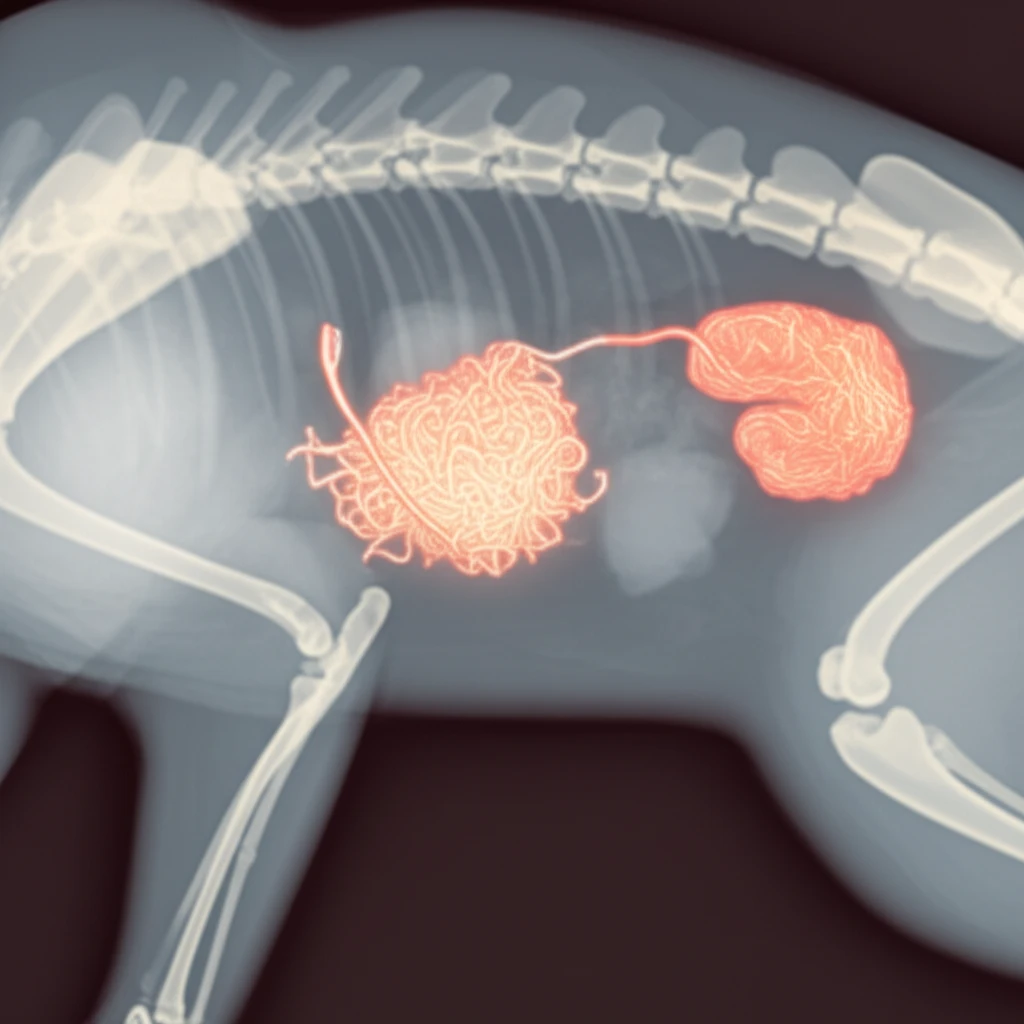
Digital illustration of a cat abdomen X-ray featuring a glowing 'spaghetti sign' indicating collateral blood vessels.

Decoding the "Spaghetti Sign": What Cat X-Rays Reveal About Hidden Health Issues

"Is that unusual pattern on your cat's abdominal X-ray cause for concern? Learn how the 'spaghetti sign' can point to critical circulatory problems and what it means for your feline friend."


In veterinary medicine, digital radiography has revolutionized how we visualize our patients' insides. Unlike traditional X-rays, digital radiography offers enhanced contrast resolution, allowing vets to spot subtle differences in tissues and organs. This advancement means we can detect problems earlier and with greater accuracy, leading to better outcomes for our beloved pets.

One such finding, playfully termed the "spaghetti sign," has caught the attention of veterinary radiologists. This term describes a peculiar, winding, and tubular structure observed in the abdominal X-rays of some cats. But what does it mean when a vet spots this "spaghetti sign" on an X-ray? The answer lies in understanding spleno-systemic collateral circulation, a condition where the body reroutes blood flow due to underlying health problems.

Spleno-systemic shunts, the underlying cause of the “spaghetti sign”, have increasingly been recognized in feline patients, especially in spayed females. While these shunts, which divert blood from the spleen, may sound alarming, understanding their radiographic appearance can help veterinarians diagnose and manage the associated conditions effectively.

What is the "Spaghetti Sign" and Why Does It Matter?

Digital illustration of a cat abdomen X-ray featuring a glowing 'spaghetti sign' indicating collateral blood vessels.

The "spaghetti sign" refers to a distinctive radiographic finding: a tortuous, tubular, soft tissue-like structure visible on abdominal X-rays of cats. Typically, this structure is found in the left mid-abdominal cavity, specifically caudal to the spleen and lateral to the left kidney. Think of it as an unexpected noodle appearing in your cat's internal landscape!

Veterinary researchers have hypothesized that the “spaghetti sign” serves as a predictor for spleno-systemic collateral circulation. This means that the unusual structure is actually a series of newly formed or enlarged blood vessels that are redirecting blood flow. To understand why this happens, it's important to know a bit about the normal circulatory system.

  • Normal Circulation: In a healthy cat, blood flows from the spleen to the liver via the splenic and portal veins. The liver filters the blood before it returns to the heart.
  • Spleno-Systemic Shunt: When there's a blockage or increased resistance in the normal blood flow, the body creates alternative routes. In spleno-systemic collateral circulation, blood from the spleen is diverted into the systemic circulation, bypassing the liver.
  • The "Spaghetti Sign" Vessels: The tortuous vessels that make up the “spaghetti sign” are these newly formed or enlarged pathways. They represent the body's attempt to maintain blood flow despite an obstruction or other underlying issue.
Spotting the "spaghetti sign" on an X-ray isn't just about identifying a quirky pattern; it's about recognizing a potential sign of underlying health issues. These can range from congenital abnormalities to acquired conditions affecting blood flow. Early detection of the “spaghetti sign” allows for prompt investigation and appropriate management of the underlying cause.

What Does This Mean for Your Cat?

If your cat's veterinarian has identified the "spaghetti sign" on an abdominal X-ray, it’s essential to work closely with them to determine the underlying cause and develop an appropriate treatment plan. Further diagnostics, such as ultrasound or computed tomography (CT), may be necessary to fully evaluate the circulatory system and identify any underlying conditions. While the "spaghetti sign" can be an indicator of serious health problems, early detection and proper management can help ensure your feline companion lives a long and happy life.

About this Article -

This article was crafted using a human-AI hybrid and collaborative approach. AI assisted our team with initial drafting, research insights, identifying key questions, and image generation. Our human editors guided topic selection, defined the angle, structured the content, ensured factual accuracy and relevance, refined the tone, and conducted thorough editing to deliver helpful, high-quality information.See our About page for more information.

This article is based on research published under:

DOI-LINK: 10.1111/vru.12555, Alternate LINK

Title: A “Spaghetti Sign” In Feline Abdominal Radiographs Predicts Spleno-Systemic Collateral Circulation

Subject: General Veterinary

Journal: Veterinary Radiology & Ultrasound

Publisher: Wiley

Authors: Swan Specchi, Ioannis Panopoulos, Anna M. Adrian, Giliola Spattini, Simona Morabito, Matthew Paek

Published: 2017-09-03

Everything You Need To Know

1

What exactly is the "spaghetti sign" seen on cat X-rays, and where is it typically located?

The "spaghetti sign" refers to a tortuous, tubular, soft tissue-like structure visible on abdominal X-rays of cats. It's typically found in the left mid-abdominal cavity, specifically caudal to the spleen and lateral to the left kidney. This unusual pattern can indicate underlying circulatory issues.

2

If a cat X-ray shows the "spaghetti sign", what underlying circulatory problem does it suggest, and why is this significant?

The "spaghetti sign" suggests spleno-systemic collateral circulation, where blood flow is rerouted due to underlying health issues. In this condition, blood from the spleen is diverted into the systemic circulation, bypassing the liver. This is significant because it indicates that the normal blood flow from the spleen to the liver is obstructed or faces increased resistance, prompting the body to create alternative routes.

3

How does digital radiography enhance the detection of conditions like the "spaghetti sign" in cats, compared to traditional X-rays?

Digital radiography offers enhanced contrast resolution compared to traditional X-rays. This allows veterinarians to spot subtle differences in tissues and organs more easily. This advancement enables earlier and more accurate detection of conditions such as spleno-systemic collateral circulation indicated by the "spaghetti sign", leading to better outcomes for cats.

4

What are spleno-systemic shunts, how do they relate to the "spaghetti sign", and why are they more frequently observed in spayed female cats?

Spleno-systemic shunts are the underlying cause of the "spaghetti sign". They involve the diversion of blood flow from the spleen into the systemic circulation, bypassing the liver's normal filtration process. The exact reason why they are more frequently observed in spayed female cats isn't explicitly detailed here but is an area of ongoing veterinary research. It's important to understand that the tortuous vessels of the "spaghetti sign" are the body's attempt to maintain blood flow despite an obstruction or other underlying issue related to these shunts.

5

Beyond identifying the "spaghetti sign", what further diagnostic steps might a veterinarian take to determine the underlying cause and appropriate treatment plan for a cat?

If a veterinarian identifies the "spaghetti sign", they would likely recommend further diagnostics such as ultrasound or computed tomography (CT) to fully evaluate the circulatory system and identify any underlying conditions causing the spleno-systemic collateral circulation. Understanding the root cause is essential for developing an effective treatment plan. While not mentioned, additional blood tests and possibly exploratory surgery could also be considered depending on the initial findings.

Newsletter Subscribe

Subscribe to get the latest articles and insights directly in your inbox.