
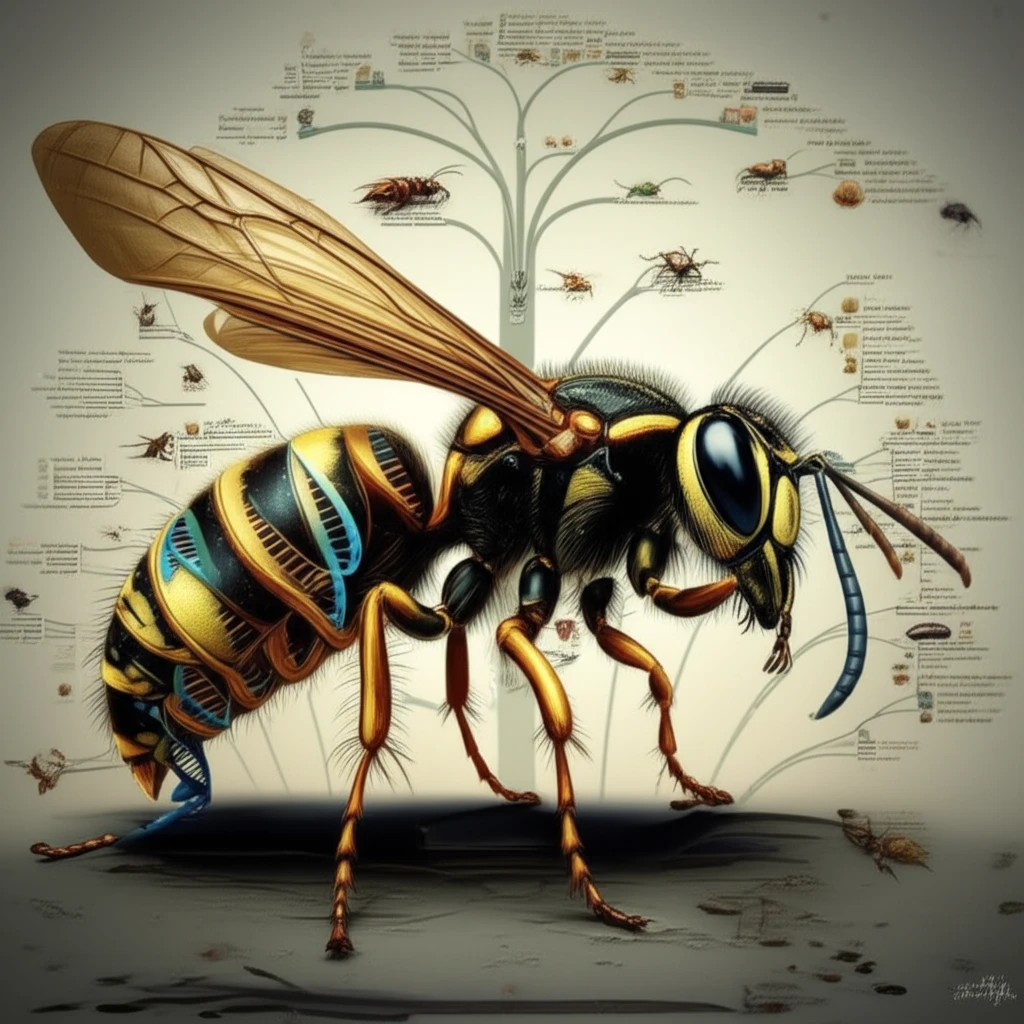
Decoding the Secrets of Wasp DNA: What a Rearranged Genome Tells Us

"A deep dive into the surprising world of wasp genetics, revealing evolutionary twists and turns hidden within the DNA of Podagrion."
Mitochondrial genomes are powerful tools for understanding the evolutionary relationships between species. In most organisms, the arrangement of genes within this genome is highly conserved. However, insects, especially those within the order Hymenoptera (which includes bees, ants, and wasps), often display significant rearrangements, offering valuable insights into their evolutionary history.
The Hymenoptera order is incredibly diverse, boasting over 115,000 species. These insects exhibit unique characteristics in their mitochondrial DNA, such as a high proportion of adenine (A) and thymine (T) nucleotides and frequent gene rearrangements. These genomic shifts can reveal how different groups within Hymenoptera are related.
This article delves into the complete mitochondrial genome sequence of Podagrion sp., a parasitoid wasp. By examining its unique gene arrangement, we can learn more about the evolution of these fascinating creatures and their place within the insect world.
Decoding the Podagrion sp. Genome: A Genetic Puzzle
The Podagrion sp. mitogenome is 15,845 base pairs long, containing the typical set of mitochondrial genes. What makes it stand out is the arrangement of these genes. Unlike the ancestral pattern, Podagrion sp. exhibits a novel rearrangement. Specifically, six protein-coding genes (nad3, cox3, atp6, atp8, cox2, and cox1) have flipped their orientation, now residing on the minor strand of the DNA molecule.
- Gene Inversions: The nad3, cox3, atp6, atp8, cox2, and cox1 genes have flipped to the minor strand.
- A+T Rich Region: This region between trnN and trnI contains five tandem repeats.
- Conserved Block: The conserved block is "cox3-atp6-atp8-cox2-cox1-nad5-nad4-nad4l-nad6-cob".
- tRNA Locations: The locations of trnV and trnA are special to its phylogeny.
Unlocking the Evolutionary Story
By analyzing the gene arrangement in Podagrion sp., researchers can piece together its evolutionary history and relationships to other wasps. These genetic signatures act as a roadmap, revealing how different species have adapted and diversified over time.
Further research involving more species within the Chalcidoidea superfamily is crucial to fully understand the complex patterns of gene rearrangement and their link to parasitic lifestyles.
This study underscores the power of mitochondrial genomics in unraveling the mysteries of insect evolution. By continuing to explore these genetic landscapes, we can gain a deeper appreciation for the biodiversity and intricate relationships within the natural world.