
Decoding the Secrets of Neurotransmitter Release: A New Look at Synaptic Fusion

"Cryo-electron tomography reveals the intricate dance of proteins during neurotransmitter release, offering fresh insights into this essential process."
Neurotransmitter release, a fundamental process in neuronal communication, relies on the precise fusion of synaptic vesicles with the plasma membrane. This event, triggered by calcium ions, releases neurotransmitters into the synaptic cleft, enabling signal transmission between neurons. Understanding the molecular mechanisms underlying this fusion process is crucial for deciphering the complexities of brain function.
For years, scientists have been meticulously identifying and characterizing the essential components involved in neurotransmitter release. In vitro reconstitution experiments, simulating the fusion of two liposomes (one mimicking a synaptic vesicle, the other the plasma membrane), have provided valuable insights. Now, a groundbreaking study by Gipson et al. takes a leap forward by directly visualizing the steps in this fusion process using advanced electron cryotomography (cryo-ET).
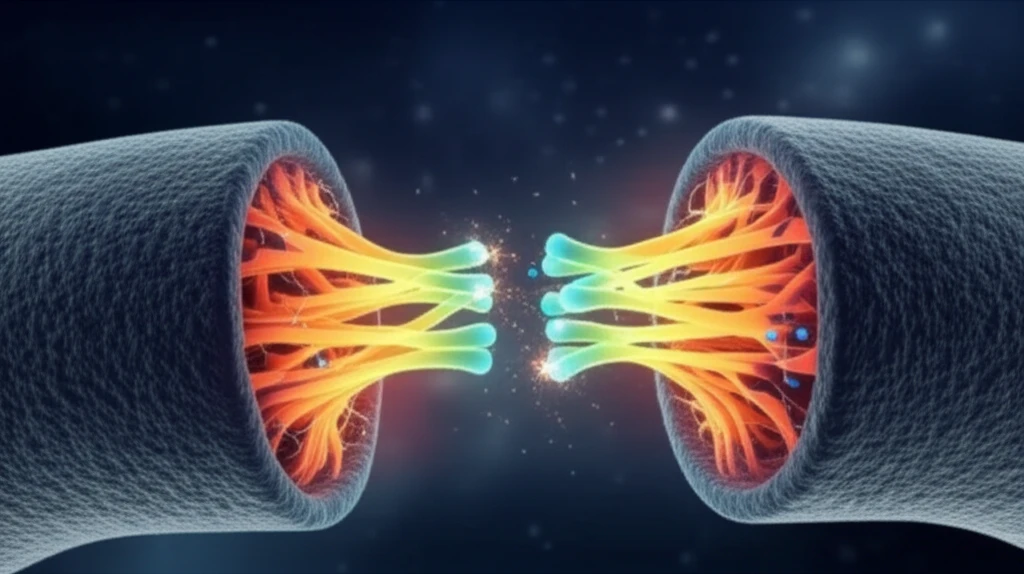
Their research, published in PNAS, unveils that productive fusion occurs through point contacts between membranes, mediated by a small number of fusion-protein complexes—likely just two. This innovative approach offers a novel perspective on the intricate dance of proteins that orchestrate membrane fusion.
The Point of Contact: How Lipid Bilayers Fuse
Lipid bilayers, the building blocks of cell membranes, naturally repel each other through a “hydration force” when they come within a certain proximity (around 15-20 Å). Overcoming this repulsion is essential for membrane fusion, requiring a force that either acts in bulk or through localized fusion facilitators.
- Key Players: SNAREs. The essential fusogens for synaptic vesicle fusion are SNARE proteins: synaptobrevin-2 (VAMP2) on the vesicle, syntaxin-1 on the plasma membrane, and SNAP-25 associated with the plasma membrane.
- Calcium's Role. Synaptotagmin-1, a calcium sensor on the vesicle, initiates fusion when calcium is present.
- Regulatory Factors. Complexin and Munc13 further modulate the fusion process, affecting the speed, yield, and range of morphological changes.
Drawing Parallels: SNAREs Versus Viral Fusion
The point contacts observed by Gipson et al. are believed to represent the physiologically functional state, with complexin and Munc13 ensuring fidelity by modulating SNARE-complex geometry. The researchers estimate that just two complete, calcium-triggered complexes are sufficient for a productive fusion event.
Viral membrane fusion shares similarities with SNARE-mediated fusion but occurs on a longer timescale. Both processes involve a zippering-like rearrangement of fusion complexes, but unlike the preassembled SNARE complex, viral fusion proteins must come together after a triggering event. This difference accounts for the longer delay in viral fusion, highlighting the efficiency of preassembly in neurotransmitter release.
Cryo-ET images of influenza virus fusing with liposomes reveal intermediate structures that support this model. Visualizing the rapid transition from a calcium-triggered complex (or critical accumulation of bridging viral-protein intermediates) to a hemifusion stalk remains a formidable challenge for future research, promising deeper insights into the fundamental mechanisms of membrane fusion.