
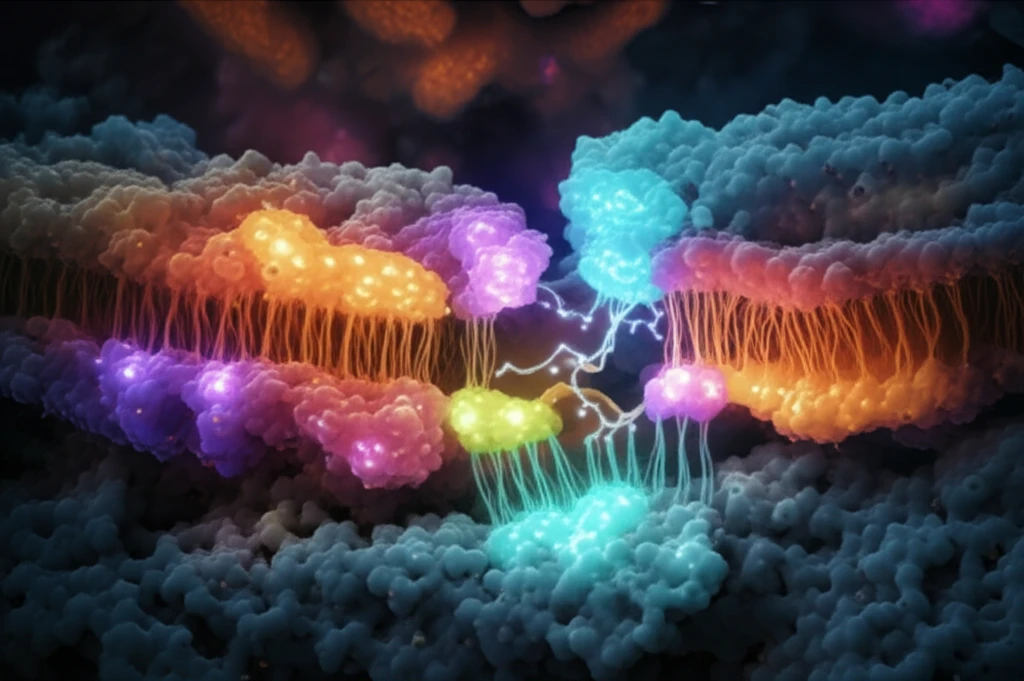
Illustration of the Vc-NhaP2 protein, showing the ion transport pathway.

Decoding the Secrets of Bacterial Survival: How a Tiny Protein Holds the Key to Fighting Infections

"Scientists Uncover the Inner Workings of a Bacterial Protein, Offering New Hope in the Battle Against Antibiotic Resistance."


In the relentless battle against infectious diseases, scientists are constantly seeking new strategies to outsmart the ever-evolving microbes that threaten human health. One of the most pressing challenges is the rise of antibiotic resistance, making common infections increasingly difficult to treat. But what if the key to overcoming these challenges lies in understanding the inner workings of bacteria themselves? Recent research has unveiled a fascinating mechanism that could provide crucial insights into how bacteria survive and how we can potentially disrupt their defenses.

A new study published in the journal 'Biochem. Cell Biol.' sheds light on a specific protein found in the bacterium Vibrio cholerae, the causative agent of cholera. This protein, known as Vc-NhaP2, plays a vital role in the bacterium's survival by regulating the transport of ions across its cell membrane. Understanding the intricacies of Vc-NhaP2 could lead to novel approaches for combating infections and could open doors to more effective treatments.

This article delves into the key findings of the research, unraveling the molecular mechanisms behind Vc-NhaP2's function. We will explore how scientists have deciphered the structure of the protein, identified the critical regions responsible for its activity, and discovered the potential implications of this knowledge for the development of new antimicrobial therapies. This research not only highlights the importance of fundamental scientific discoveries but also offers a glimpse into the future of medicine.

Unveiling Vc-NhaP2: The Tiny Protein with a Big Impact on Bacterial Life

Illustration of the Vc-NhaP2 protein, showing the ion transport pathway.

Vc-NhaP2, a protein residing within the cell membrane of Vibrio cholerae, functions as an ion transporter, facilitating the movement of ions like sodium (Na+) and potassium (K+) across the membrane. This seemingly simple task is crucial for the bacterium's survival. It helps to maintain the proper balance of ions within the cell and allows it to thrive in diverse environments. The protein's ability to differentiate between different types of ions is a key aspect of its functionality.

The researchers employed a combination of sophisticated techniques, including structural modeling and site-directed mutagenesis, to understand the intricacies of Vc-NhaP2. Structural modeling provides a three-dimensional representation of the protein, revealing its architecture and how different parts interact. Site-directed mutagenesis involves altering specific amino acids within the protein to assess their influence on its function. This integrated approach provided valuable insights into how the protein works.

  • The study found that Vc-NhaP2 can transport Na+ and K+ ions.
  • The protein's ability to distinguish between different ions is crucial for its activity.
  • Vc-NhaP2 helps bacteria survive in diverse environments.
The research team identified key regions of the protein that are essential for its ion-transporting activity. They found that altering specific amino acids within these regions could drastically affect the protein's ability to transport ions, and it showed that certain amino acids in the protein play a critical role in cation binding and ion selectivity. Moreover, the findings suggest that the structure of the protein creates a pathway that can be manipulated to control the transport of ions, highlighting the potential for developing therapeutic interventions that target this pathway.

A Promising Future: Harnessing the Power of Vc-NhaP2 for Improved Health

The research on Vc-NhaP2 represents a significant step forward in understanding the strategies bacteria employ to survive and spread. The findings provide a foundation for developing innovative antimicrobial therapies that specifically target this protein. By disrupting the ion transport process, scientists could potentially disable bacteria like Vibrio cholerae, offering a novel approach to combat infectious diseases. As we continue to unravel the mysteries of bacterial biology, the insights gained from studies like these will be essential for protecting human health and creating a healthier future.

About this Article -

This article was crafted using a human-AI hybrid and collaborative approach. AI assisted our team with initial drafting, research insights, identifying key questions, and image generation. Our human editors guided topic selection, defined the angle, structured the content, ensured factual accuracy and relevance, refined the tone, and conducted thorough editing to deliver helpful, high-quality information.See our About page for more information.

Everything You Need To Know

1

What is Vc-NhaP2, and why is it important in the context of bacterial infections?

Vc-NhaP2 is a protein found in the bacterium *Vibrio cholerae*, which causes cholera. It functions as an ion transporter, specifically regulating the movement of ions like sodium (Na+) and potassium (K+) across the bacterium's cell membrane. This process is crucial for maintaining the bacterium's internal balance and enabling it to survive in various environments. Understanding Vc-NhaP2 is important because it presents a potential target for developing new antimicrobial therapies to combat infections. While the text focuses on *Vibrio cholerae*, ion transport proteins are fundamental to many bacteria, making this research potentially relevant to a broader range of infections.

2

How did scientists uncover the function of Vc-NhaP2 in *Vibrio cholerae*?

Scientists employed a combination of techniques to understand Vc-NhaP2's function. They used structural modeling to create a three-dimensional representation of the protein, revealing its structure and how different parts interact. Additionally, they used site-directed mutagenesis, altering specific amino acids within the protein to see how these changes affected its ability to transport ions. By integrating these methods, they could identify key regions of Vc-NhaP2 essential for its ion-transporting activity and to determine the importance of cation binding and ion selectivity.

3

What are the potential implications of the Vc-NhaP2 research for developing new antimicrobial therapies?

The research suggests that targeting Vc-NhaP2 could be a novel approach to combating bacterial infections. By disrupting the ion transport process that Vc-NhaP2 facilitates, it may be possible to disable bacteria like *Vibrio cholerae*. This could lead to the development of new antimicrobial therapies that specifically target this protein, offering a way to overcome antibiotic resistance. The protein structure creates a pathway that can be manipulated to control the transport of ions, highlighting the potential for developing therapeutic interventions that target this pathway. Future research may explore molecules that bind to Vc-NhaP2 and disrupt its function, effectively weakening or killing the bacteria.

4

How does Vc-NhaP2's ability to differentiate between ions contribute to the survival of *Vibrio cholerae*?

Vc-NhaP2's ability to distinguish between different ions like sodium (Na+) and potassium (K+) is critical for maintaining the proper ionic balance within the cell of *Vibrio cholerae*. This balance is essential for various cellular processes, including maintaining cell volume, regulating enzyme activity, and generating energy. By selectively transporting specific ions, Vc-NhaP2 helps the bacterium adapt to and thrive in diverse environments where ion concentrations may vary widely. The research showed that certain amino acids in the protein play a critical role in cation binding and ion selectivity.

5

Beyond *Vibrio cholerae*, could research on Vc-NhaP2 have broader implications for understanding bacterial survival mechanisms and combating antibiotic resistance in other species?

Yes, while the study focuses on Vc-NhaP2 in *Vibrio cholerae*, the principles of ion transport and its importance for bacterial survival are universal. Many bacteria utilize similar ion transport proteins to maintain cellular homeostasis. Therefore, the insights gained from studying Vc-NhaP2 could inform research on homologous proteins in other bacterial species. Understanding how these proteins function and how they can be targeted could potentially lead to the development of broad-spectrum antimicrobial therapies effective against a wider range of bacterial infections. Further research might investigate the similarities and differences between Vc-NhaP2 and related proteins in other bacteria to identify common vulnerabilities that could be exploited therapeutically.

Newsletter Subscribe

Subscribe to get the latest articles and insights directly in your inbox.