
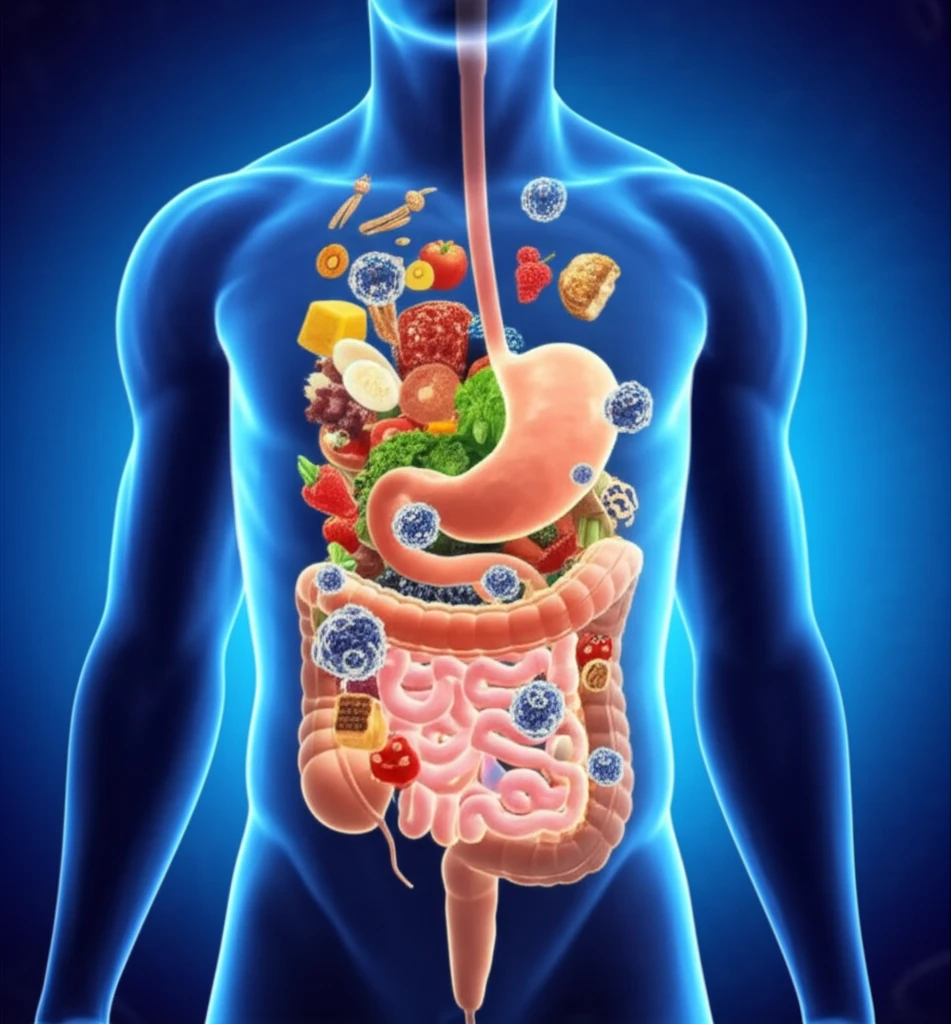
A digital illustration depicting the human digestive system transformed into a colorful food landscape, highlighting interactions between food components and friendly nanoparticles.

Decoding the Mystery: How Food Affects Your Body's Reaction to Tiny Particles

"Groundbreaking research unveils the surprising link between what you eat and how your body handles nanomaterials, offering a new perspective on health and nutrition."


In today's world, we're surrounded by tiny particles, or nanomaterials, in everything from food packaging to cosmetics. While many are harmless, understanding how our bodies react to them is crucial. This understanding becomes even more critical when considering how our daily food choices intertwine with our body's response to these materials.

New research published in NanoImpact has delved into the surprisingly complex relationship between food and our body's interaction with nanomaterials. The study, conducted by researchers at the University of Massachusetts, Amherst, unveils how the food matrix, the environment within our digestive system, significantly influences how our bodies process these tiny particles.

This article will explore the key findings of this study, breaking down complex scientific concepts into easy-to-understand insights. You'll discover how specific foods can either amplify or mitigate the effects of nanomaterials and why this knowledge could revolutionize the way we think about nutrition and health. Prepare to be enlightened!

The Food Matrix: Your Body's First Line of Defense (and Offense)

A digital illustration depicting the human digestive system transformed into a colorful food landscape, highlighting interactions between food components and friendly nanoparticles.

The study's primary focus was on the 'food matrix,' which acts like a complex environment within our digestive system. Imagine it as a bustling marketplace where nutrients, enzymes, and tiny particles interact. This study shows the characteristics of this 'marketplace' greatly influence how our bodies handle nanomaterials.

Researchers created a 'standardized food model' (SFM) that mirrored the average American diet, including proteins, fats, carbohydrates, and minerals. This model allowed them to isolate and study how different food components affected nanomaterials. It is also worthy to note that The SFM was designed to have a number of attributes that would facilitate its widespread application: (i) ease of fabrication; (ii) good stability; (iii) small initial particle size; and (iv) narrow and reproducible particle size distribution. This highlights the importance of a controlled environment when studying the interaction between nanomaterials and food.

  • Particle Size Matters: The study found that the size of the nanomaterials changed as they moved through the digestive system.
  • Aggregation and Flocculation: Some food components caused the nanomaterials to clump together (aggregate) or form larger clusters (flocculate).
  • Impact on Digestion: The food matrix influenced how well the food was digested and how the body absorbed nutrients.
  • Toxicity Levels: The study shows that the food matrix significantly affected the potential toxicity of the nanomaterials
The researchers discovered that the food matrix, the environment inside our gut, could significantly alter the potential toxicity of the nanomaterials. This means that the same nanomaterial, when consumed with different foods, can have drastically different effects on our health. This also emphasizes the role of food choices in our health and wellness.

The Future of Food and Health: Making Informed Choices

This research opens up new avenues for exploring the link between nutrition and our response to environmental factors. By understanding how food choices influence our body's interaction with nanomaterials, we can make more informed decisions about our diets. It underscores the importance of a balanced diet. Further research in this area is necessary. The ability to design and control our nutritional environments can be of major benefit to the public.

About this Article -

This article was crafted using a human-AI hybrid and collaborative approach. AI assisted our team with initial drafting, research insights, identifying key questions, and image generation. Our human editors guided topic selection, defined the angle, structured the content, ensured factual accuracy and relevance, refined the tone, and conducted thorough editing to deliver helpful, high-quality information.See our About page for more information.

This article is based on research published under:

DOI-LINK: 10.1016/j.impact.2018.11.002, Alternate LINK

Title: Development Of A Standardized Food Model For Studying The Impact Of Food Matrix Effects On The Gastrointestinal Fate And Toxicity Of Ingested Nanomaterials

Subject: Public Health, Environmental and Occupational Health

Journal: NanoImpact

Publisher: Elsevier BV

Authors: Zipei Zhang, Ruojie Zhang, Hang Xiao, Kunal Bhattacharya, Dimitrios Bitounis, Philip Demokritou, David Julian Mcclements

Published: 2019-01-01

Everything You Need To Know

1

What is the 'food matrix,' and why is it important in how our bodies interact with nanomaterials?

The 'food matrix' refers to the complex environment within our digestive system where nutrients, enzymes, and tiny particles interact. It significantly influences how our bodies process nanomaterials. The characteristics of this matrix—including its composition of proteins, fats, carbohydrates, and minerals—can alter the size, aggregation, and potential toxicity of these particles, ultimately affecting digestion and nutrient absorption. Understanding the food matrix is crucial because it highlights how different food components can either amplify or mitigate the effects of nanomaterials on our health. While this explains the importance of the 'food matrix' there are other elements that need to be studied. Such as how the human body make up differs among individuals. Each individual can have a very different experience based on their body type.

2

How did the *NanoImpact* study investigate the relationship between food and nanomaterials?

Researchers at the University of Massachusetts, Amherst, conducted the *NanoImpact* study to explore the relationship between food and nanomaterials. They created a 'standardized food model' (SFM) that mimicked the average American diet, containing proteins, fats, carbohydrates, and minerals. This SFM allowed them to isolate and study how different food components affected the behavior and impact of nanomaterials within a controlled digestive environment. By observing changes in particle size, aggregation, flocculation, digestion, and toxicity levels, the study provided insights into how the food matrix influences the processing of these tiny particles in our bodies. The *NanoImpact* study focused primarily on how nanomaterials interact in a controlled environment, but there are outside factors that need to be considered.

3

What were the key findings of the *NanoImpact* study regarding nanomaterials and the digestive system?

The *NanoImpact* study revealed several key findings: first, the size of nanomaterials changes as they move through the digestive system. Second, certain food components cause nanomaterials to clump together (aggregate) or form larger clusters (flocculate). Third, the food matrix influences how well food is digested and how the body absorbs nutrients. Lastly, and perhaps most significantly, the food matrix significantly affects the potential toxicity of nanomaterials. This means that the same nanomaterial can have different effects on our health depending on the food it is consumed with. This shows how much more research is necessary to explore the link between nutrition and our response to environmental factors.

4

What is the 'standardized food model' (SFM), and why was it used in the study?

The 'standardized food model' (SFM) is a controlled representation of an average diet, designed with attributes such as ease of fabrication, good stability, small initial particle size, and narrow, reproducible particle size distribution. In the study, the SFM was created to mirror the average American diet, including proteins, fats, carbohydrates, and minerals. It was used to isolate and study how different food components affect nanomaterials within a controlled digestive environment. By using the SFM, researchers could observe changes in particle size, aggregation, flocculation, digestion, and toxicity levels, thereby gaining insights into how food influences the processing of these tiny particles in our bodies. Further testing outside the SFM, and testing in live environments should be conducted. The SFM provides a good testing environment, but is not a complete picture.

5

How can understanding the interaction between food and nanomaterials help us make better health choices?

Understanding how food choices influence our body's interaction with nanomaterials allows us to make more informed decisions about our diets. This knowledge underscores the importance of a balanced diet and opens up new avenues for exploring the link between nutrition and our response to environmental factors. By knowing that the food matrix can alter the potential toxicity of nanomaterials, we can choose foods that mitigate negative effects and promote better health outcomes. This understanding can revolutionize the way we think about nutrition and health, emphasizing the power of food in influencing our well-being on a microscopic level. However, the research is still in early stages, and further studies are needed to fully understand the implications of these interactions. In the future, controlling our nutritional environments could provide major benefits to public health.

Newsletter Subscribe

Subscribe to get the latest articles and insights directly in your inbox.