
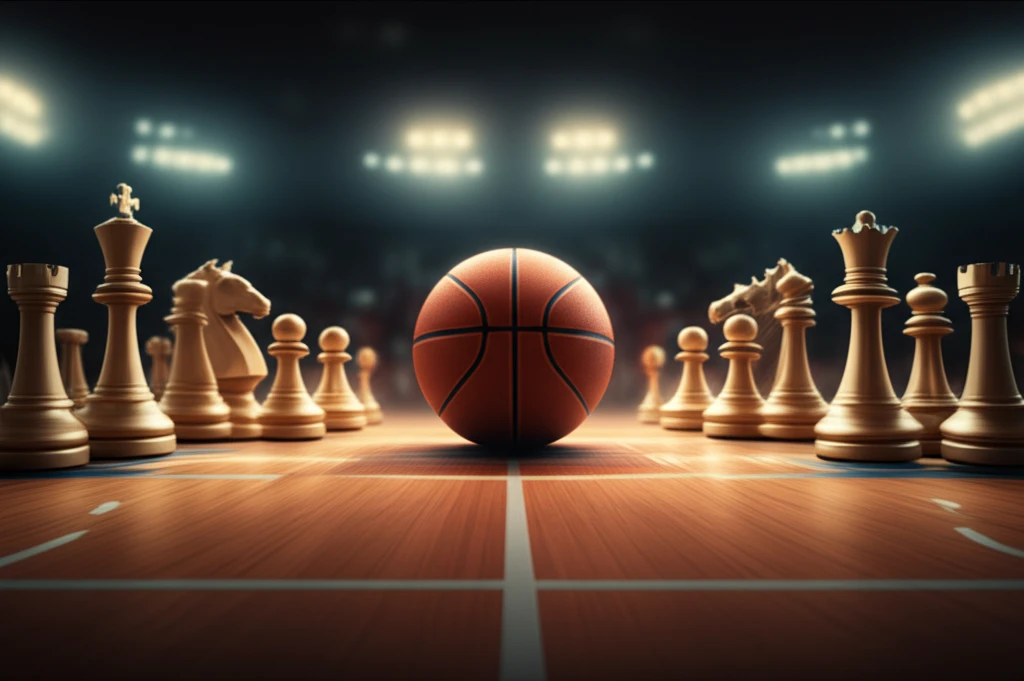
Chess pieces on a basketball court, symbolizing strategic decision-making in basketball.

Decoding the Mismatch: How Pro Basketball Teams Turn Defensive Switches into Winning Plays

"Uncover the secrets of Spanish professional basketball with our deep dive into how teams exploit mismatches after ball screens for a competitive edge."


In the dynamic world of team sports, especially basketball, success hinges on the ability of players to adapt and specialize within their roles. Each player must not only master their individual skills but also learn to work seamlessly with teammates, anticipating and responding to the opposition's moves. This interplay forms the essence of a team's strategic advantage, leading to outcomes that surpass the sum of individual efforts.

Within basketball, certain tactical maneuvers stand out for their effectiveness, particularly in offensive and defensive plays. Understanding and mastering these tactics can significantly impact a team's performance. Modern basketball relies heavily on detailed scouting, providing teams with insights into their own strengths and weaknesses as well as those of their rivals. This information is vital for analyzing trends and developing effective strategies.

One increasingly prominent tactic involves creating mismatches following ball screens. A 'mismatch' occurs when defenders switch assignments in a man-to-man defense, leaving a player guarded by someone less suited to defend them. This study delves into how teams leverage these mismatches, specifically focusing on which players benefit most and how the timing of actions influences the outcome.

How Mismatches Arise and How Teams Capitalize

Chess pieces on a basketball court, symbolizing strategic decision-making in basketball.

The study focuses on ball screens, a key offensive maneuver where a player sets a screen (or pick) to create an advantageous situation for a teammate with the ball. This allows the teammate, or dribbler, opportunities to shoot, pass, or drive, disrupting the defense. Typically, this involves an inside player (like a power forward or center) setting the screen for an outside player (such as a guard).

One common strategy that emerges from a ball screen is the pick and roll (PNR). Here, the screener moves toward the basket after setting the screen, opening possibilities for a pass or a shot. However, the PNR can also force a defensive switch, leading to a mismatch. In this scenario, the defender of the dribbler (often an inside player) switches to guard the screener, while the screener’s defender (usually an outside player) now guards the dribbler.

Here are the typical scenarios that may arise during mismatch situations:
  • The Dribbler Attacks: The outside player, now guarded by a typically slower inside player, drives to the basket or takes a shot from the perimeter.
  • Pass to Screener: The dribbler passes the ball to the inside player, who is now defended by a smaller, quicker outside player.
  • Defensive Recovery and Pass to Teammate: The defense adjusts, and the dribbler passes to an open teammate.
While prior research has extensively analyzed ball screens, the effectiveness of using mismatches as a direct response to the ball screen remains underexplored. This study investigates which players benefit most from these mismatches and how the timing of actions affects the overall outcome.

Key Findings and Strategic Implications

This study highlights that while mismatches can significantly influence basketball games, their effective exploitation depends on various factors, including player roles and timing. The duration of the action following a mismatch is critical; shorter durations often favor offensive players, particularly those on the perimeter. Conversely, longer durations allow defenses to reorganize and mitigate the mismatch's impact. Coaches and players can use these insights to refine strategies, focusing on quick decision-making and adapting defensive alignments to counter mismatch advantages.

About this Article -

This article was crafted using a human-AI hybrid and collaborative approach. AI assisted our team with initial drafting, research insights, identifying key questions, and image generation. Our human editors guided topic selection, defined the angle, structured the content, ensured factual accuracy and relevance, refined the tone, and conducted thorough editing to deliver helpful, high-quality information.See our About page for more information.

This article is based on research published under:

DOI-LINK: 10.1080/24748668.2017.1367999, Alternate LINK

Title: Analysis Of Mismatch After Ball Screens In Spanish Professional Basketball

Subject: Physical Therapy, Sports Therapy and Rehabilitation

Journal: International Journal of Performance Analysis in Sport

Publisher: Informa UK Limited

Authors: Jorge Lorenzo Calvo, Alejandro Menéndez García, Archit Navandar

Published: 2017-07-04

Everything You Need To Know

1

What is a 'mismatch' in basketball, and why is it important?

A 'mismatch' in basketball arises when a defensive switch in a man-to-man defense results in a player being guarded by someone less capable of defending them. This situation is strategically important because it can create an exploitable advantage for the offense. Implications include opportunities for the mismatched offensive player to leverage their strengths against the defender's weaknesses, leading to higher scoring chances.

2

What are ball screens, and how do they lead to mismatches?

Ball screens, also known as picks, are offensive maneuvers where a player sets a screen for a teammate with the ball, creating an advantageous situation for the teammate. This is significant because it disrupts the defense and provides the teammate with options to shoot, pass, or drive. Ball screens often lead to defensive switches and, consequently, mismatches. The implications include forcing the defense into uncomfortable situations and opening up scoring opportunities that might not otherwise exist.

3

What is the 'pick and roll' (PNR), and how does it relate to creating mismatches?

The pick and roll (PNR) is a specific play that occurs after a ball screen, where the screener moves towards the basket, creating opportunities for a pass or a shot. The PNR is important because it can force defensive switches, leading to mismatches that the offense can exploit. Its implication is that it places immediate pressure on the defense, potentially leading to easy baskets if the defense is not prepared to handle the switch effectively. The screener moves towards the basket after setting the screen and this forces the defense to make a split second decision.

4

What are the typical scenarios that may arise during mismatch situations after a ball screen?

When a mismatch occurs after a ball screen, there are a few typical scenarios that can arise. These scenarios are: (1) The dribbler, usually an outside player, attacks the basket or shoots from the perimeter, taking advantage of being guarded by a slower inside player. (2) The dribbler passes the ball to the screener, who is now defended by a smaller, quicker outside player. (3) The defense recovers, and the dribbler passes to an open teammate. The importance of these scenarios lies in their ability to create immediate scoring opportunities or to force the defense to rotate, potentially opening up other scoring chances.

5

Why is the duration of the action following a mismatch so important?

The duration of the action following a mismatch is a critical factor in determining its success. Shorter durations tend to favor offensive players, especially those on the perimeter, because they have less time to reorganize. Conversely, longer durations allow defenses to recover and mitigate the impact of the mismatch. The duration is significant because it highlights the importance of quick decision-making and adaptability in both offensive and defensive strategies. Coaches and players must understand and react to these changes in duration to optimize their play.

Newsletter Subscribe

Subscribe to get the latest articles and insights directly in your inbox.