
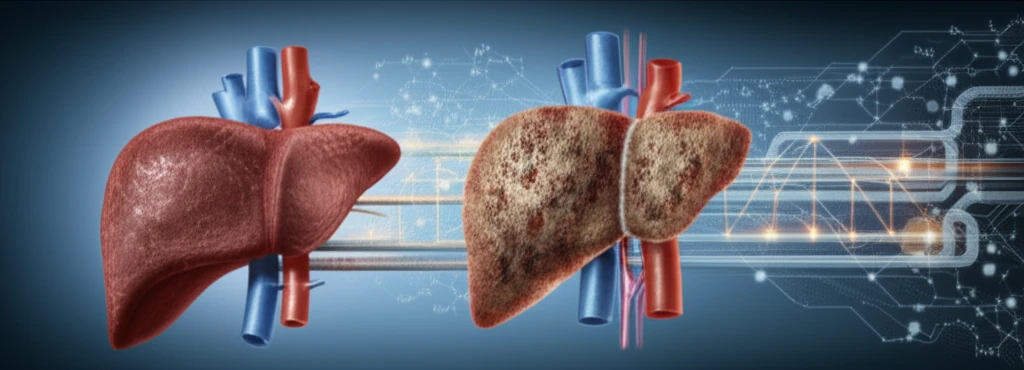
Transformation of a Healthy Liver into a Diseased Liver.

Decoding the Liver's Silent Killer: How Growth Hormones, Metabolism, and Cancer Intertwine

"Unraveling the complexities of NAFLD, HCC, and the critical role of GH-JAK2-STAT5 signaling in maintaining liver health and preventing disease progression."


Obesity rates are climbing, and with them, a surge in metabolic disorders across the Western world. One of the most concerning is non-alcoholic fatty liver disease (NAFLD), a condition where the liver accumulates excess fat, mirroring the body’s struggle to process increasing caloric intake. NAFLD isn't just a benign condition; it's a gateway to more severe health problems, including liver cancer.

Growth hormone (GH) is a critical regulator, overseeing energy distribution and cellular repair. Its influence extends deeply into the liver, orchestrating key functions through the Janus kinase (JAK) 2 and signal transducer and activator of transcription (STAT) 5 pathway. This GH-JAK2-STAT5 axis governs liver health; when disrupted, metabolic chaos ensues, paving the way for NAFLD and, potentially, liver cancer.

While the absence of both STAT5 and JAK2 is linked to fat accumulation in the liver, new research indicates these proteins have distinctive, sometimes contradictory, roles in chronic liver disease and tumor development. By studying genetically modified animal models, we’re beginning to tease apart these complex mechanisms, offering hope for new treatments.

The Liver's Balancing Act: How it Manages Energy and Prevents Disease

Transformation of a Healthy Liver into a Diseased Liver.

The liver is the body's metabolic command center, responsible for processing proteins, lipids, and carbohydrates. It acts as both a storage facility and a distribution hub, absorbing, converting, and releasing essential substances. When this carefully orchestrated system malfunctions, the consequences can be dire, ranging from simple steatosis (fatty liver) to the more aggressive hepatocellular carcinoma (HCC).

The liver is constantly communicating with other tissues, ensuring the body’s energy needs are met. It synthesizes crucial proteins like albumin, which maintains blood pressure and transports hormones and fatty acids. It also produces coagulation factors and hormones like insulin-like growth factor 1 (IGF1).

  • Glucose Regulation: The liver balances blood sugar levels, storing excess glucose as glycogen or releasing it when needed.
  • Gluconeogenesis: When glycogen stores deplete, the liver creates glucose from other sources, ensuring the brain and other tissues receive the energy they require.
  • Lipid Metabolism: The liver synthesizes and distributes fatty acids, triglycerides, and cholesterol, maintaining a delicate balance to prevent fat accumulation.
When these processes go awry, often due to dietary excess or genetic predispositions, NAFLD can develop. This condition, characterized by triglyceride accumulation in hepatocytes, is increasingly common and can progress to more severe stages if left unchecked.

Future Directions: Targeting JAK2 for Liver Health

The GH-JAK2-STAT5 pathway is central to understanding and treating fatty liver disease and preventing liver cancer. Impairing this pathway through the deletion of Stat5 or Jak2 leads to significant changes in lipid metabolism and accumulation of lipids. While both STAT5 and JAK2 are crucial for liver homeostasis, they play different roles in liver cancer development, partly due to differences in ROS generation and clearance. Targeting JAK2 may reduce oxidative stress and prevent liver damage.

About this Article -

This article was crafted using a human-AI hybrid and collaborative approach. AI assisted our team with initial drafting, research insights, identifying key questions, and image generation. Our human editors guided topic selection, defined the angle, structured the content, ensured factual accuracy and relevance, refined the tone, and conducted thorough editing to deliver helpful, high-quality information.See our About page for more information.

This article is based on research published under:

DOI-LINK: 10.1016/j.cyto.2018.10.010, Alternate LINK

Title: Hepatic Growth Hormone - Jak2 - Stat5 Signalling: Metabolic Function, Non-Alcoholic Fatty Liver Disease And Hepatocellular Carcinoma Progression

Subject: Molecular Biology

Journal: Cytokine

Publisher: Elsevier BV

Authors: Doris Kaltenecker, Madeleine Themanns, Kristina M. Mueller, Katrin Spirk, Tobias Suske, Olaf Merkel, Lukas Kenner, Andreia Luís, Andrey Kozlov, Johannes Haybaeck, Mathias Müller, Xiaonan Han, Richard Moriggl

Published: 2019-12-01

Everything You Need To Know

1

What exactly is non-alcoholic fatty liver disease (NAFLD), and why is it important?

Non-alcoholic fatty liver disease (NAFLD) is a condition where the liver accumulates excess fat. This often occurs due to the body's inability to process high caloric intake. NAFLD can lead to more severe conditions like hepatocellular carcinoma (HCC), making its understanding and treatment vital. Its implications stem from the liver’s critical role in metabolism and overall health.

2

What is the role of the GH-JAK2-STAT5 signaling pathway in liver health?

The GH-JAK2-STAT5 signaling pathway is a critical pathway that growth hormone (GH) uses to orchestrate key functions within the liver. The GH-JAK2-STAT5 axis governs liver health. When it's disrupted, metabolic chaos arises, contributing to NAFLD and potentially liver cancer. The JAK2 element of this pathway is a target for potential therapies to reduce oxidative stress and prevent liver damage, highlighting its significance in disease prevention and treatment.

3

What are the main functions of the liver in the body?

The liver is the body's metabolic command center, handling proteins, lipids, and carbohydrates. Its functions include glucose regulation, where it manages blood sugar levels; gluconeogenesis, which produces glucose from other sources when glycogen is depleted; and lipid metabolism, involving the synthesis and distribution of fatty acids, triglycerides, and cholesterol. These processes are essential for maintaining overall health, and any disruption can lead to NAFLD.

4

What is hepatocellular carcinoma (HCC), and how is it related to the other topics?

Hepatocellular carcinoma (HCC) is a severe form of liver cancer. The article highlights the progression from NAFLD to HCC, which is a significant concern given the rising rates of obesity and metabolic disorders. Understanding the role of the GH-JAK2-STAT5 pathway in liver health is critical for preventing and treating HCC.

5

Why is targeting JAK2 significant for liver health and cancer prevention?

Targeting JAK2 is considered a promising approach because it may help prevent liver damage. While both STAT5 and JAK2 are crucial for liver homeostasis, they play different roles in liver cancer development. Impairing the GH-JAK2-STAT5 pathway, by deleting Stat5 or Jak2, leads to significant changes in lipid metabolism and lipid accumulation. Targeting JAK2 may reduce oxidative stress, which can prevent liver damage and potentially reduce the risk of liver cancer. This approach is important due to the increasing prevalence of NAFLD and the potential for progression to HCC.

Newsletter Subscribe

Subscribe to get the latest articles and insights directly in your inbox.