
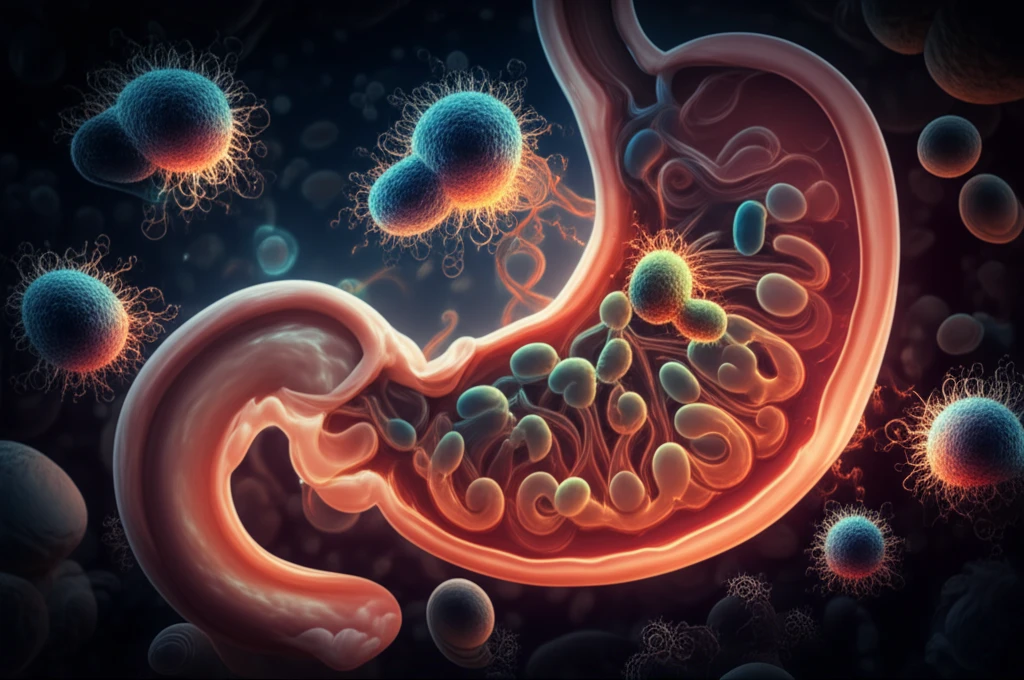
Microscopic view of H. pylori bacteria interacting with human stomach cells.

Decoding the Gut: How Bacteria-Host Protein Interactions Can Impact Your Health

"New research sheds light on how Helicobacter pylori manipulates human proteins, opening doors to novel therapeutic strategies."


The intricate relationship between the human body and the trillions of bacteria residing within it is a subject of intense scientific scrutiny. These microorganisms, collectively known as the microbiome, play a pivotal role in various aspects of our health, from digestion and immunity to mental well-being. However, this delicate balance can be disrupted by pathogenic bacteria, leading to disease. One such bacterium, Helicobacter pylori (H. pylori), has mastered the art of manipulating human proteins to its advantage.

H. pylori, a common inhabitant of the human stomach, is a major culprit in the development of gastritis, peptic ulcers, and even gastric cancer. This resilient bacterium employs a sophisticated arsenal of strategies to colonize the harsh acidic environment of the stomach and evade the host's immune defenses. Central to its success is its ability to interact with and modify human proteins, effectively hijacking cellular processes to promote its own survival and propagation.

Recent research has illuminated a critical aspect of this interaction: the binding of H. pylori proteins to human proteins, specifically focusing on the interaction between the H. pylori protein (Hup) and human Small Ubiquitin-like Modifier (SUMO) proteins. Understanding these interactions at a molecular level could pave the way for novel therapeutic interventions targeting H. pylori-related diseases.

How Does Helicobacter pylori Interact with Human Proteins?

Microscopic view of H. pylori bacteria interacting with human stomach cells.

H. pylori secretes various proteins that interact with human cells, disrupting normal cellular functions and contributing to inflammation and tissue damage. These interactions can suppress the host's immune responses, allowing the bacteria to persist and cause chronic infection. The mechanism is often referred to as "immune hijacking,", whereby H. pylori essentially takes control of the host's immune system for its benefit.

The Hup protein, a histone-like DNA-binding protein in H. pylori, is a key player in this process. Hup is secreted by the bacterium and interacts with human proteins, including SUMO proteins. SUMO proteins are crucial for regulating various cellular processes, including immune responses. By binding to SUMO proteins, Hup can disrupt these regulatory pathways and manipulate the host's cellular machinery.

Here are some functions of SUMO proteins that can be disrupted by H. pylori:
  • Regulating protein function and stability
  • Modifying protein-protein interactions
  • Influencing DNA repair
  • Participating in immune response pathways
The study highlights the presence of SUMO interacting motifs (SIMs) on the Hup protein, suggesting a direct interaction with SUMO proteins. Furthermore, the researchers found that Hup and SUMO-1 (a specific type of SUMO protein) exhibit charge complementarity, which facilitates their binding. Through a series of experiments, including Nuclear Magnetic Resonance (NMR) and Isothermal Titration Calorimetry (ITC), the researchers confirmed the interaction between Hup and SUMO-1, providing valuable insights into the molecular details of this interaction.

What Are the Implications for Your Health?

The study's findings have significant implications for understanding H. pylori pathogenesis and developing new therapeutic strategies. By elucidating the molecular mechanisms underlying the interaction between Hup and SUMO proteins, researchers can potentially design targeted therapies that disrupt this interaction, restoring normal cellular function and boosting the host's immune response. These therapies could potentially reduce the severity of H. pylori infections and prevent the development of associated diseases.

About this Article -

This article was crafted using a human-AI hybrid and collaborative approach. AI assisted our team with initial drafting, research insights, identifying key questions, and image generation. Our human editors guided topic selection, defined the angle, structured the content, ensured factual accuracy and relevance, refined the tone, and conducted thorough editing to deliver helpful, high-quality information.See our About page for more information.

This article is based on research published under:

DOI-LINK: 10.1016/j.ijbiomac.2018.11.054, Alternate LINK

Title: Molecular Interaction Between Human Sumo-I And Histone Like Dna Binding Protein Of Helicobacter Pylori (Hup) Investigated By Nmr And Other Biophysical Tools

Subject: Molecular Biology

Journal: International Journal of Biological Macromolecules

Publisher: Elsevier BV

Authors: Nancy Jaiswal, Nipanshu Agarwal, Anupreet Kaur, Sarita Tripathi, Gagandeep Kaur Gahlay, Ashish Arora, Venus Singh Mithu, Krishna Mohan Poluri, Dinesh Kumar

Published: 2019-02-01

Everything You Need To Know

1

What is the role of *Helicobacter pylori* in human health?

*Helicobacter pylori* (*H. pylori*) is a bacterium that commonly resides in the human stomach. It plays a significant role in the development of several health issues, including gastritis, peptic ulcers, and even gastric cancer. Its ability to manipulate human proteins is key to its ability to cause disease. The bacterium achieves this by interacting with human proteins, disrupting normal cellular functions, and promoting inflammation and tissue damage.

2

How does the *Hup* protein of *Helicobacter pylori* interact with human proteins?

The *Hup* protein, a histone-like DNA-binding protein secreted by *Helicobacter pylori*, interacts with human proteins, particularly SUMO proteins. *Hup* contains SUMO interacting motifs (SIMs) that facilitate its binding to SUMO proteins. This interaction disrupts the regulatory pathways governed by SUMO proteins, allowing *H. pylori* to manipulate the host's cellular machinery. Through this, *H. pylori* can suppress the host's immune responses and persist in the stomach.

3

What are SUMO proteins, and why are they important in the context of *Helicobacter pylori* infection?

SUMO (Small Ubiquitin-like Modifier) proteins are crucial for regulating various cellular processes within the human body. These processes include regulating protein function and stability, modifying protein-protein interactions, influencing DNA repair, and participating in immune response pathways. In the context of *Helicobacter pylori* infection, the bacterium's *Hup* protein interacts with SUMO proteins, disrupting these regulatory pathways. This disruption enables *H. pylori* to manipulate the host's cellular machinery, suppress immune responses, and facilitate its survival and propagation within the stomach.

4

What are the potential therapeutic implications of the interaction between *Hup* and SUMO proteins?

Understanding the molecular mechanisms underlying the interaction between *Hup* and SUMO proteins opens doors to novel therapeutic strategies. Researchers could potentially design targeted therapies that disrupt this specific interaction. Such therapies could restore normal cellular function and boost the host's immune response. The goal is to reduce the severity of *H. pylori* infections and prevent the development of associated diseases like gastritis, peptic ulcers, and gastric cancer. Specifically, the focus is on disrupting the binding between *Hup* and SUMO-1 to restore the natural cellular processes hijacked by the bacteria.

5

How does the interaction between *Hup* and SUMO-1 occur at a molecular level?

The interaction between *Hup* and SUMO-1 is facilitated by several factors. Firstly, the *Hup* protein has SUMO interacting motifs (SIMs), which promote its binding to SUMO proteins. Secondly, *Hup* and SUMO-1 exhibit charge complementarity, meaning their charges align in a way that encourages binding. Researchers have confirmed this interaction through experiments like Nuclear Magnetic Resonance (NMR) and Isothermal Titration Calorimetry (ITC), providing detailed insights into the molecular mechanics of the interaction. This detailed understanding is critical for developing therapies that can effectively disrupt this binding and restore normal cellular functions, helping to combat *H. pylori* infections.

Newsletter Subscribe

Subscribe to get the latest articles and insights directly in your inbox.