
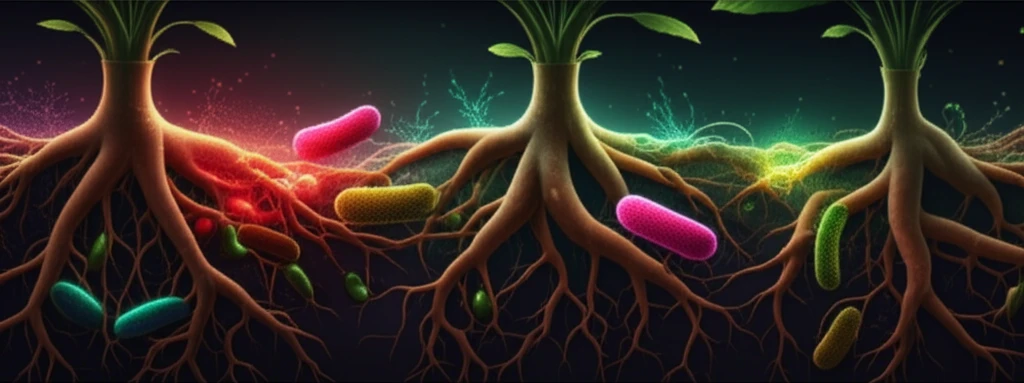
Intertwined plant roots and bacterial colonies, symbolizing horizontal gene transfer of expansin proteins.

Decoding the Great Expansin Mystery: How Plant Proteins Wound Up in Bacteria

"Unraveling the evolutionary journey of expansins in Streptomyces and Kutzneria – a tale of gene transfer, adaptation, and potential biotech innovation."


Expansins, a protein superfamily predominantly found in plants, also appear in bacteria, fungi, and amoebozoa. In plants, these proteins play a crucial role in cell wall loosening by binding to the cell wall and relaxing cellulose microfibrils without enzymatic action. This mechanism is essential for plant growth and development.

The presence of expansins outside the plant kingdom has long puzzled scientists. The evolutionary history of these non-plant expansins is complicated by horizontal gene transfer (HGT), a process where genetic material is transferred between organisms that are not parent and offspring. This makes it difficult to pinpoint the precise origin and function of expansins in bacteria and other organisms.

Recent research has uncovered a fascinating case of plant-like expansins in two bacterial genera: Streptomyces and Kutzneria. This discovery provides a unique opportunity to delve deeper into the evolution of expansins and their potential roles in bacterial physiology and interactions with other organisms.

The Curious Case of Bacterial Expansins

Intertwined plant roots and bacterial colonies, symbolizing horizontal gene transfer of expansin proteins.

Researchers conducted a comprehensive genome-wide search for HGT events in Streptomyces species. This search led to the identification of a plant-like expansin within the proteome of Streptomyces acidiscabies, a bacterium known for causing potato scab. Further investigation revealed the presence of a similar protein in Kutzneria sp. 744.

Phylogenetic analyses confirmed that the expansins found in S. acidiscabies and Kutzneria sp. 744 are closely related to plant expansins, specifically those belonging to the expansin A clade. This placement suggests that these bacterial expansins originated from plants.

  • Structural Similarity: Despite their bacterial hosts, the 3D structures of the bacterial expansins show similarities to plant expansins, particularly in their electrostatic potentials and folding patterns.
  • Distinct from Canonical Expansins: These expansins differ from both plant and bacterial canonical expansins, suggesting they've undergone specific adaptations since their transfer.
  • Plant Origin Confirmed: Analysis points towards a plant origin for these bacterial expansins, setting them apart from typical bacterial expansins.
These findings suggest that S. acidiscabies and Kutzneria sp. 744 acquired their expansins from plants through HGT. However, these bacterial expansins have evolved independently, resulting in unique characteristics that distinguish them from their plant counterparts and other bacterial expansins.

Why This Matters and What's Next

The discovery of plant-like expansins in bacteria raises several intriguing questions about their function and evolution. What role do these expansins play in the biology of S. acidiscabies and Kutzneria sp. 744? How did they adapt to function in a bacterial context?

Further research is needed to fully understand the functional significance of these bacterial expansins. Experimental studies could reveal their specific roles in bacterial cell wall modification, biofilm formation, or interactions with plant hosts.

Moreover, these unique bacterial expansins could have potential applications in biotechnology. Their ability to modify cell walls could be harnessed for various purposes, such as improving biomass processing or developing novel drug delivery systems. As more plant and bacterial genomes become available, scientists will be able to validate, improve, or change the proposed hypotheses, the uniqueness of BEAPLs turns these proteins interesting for further experimental research and applications in biotechnology.

About this Article -

This article was crafted using a human-AI hybrid and collaborative approach. AI assisted our team with initial drafting, research insights, identifying key questions, and image generation. Our human editors guided topic selection, defined the angle, structured the content, ensured factual accuracy and relevance, refined the tone, and conducted thorough editing to deliver helpful, high-quality information.See our About page for more information.

This article is based on research published under:

DOI-LINK: 10.1080/19420889.2018.1539612, Alternate LINK

Title: The Dilemma Of Bacterial Expansins Evolution. The Unusual Case Of Streptomyces Acidiscabies And Kutzneria Sp. 744

Subject: General Agricultural and Biological Sciences

Journal: Communicative & Integrative Biology

Publisher: Informa UK Limited

Authors: Vinicio Armijos-Jaramillo, Daniela Santander-Gordón, Eduardo Tejera, Yunierkis Perez-Castillo

Published: 2018-11-02

Everything You Need To Know

1

What are expansins, and why are they important?

Expansins are proteins primarily found in plants, responsible for loosening the cell wall, which is essential for plant growth and development. These proteins function by binding to the cell wall and relaxing cellulose microfibrils without enzymatic action. Their presence in bacteria such as Streptomyces and Kutzneria is significant because it challenges the traditional understanding of where these proteins originate and how they function, highlighting the role of horizontal gene transfer and adaptation in evolution.

2

What is horizontal gene transfer, and what role does it play in this discovery?

Horizontal gene transfer (HGT) is a process where genetic material moves between organisms that aren't directly related through parent and offspring. In this context, HGT explains how plant-like expansins ended up in the bacteria Streptomyces and Kutzneria. This process is crucial to understanding the evolutionary history of these expansins, indicating they were acquired from plants. Analyzing the genes and proteins helps scientists understand how these bacterial expansins have adapted and potentially evolved to perform different functions within the bacteria.

3

Why are Streptomyces acidiscabies and Kutzneria sp. 744 important?

Streptomyces acidiscabies is a bacterium that causes potato scab. Its significance lies in the fact that it contains a plant-like expansin. Kutzneria sp. 744, also houses a similar expansin. These findings are important because they provide valuable insights into the bacterial expansins. These insights highlight the potential adaptation of these proteins within a bacterial context, opening up new avenues for research into bacterial physiology and their interactions with other organisms.

4

How do the bacterial expansins compare to plant expansins?

The 3D structures of bacterial expansins in Streptomyces and Kutzneria are similar to plant expansins, specifically in electrostatic potentials and folding patterns. However, they differ from both plant and canonical bacterial expansins. These differences suggest that these bacterial expansins have evolved and adapted since their transfer from plants, potentially to suit their specific roles within the bacterial cells and their interactions with the environment. This evolution is key to understanding how these proteins function.

5

What are the implications of this discovery?

The discovery opens doors for new research into how bacterial expansins function and adapt. Scientists are now investigating what roles these expansins play in the biology of Streptomyces acidiscabies and Kutzneria sp. 744, and how they have adapted to function within a bacterial environment. This includes exploring the potential for biotechnological applications. The research implications will deepen our understanding of protein evolution, horizontal gene transfer, and the adaptation of proteins in new cellular environments.

Newsletter Subscribe

Subscribe to get the latest articles and insights directly in your inbox.