
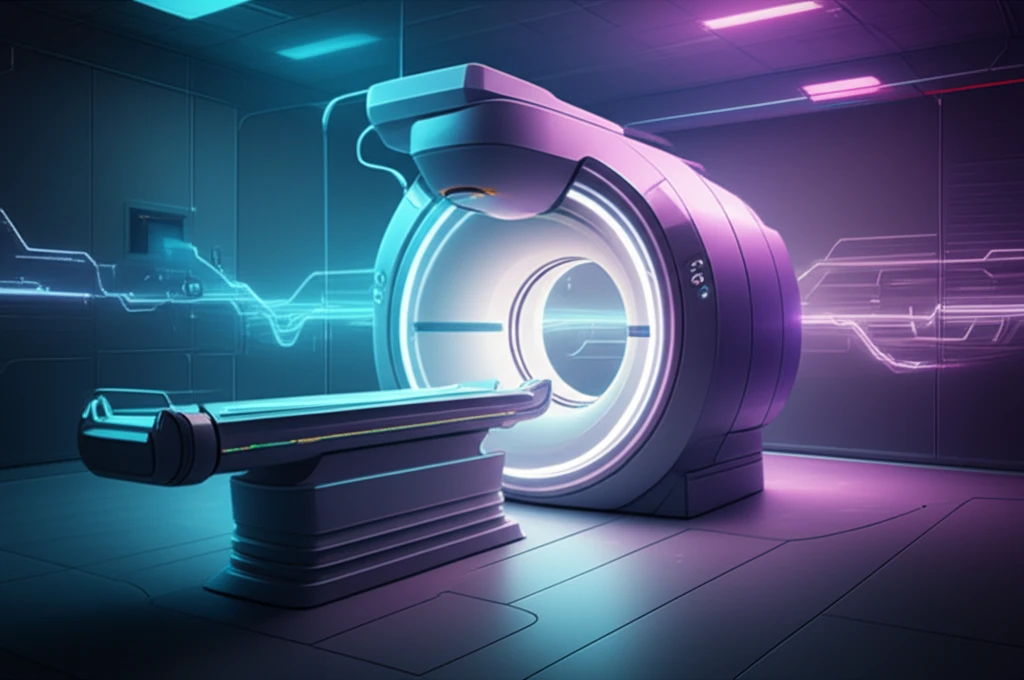
Illustration of a PET scan machine, symbolizing advancements in cancer treatment.

Decoding the Future of Cancer Treatment: How Cutting-Edge Technology is Revolutionizing PET Scans

"Unlocking Precision: Exploring the Revolutionary Advancements in PET Scans and Their Impact on Cancer Detection and Treatment"


In the ever-evolving landscape of medical technology, few advancements hold as much promise as the innovations in Positron Emission Tomography (PET) scans. These sophisticated imaging techniques are not just tools for visualizing the human body; they are powerful allies in the fight against cancer and other life-threatening diseases. As we stand on the cusp of a new era in healthcare, understanding the profound impact of these technological leaps is more critical than ever.

PET scans, once a cutting-edge novelty, are rapidly becoming indispensable in the arsenal of diagnostic and therapeutic tools available to medical professionals. They offer a unique window into the body's inner workings, allowing doctors to detect diseases at their earliest stages, monitor treatment effectiveness, and tailor therapies to each patient's unique needs. This level of precision is not just a medical advantage; it is a beacon of hope for millions around the globe.

This article will explore the latest advancements in PET scan technology, focusing on how they are improving the accuracy and efficiency of cancer detection and treatment. We'll delve into the science behind these innovations, examine the benefits they offer, and discuss the impact they are having on healthcare systems worldwide. Join us as we uncover the future of cancer care, one scan at a time.

The Science Behind the Scan: Understanding How PET Technology Works

Illustration of a PET scan machine, symbolizing advancements in cancer treatment.

At its core, a PET scan is a remarkable feat of medical engineering that relies on the principles of nuclear medicine. The process begins with the introduction of a radiopharmaceutical, a substance that emits positrons, into the patient's body. These positrons, which are essentially positively charged particles, travel a short distance before colliding with electrons. When this collision occurs, the particles annihilate each other, producing two gamma photons that travel in opposite directions.

These gamma photons are then detected by the PET scanner, a sophisticated device equipped with specialized detectors that capture the photons and generate detailed images. These images are not just static snapshots; they are dynamic representations of the body's metabolic activity. By analyzing the patterns of radioactive decay, medical professionals can pinpoint areas where cells are exhibiting increased activity, which may indicate the presence of cancer or other diseases.

  • Radiopharmaceuticals: These are the key to the entire process, as they emit the positrons needed for detection.
  • Detection: The scanner detects the photons and generates images.
  • Metabolic Activity: Images showcase the body's inner workings.
  • Disease Detection: Areas with increased activity can pinpoint diseases.
What sets PET scans apart is their ability to provide functional information. Unlike other imaging techniques that primarily focus on anatomical structures, PET scans highlight the metabolic processes at work within the body. This capability is invaluable in diagnosing and staging cancer, as cancerous cells often exhibit a higher metabolic rate than normal cells.

Looking Ahead: The Future of PET Scans in Cancer Care

The journey of PET scan technology is far from over. As research continues and new innovations emerge, we can expect even greater precision in cancer detection, more effective treatment strategies, and improved patient outcomes. These advancements represent not just progress in medical science but a renewed sense of hope for those facing the challenges of cancer. The future of cancer care is being shaped by the power of innovation, and PET scans are at the forefront of this remarkable transformation.

About this Article -

This article was crafted using a human-AI hybrid and collaborative approach. AI assisted our team with initial drafting, research insights, identifying key questions, and image generation. Our human editors guided topic selection, defined the angle, structured the content, ensured factual accuracy and relevance, refined the tone, and conducted thorough editing to deliver helpful, high-quality information.See our About page for more information.

This article is based on research published under:

DOI-LINK: 10.1088/1361-6560/aaf0bb, Alternate LINK

Title: Achieving Reliable Coincidence Resolving Time Measurement Of Pet Detectors Using Multichannel Waveform Digitizer Based On Drs4 Chip

Subject: Radiology, Nuclear Medicine and imaging

Journal: Physics in Medicine & Biology

Publisher: IOP Publishing

Authors: Haewook Park, Seungeun Lee, Guen Bae Ko, Jae Sung Lee

Published: 2018-12-10

Everything You Need To Know

1

How do Positron Emission Tomography (PET) scans uniquely contribute to cancer diagnosis compared to other imaging techniques?

Positron Emission Tomography (PET) scans uniquely contribute to cancer diagnosis by providing functional information about the body's metabolic processes, whereas other imaging techniques primarily focus on anatomical structures. This capability is invaluable in diagnosing and staging cancer, as cancerous cells often exhibit a higher metabolic rate than normal cells, allowing for earlier and more precise detection.

2

What role do radiopharmaceuticals play in Positron Emission Tomography (PET) scans, and why are they crucial for the process?

Radiopharmaceuticals are key to Positron Emission Tomography (PET) scans because they emit positrons, which are essential for detection. These substances are introduced into the patient's body, where they emit positrons that collide with electrons, producing gamma photons. These photons are then detected by the Positron Emission Tomography (PET) scanner, enabling the creation of detailed images that highlight metabolic activity within the body.

3

Can you elaborate on how the detection process works within a Positron Emission Tomography (PET) scan and the significance of gamma photons?

In a Positron Emission Tomography (PET) scan, the detection process relies on the annihilation of positrons and electrons, which produces two gamma photons that travel in opposite directions. The Positron Emission Tomography (PET) scanner, equipped with specialized detectors, captures these gamma photons and generates detailed images. These images are dynamic representations of the body's metabolic activity, allowing medical professionals to pinpoint areas where cells exhibit increased activity, potentially indicating cancer or other diseases. The gamma photons are significant because their detection and analysis enable the visualization of metabolic processes at a cellular level.

4

What advancements in Positron Emission Tomography (PET) scan technology are anticipated to further improve cancer treatment strategies and patient outcomes?

Ongoing research and emerging innovations in Positron Emission Tomography (PET) scan technology are expected to bring even greater precision to cancer detection, leading to more effective treatment strategies and improved patient outcomes. These advancements aim to enhance the ability to detect cancer at earlier stages, monitor treatment effectiveness more accurately, and tailor therapies to each patient's unique needs. The continuous progress in this field holds immense promise for transforming cancer care and offering renewed hope to those affected by the disease.

5

How does the ability of Positron Emission Tomography (PET) scans to reveal metabolic activity contribute to more effective and personalized cancer treatment plans?

Positron Emission Tomography (PET) scans' ability to reveal metabolic activity allows medical professionals to identify areas with increased cellular activity, often indicative of cancerous cells. This functional information is crucial for creating more effective and personalized cancer treatment plans. By understanding the metabolic processes at work within the body, doctors can tailor therapies to target cancerous cells specifically, monitor the effectiveness of treatments, and make informed decisions about adjusting treatment strategies to optimize patient outcomes. This personalized approach enhances the precision and efficacy of cancer care.

Newsletter Subscribe

Subscribe to get the latest articles and insights directly in your inbox.