
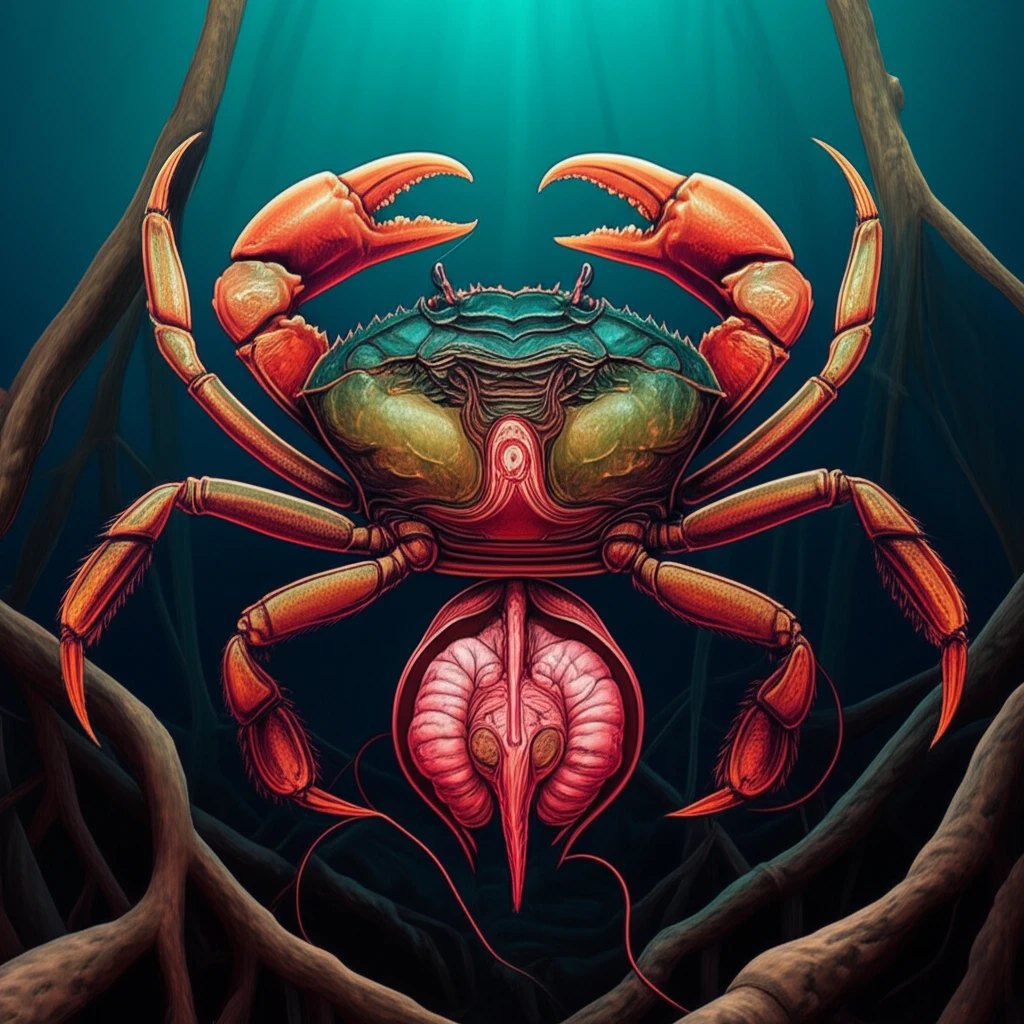
Mangrove crab reproductive system interwoven with mangrove roots.

Decoding the Crab: A Close Look at Mangrove Land Crab Reproduction

"Unveiling the secrets of the Ucides cordatus: a deep dive into the reproductive system of the mangrove land crab and what it tells us about their life cycle."


The mangrove land crab, Ucides cordatus, is a crucial part of mangrove ecosystems, distributed along the western Atlantic coast from Florida to Brazil. These crabs play a vital role in the ecosystem and serve as an economic resource for local communities.

Understanding the reproductive cycle of Ucides cordatus is essential for conservation and sustainable harvesting. While some research exists, a comprehensive understanding of the female reproductive system's morphology and histology is needed.

This article explores the in-depth study of the female reproductive system of Ucides cordatus, providing insights into its anatomy, oocyte development, and reproductive stages. This research enhances our knowledge of this species and provides valuable information for future conservation efforts.

How Does the Female Reproductive System of the Mangrove Land Crab Function?

Mangrove crab reproductive system interwoven with mangrove roots.

The study examined 277 female Ucides cordatus crabs collected over a year in Victoria Bay, Brazil. Researchers carefully dissected and analyzed the reproductive systems, documenting the different developmental stages of the ovaries. Histological analysis provided a microscopic view of the oocyte development, revealing six distinct stages.

The female reproductive system consists of two ovaries connected by a bridge, forming an H-shape when viewed from above. These ovaries extend throughout the cephalothorax cavity and connect to oviducts that lead to genital openings. Two seminal receptacles store sperm after mating.

Here's a breakdown of the six stages of oocyte development observed:
  • Stage I: Young germ cells (oogonias) with intensely basophilic nuclei.
  • Stage II: Oocytes of the germinative centers with faintly stained cytoplasm and defined nuclei.
  • Stage III: Oocytes undergoing lipid vitellogenesis, marked by the formation of lipid droplets.
  • Stage IV: Vitellogenic oocytes with both lipid and protein, showing acidophilic granules.
  • Stage V: Oocytes with completed vitellogenesis, characterized by large lipid droplets.
  • Stage VI: Oocytes in hyalinization, with a large increase in volume due to yolk granules.
These stages provide a detailed roadmap of oocyte maturation within the Ucides cordatus.

Why This Matters: Implications for Conservation and Sustainability

This research confirms that Ucides cordatus exhibits multiple spawning, with reproduction occurring primarily in the summer months. This finding is crucial for developing effective conservation strategies and regulations.

Understanding the reproductive cycle allows for targeted protection measures during peak spawning periods, ensuring the long-term health of crab populations. This is especially important given the economic reliance of many communities on this resource.

By providing a detailed understanding of the female reproductive system, this study contributes valuable information for sustainable management practices, protecting both the mangrove ecosystem and the livelihoods of those who depend on it.

About this Article -

This article was crafted using a human-AI hybrid and collaborative approach. AI assisted our team with initial drafting, research insights, identifying key questions, and image generation. Our human editors guided topic selection, defined the angle, structured the content, ensured factual accuracy and relevance, refined the tone, and conducted thorough editing to deliver helpful, high-quality information.See our About page for more information.

This article is based on research published under:

DOI-LINK: 10.1590/s0104-64972011000200006, Alternate LINK

Title: Morphology And Histology Of The Female Reproductive System Of The Mangrove Land Crab, Ucides Cordatus (Linnaeus, 1763) (Brachyura: Ocypodidae)

Subject: General Medicine

Journal: Nauplius

Publisher: FapUNIFESP (SciELO)

Authors: Flávia Duarte Ferraz Sampaio, Tania Mara Simões Do Carmo, Assunta Maria Penna

Published: 2011-12-01

Everything You Need To Know

1

What are the main components of the female reproductive system of the Mangrove Land Crab?

The female reproductive system of the *Ucides cordatus* is composed of two ovaries, connected by a bridge, which together create an H-shape. These ovaries are located within the cephalothorax cavity and are linked to oviducts that lead to genital openings. Also, two seminal receptacles are present within the system, which are responsible for storing sperm after mating. Understanding this anatomy is critical to understanding the crab's reproductive cycle.

2

What are the different stages of oocyte development in the Mangrove Land Crab?

The six stages of oocyte development within the *Ucides cordatus* are Stage I, which involves young germ cells; Stage II, with oocytes from the germinative centers; Stage III, where lipid vitellogenesis begins; Stage IV, showing vitellogenic oocytes with both lipid and protein; Stage V, marked by completed vitellogenesis; and finally, Stage VI, characterized by hyalinization. These stages are essential because they represent the step-by-step maturation of the eggs, crucial for reproduction.

3

Why is it important to study the female reproductive system of the Mangrove Land Crab?

Studying the female *Ucides cordatus* reproductive system is vital for developing effective conservation strategies and sustainable harvesting practices. Knowing the reproductive cycle, including when spawning occurs, helps to establish regulations that protect the crabs during their most vulnerable periods. Understanding the morphology and histology of the ovaries provides insights into the overall health of the crab population.

4

When does the Mangrove Land Crab primarily reproduce?

The study found that *Ucides cordatus* crabs reproduce multiple times, with the primary reproduction occurring during the summer months. This information is crucial for conservation efforts because it highlights the importance of protecting the crabs during these specific periods. Effective conservation strategies can be implemented through an understanding of the seasonal patterns.

5

What does oocyte development mean in the context of the Mangrove Land Crab?

Oocyte development refers to the maturation process of the eggs, or oocytes, within the ovaries of the *Ucides cordatus*. The researchers identified six distinct stages, from the earliest germ cells to the final hyalinization stage. This detailed examination of oocyte development provides a clear understanding of how these crabs produce eggs and supports our understanding of their reproductive health and overall life cycle.

Newsletter Subscribe

Subscribe to get the latest articles and insights directly in your inbox.