
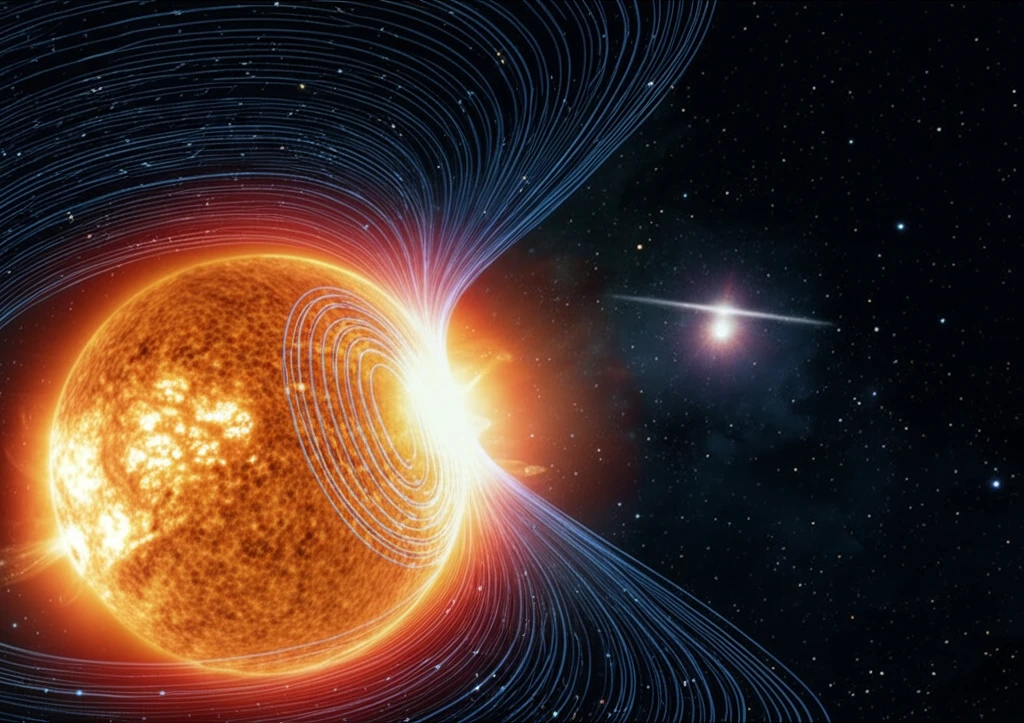
Decoding the Cosmos: How the IBEX Ribbon Reveals the Secrets of Interstellar Space

"Unveiling the mysteries of the local interstellar magnetic field through the IBEX ribbon, enhancing our understanding of space weather and its impact on Earth."
For years, scientists have been working tirelessly to understand the complex interactions that occur at the edge of our solar system, where the solar wind collides with the interstellar medium. This boundary, known as the heliosphere, is a dynamic region shaped by the interplay of magnetic fields and plasma. One of the most intriguing discoveries in this field has been the IBEX ribbon, a region of enhanced energetic neutral atom (ENA) emission detected by the Interstellar Boundary Explorer (IBEX) spacecraft.
The IBEX ribbon has challenged existing models of the heliosphere interface and opened up new avenues for research. It is very important to understanding the local interstellar magnetic field (ISMF), which plays a very important role in shaping our solar system's interaction with the galaxy. Understanding the ISMF is crucial for predicting space weather events and assessing their potential impact on Earth.
This article delves into the groundbreaking research of Romana Ratkiewicz and Marek Strumik, who have been at the forefront of efforts to decipher the secrets of the IBEX ribbon. By summarizing their three-dimensional MHD simulations of the solar wind and interstellar medium interaction, we aim to provide a clear and accessible overview of their findings and discuss the implications for our understanding of the cosmos.
Evidence Gaps
The supplied material does not provide current statistics about the IBEX Ribbon or its impact. Any quantitative assessment would therefore require additional sources. The available evidence is insufficient to make a firm claim about present-day scientific significance.
Methodological Limits
No listed source describes accepted methods for studying the IBEX Ribbon. The material therefore cannot establish how observations are collected, analyzed, or limited. Conclusions about standard approaches would be speculative without relevant mission or heliophysics sources.
Historical Context
The supplied sources do not document the history of the IBEX mission or the discovery of its Ribbon. They consequently cannot support a reliable account of milestones or foundational discoveries. A historical overview would require sources specifically addressing IBEX and heliophysics.
What is the Heliosphere and How Does It Affect Us?
To fully appreciate the significance of the IBEX ribbon, it's important to understand the heliosphere and its role in protecting our solar system. The heliosphere is basically a cavity created in the local interstellar medium (LISM) by the solar wind, a stream of charged particles continuously emitted by the Sun. This solar wind carves out a region in space, pushing back against the LISM and creating a boundary that separates our solar system from the rest of the galaxy.
- Termination Shock (TS): The point where the solar wind slows down to subsonic speeds.
- Heliopause (HP): The boundary between the solar wind and the interstellar medium.
- Bow Shock (BS): A shock wave formed as the heliosphere moves through the interstellar medium.
- Inner Heliosheath (IHS): The region between the Termination Shock (TS) and the Heliopause (HP)
- Outer Heliosheath (OHS): The region between the Heliopause (HP) and the Bow Shock (BS).
Source Mismatch
The listed results do not provide research or reviews about the IBEX Ribbon. Two sources describe ibex goats, including the Siberian ibex and Alpine ibex, while another concerns IBEX merino-wool clothing. A fourth discusses caring for ibex in captivity, so these materials cannot substantiate conclusions about current Ribbon research. The sources are therefore not evidence for the space mission's latest findings.
Unrelated Evidence
The only listed source identifies IBEX as a marine-industry event for people who build, design, service, or sell boats and marine products. It does not discuss the IBEX Ribbon, competing interpretations, observational failures, or scientific counterarguments. No conclusion about weaknesses in Ribbon research can be drawn from this source.
Comparative Limits
The supplied material does not provide comparable missions, datasets, models, or measurements related to the IBEX Ribbon. Comparisons with other heliophysics investigations would therefore go beyond the evidence available here. The subsection must remain general until relevant sources are provided.
The Future of Interstellar Exploration
The study of the IBEX ribbon and the local interstellar magnetic field is an ongoing endeavor that holds immense promise for advancing our understanding of the cosmos. By continuing to analyze the data from IBEX and developing more sophisticated models, scientists can gain deeper insights into the complex interactions that shape our heliosphere and its interaction with the galaxy. This knowledge will not only enhance our fundamental understanding of space but also help us protect our planet and spacecraft from the hazards of space weather.
Evidence-Based Synthesis
The listed material does not include expert commentary on the IBEX Ribbon. It cannot support a synthesis of the Ribbon's observations, interpretation, or scientific importance. Any stronger assessment would require sources focused on the IBEX spacecraft and interstellar space.
Unspecified Directions
No supplied source addresses future IBEX observations, planned missions, or next research priorities. The available material therefore cannot support specific projections about the field's direction. Future-outlook claims should be withheld until mission-focused sources are available.
Contextual Gaps
The source list does not discuss the broader astrophysical context or systemic challenges associated with studying the IBEX Ribbon. It provides no evidence about instrumentation, data interpretation, collaboration, or mission constraints. A responsible account should avoid inferring these issues from unrelated ibex references.
Human Impact Not Established
The supplied sources do not describe how IBEX Ribbon research affects people, institutions, or practical decision-making. They instead concern ibex animals, merino-wool clothing, captivity, and a marine-industry event. No real-world impact specific to the space mission can be established from this material.