
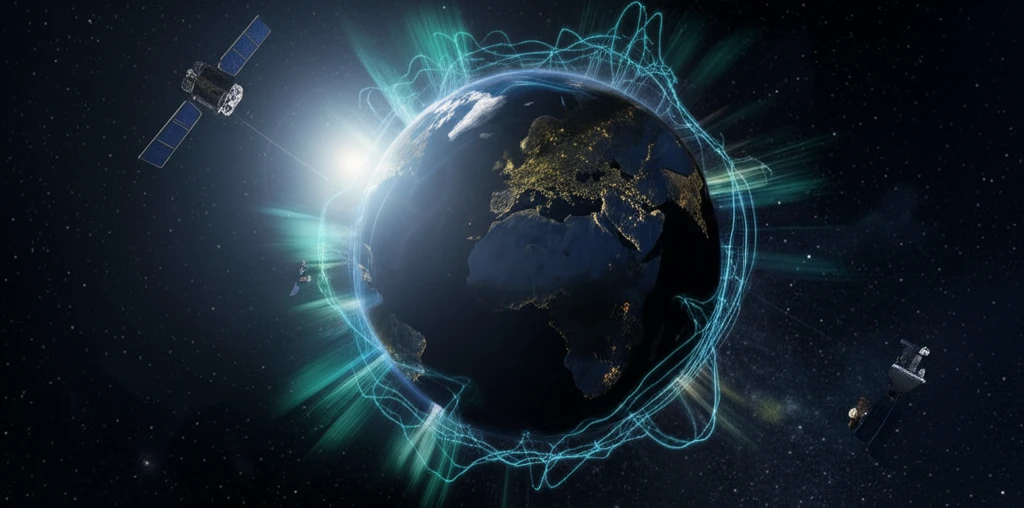
Decoding Auroral Hall Currents: What Swarm Satellite Data Reveals About Space Weather

"New research unveils the global characteristics of auroral Hall currents using data from the Swarm constellation, deepening our understanding of space weather and its impact on Earth."
The mesmerizing dance of the Northern and Southern Lights, known as the aurora borealis and australis, has captivated humanity for centuries. These celestial displays are not mere aesthetic phenomena; they are visual manifestations of complex interactions between the solar wind and Earth's magnetosphere and ionosphere. Understanding these interactions is crucial for predicting and mitigating the effects of space weather, which can disrupt satellite communications, power grids, and other critical infrastructure.
Central to this understanding are auroral currents, electrical currents flowing in the ionosphere at high latitudes. Among these, Hall currents play a significant role in the horizontal current system, particularly within the auroral electrojets. These electrojets are concentrated currents that can intensify during geomagnetic disturbances, posing a risk to technological systems on Earth and in space.
Recent research, leveraging data from the European Space Agency's (ESA) Swarm constellation, has provided unprecedented insights into the global characteristics of auroral Hall currents. This study not only confirms previous findings but also reveals new dependencies on season and the orientation of the Interplanetary Magnetic Field (IMF), offering a more comprehensive picture of these dynamic current systems.
Measured Effects
The available material does not provide statistics specific to auroral Hall currents or Swarm satellite observations. Their measured impact therefore cannot be quantified here without additional evidence. Any assessment should distinguish directly observed space-weather effects from broader interpretation.
Methodological Limits
The available material does not identify a standard method for analyzing auroral Hall currents with Swarm data. In general, conclusions should be treated cautiously when measurement methods, calibration details, and uncertainty estimates are not specified. More targeted technical sources would be needed to evaluate accepted approaches and their limitations.
Cardiac Anatomy as a System
The supplied sources describe the human heart as a muscular organ in the mediastinum with four chambers, four valves, two coronary arteries, and a conduction system. Deoxygenated blood enters through the right atrium, moves to the right ventricle, and is pumped to the lungs for pulmonary circulation. The sources also identify the atria, ventricles, septa, vessels, tissue layers, and electrical conduction system as specialized components supporting one-way blood flow.
What are Auroral Hall Currents and Why Do They Matter?
Auroral Hall currents are a type of electrical current that flows horizontally in the Earth's ionosphere, primarily at high latitudes within the auroral zone. These currents are generated by the complex interaction between the solar wind, the Earth's magnetosphere, and the ionosphere. Unlike field-aligned currents (FACs), which flow along the Earth's magnetic field lines, Hall currents flow perpendicular to both the magnetic field and the electric field. Auroral Hall currents are a fundamental component of the intricate electrical circuitry in the upper atmosphere.
- Space Weather Prediction: Hall currents play a significant role in the overall dynamics of the ionosphere. Studying their behavior helps refine space weather models, improving our ability to predict geomagnetic disturbances that can disrupt satellite communications, power grids, and navigation systems.
- Ionospheric Modeling: Detailed knowledge of Hall current distribution and intensity allows scientists to develop more accurate ionospheric models. These models are essential for various applications, including radio communication, satellite tracking, and understanding atmospheric processes.
- Energy Transfer: Hall currents are involved in the transfer of energy from the magnetosphere to the ionosphere. Understanding how energy is dissipated and distributed within the ionosphere is crucial for understanding the overall energy budget of the Earth's upper atmosphere.
- Technological Impact: Intense Hall currents, particularly during geomagnetic storms, can induce currents in ground-based conductors such as pipelines and power lines. Understanding these currents is essential for mitigating potential damage to infrastructure.
Microsoft’s Technology Landscape
Microsoft Corporation is described as an American multinational technology company headquartered in Redmond, Washington. The supplied material says Microsoft became influential in personal computing through Windows and later expanded into internet services, cloud computing, artificial intelligence, video gaming, and other areas. Microsoft’s current product page specifically lists Microsoft 365, Copilot, Teams, Xbox, Windows, Azure, Surface, and related services.
Evidence Gaps
The available material does not document specific counterarguments, failed studies, or disputed interpretations concerning auroral Hall currents. It therefore does not support assigning a particular failure to Swarm-based research. A balanced treatment would require sources that report competing findings, methodological weaknesses, or reproducibility problems.
Community and Cloud Platforms
The supplied Reddit descriptions represent different kinds of online communities and services. r/AITAH is presented as a forum for interpersonal conflicts, while r/Amazon emphasizes community-oriented news and discussion and directs help questions to a stickied thread. The LunaCloudGaming FAQ describes Amazon Luna as a cloud-gaming service that streams games to a device similarly to video streaming through Netflix or YouTube.
Looking Ahead: Future Directions in Auroral Current Research
The Swarm mission has opened new avenues for studying auroral currents and their impact on the Earth's environment. By continuing to analyze Swarm data and integrating it with other ground-based and space-based observations, scientists can further refine our understanding of space weather and its potential effects. Future research should focus on developing more sophisticated models that capture the complex interplay between auroral currents, the IMF, and the solar wind, leading to more accurate space weather forecasts and improved protection of critical infrastructure.
Interpretive Caution
The available material does not provide expert commentary that directly synthesizes Swarm satellite observations and auroral Hall-current research. Any synthesis should therefore remain provisional rather than attribute conclusions to the supplied sources. Further interpretation would require evidence specific to magnetospheric measurements and space-weather physics.
Open Research Direction
The available material does not identify specific future missions, projections, or next-frontier technologies for auroral Hall-current research. It consequently cannot support a dated forecast or a claim about which research direction will become dominant. Future outlooks should be based on sources that directly address Swarm extensions, new satellite measurements, or related modeling.
Policy and Public Initiatives
The supplied Idaho materials concern state initiatives rather than auroral currents or space weather. One source describes the Reproductive Freedom and Privacy Act as safeguarding personal reproductive medical decisions from undue state interference. Ballotpedia similarly reports that Idaho Proposition 1 would recognize a right to reproductive freedom and privacy, including decisions about reproductive healthcare affecting a person’s own body.
Data and Deployment Challenges
IBM Research describes Quantum Extreme Learning Machines as combining high-dimensional Hilbert-space dynamics with principles inspired by reservoir computing. The source says practical deployment can be hindered by device noise, while noting that much prior work focused on analog implementations or numerical simulations. This illustrates how technical noise and the gap between simulations and deployment can shape the real-world use of advanced machine-learning systems.