
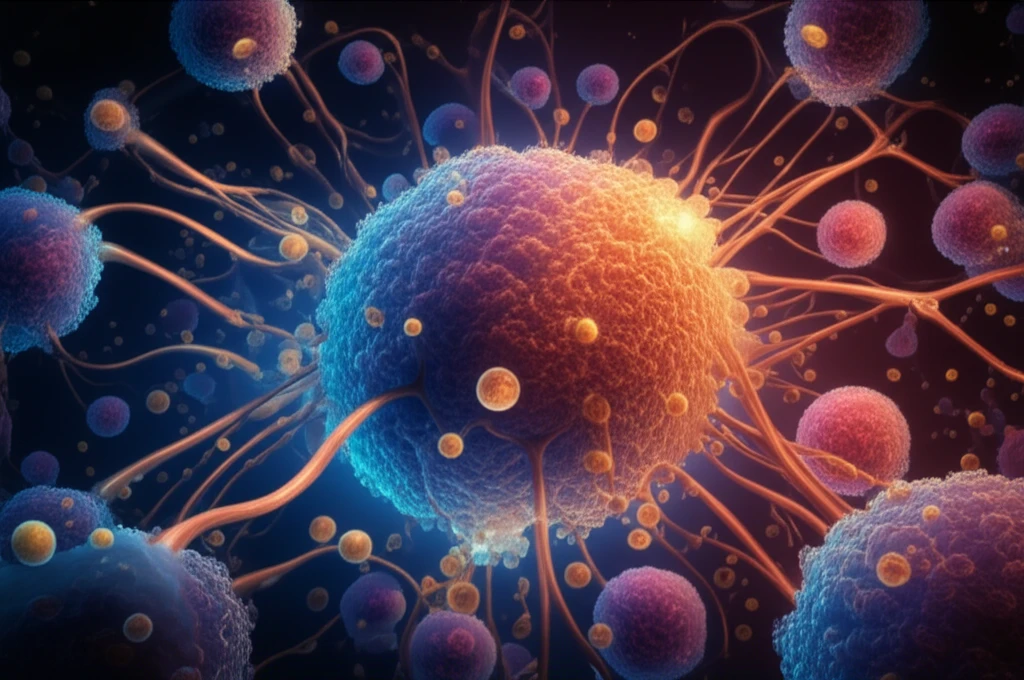
Illustration of a cell with a glowing (Pro)renin receptor at its core, representing the complexity of cellular function.

Decoding the Body's Secret Code: How a Tiny Receptor Could Unlock Big Health Secrets

"Unraveling the Mysteries of the (Pro)renin Receptor: A Journey into Cellular Secrets and Potential Health Breakthroughs"


Ever wonder how your body orchestrates its intricate functions? At the heart of this complexity lie tiny molecular machines, working tirelessly to keep you healthy. One such machine is the (Pro)renin receptor, a protein that scientists are now realizing plays a far more significant role than previously imagined. This article dives into the world of this fascinating receptor, exploring its surprising functions and potential impact on our health.

Initially, the (Pro)renin receptor was thought to be primarily involved in regulating blood pressure. However, recent research paints a much more complex picture. Scientists are uncovering the receptor's involvement in various cellular processes, from intracellular communication to vesicle trafficking. This expanded understanding opens up exciting new possibilities for treating diseases and enhancing overall wellness.

Prepare to embark on a journey through the latest scientific findings, exploring the (Pro)renin receptor's functions and its implications for conditions such as heart disease and kidney disorders. This article aims to translate complex research into an easily digestible format, offering insights into potential health benefits and providing a fresh perspective on this intriguing area of medical science. Let's decode the secrets of this tiny receptor and its vast potential.

Unveiling the (Pro)renin Receptor: Beyond Blood Pressure

Illustration of a cell with a glowing (Pro)renin receptor at its core, representing the complexity of cellular function.

The (Pro)renin receptor, often abbreviated as (P)RR, was first identified in the 1990s. Early research focused on its role in the renin-angiotensin system (RAS), a critical regulator of blood pressure. The receptor was believed to primarily mediate the effects of renin, an enzyme that helps control blood pressure. However, the scientific community's understanding of (P)RR has drastically evolved over the years.

Scientists now recognize that (P)RR has a much broader role within the body. It's not just about blood pressure anymore. Research suggests that (P)RR may be involved in a range of fundamental cellular processes. Scientists have discovered it in unexpected locations within cells and are exploring its involvement in vesicle trafficking – the movement of cellular materials – and intracellular signaling pathways, indicating its importance extends far beyond its initial classification.

  • Cellular Communication: (P)RR appears to play a role in cell-to-cell communication pathways, affecting how cells interact with each other.
  • Vesicle Trafficking: The receptor is involved in the movement of molecules and materials within cells, a process essential for cellular function.
  • Wnt Signaling: Recent studies show it interacts with the Wnt signaling pathway, which is crucial for cell development and tissue repair.
This expanded understanding opens new avenues for exploring its potential in treating various diseases. As researchers continue to delve deeper into (P)RR's functions, they hope to unlock its full potential for promoting health and well-being. This means (P)RR might be important in more conditions than just blood pressure, and that it is likely a lot more important than we initially thought.

The Future of (P)RR Research: A New Era of Possibilities

As we conclude our exploration of the (Pro)renin receptor, it's clear that this tiny protein holds immense promise for the future of medicine. The more we understand about (P)RR and its multifaceted roles, the closer we get to developing new therapies for a range of health conditions. Further research will continue to unveil the full potential of (P)RR, paving the way for a healthier future for all. The discovery of (P)RR and its importance is a great example of how even a small piece of the puzzle can lead to amazing advancements.

About this Article -

This article was crafted using a human-AI hybrid and collaborative approach. AI assisted our team with initial drafting, research insights, identifying key questions, and image generation. Our human editors guided topic selection, defined the angle, structured the content, ensured factual accuracy and relevance, refined the tone, and conducted thorough editing to deliver helpful, high-quality information.See our About page for more information.

Everything You Need To Know

1

What is the (Pro)renin receptor, and why is it important for understanding our health?

The (Pro)renin receptor, often abbreviated as (P)RR, is a protein in the body that scientists initially believed was primarily involved in regulating blood pressure through the renin-angiotensin system (RAS). However, research has revealed that (P)RR has a much broader role than previously imagined, impacting cellular communication, vesicle trafficking, and interacting with the Wnt signaling pathway. This expanded understanding of (P)RR's functions opens up new possibilities for treating various diseases and enhancing overall wellness. While the article doesn't delve into the specific molecular structure or the exact binding mechanisms of (P)RR, its importance lies in its potential as a therapeutic target for a range of health conditions.

2

Beyond blood pressure regulation, what other cellular processes is the (Pro)renin receptor involved in?

Beyond its initial association with blood pressure regulation through the renin-angiotensin system (RAS), the (Pro)renin receptor ((P)RR) is now understood to participate in several key cellular processes. These include cellular communication, affecting how cells interact with each other, vesicle trafficking, which involves the movement of molecules and materials within cells, and interaction with the Wnt signaling pathway, which is crucial for cell development and tissue repair. The specific mechanisms and the extent of its involvement in each of these processes are still under investigation, but the current findings suggest that (P)RR plays a more fundamental and versatile role in cellular function than previously thought. The research has not fully elucidated all the downstream effects of (P)RR activation or inhibition within these pathways.

3

How was the (Pro)renin receptor discovered and how has its understood function evolved over time?

The (Pro)renin receptor ((P)RR) was first identified in the 1990s, with initial research primarily focused on its role in the renin-angiotensin system (RAS) and its effects on blood pressure. At that time, it was believed that (P)RR mainly mediated the effects of renin, an enzyme that helps control blood pressure. However, as research progressed, scientists began to uncover that (P)RR had a much broader function within the body, extending beyond blood pressure regulation. It is now known that (P)RR is involved in various cellular processes like intracellular communication, vesicle trafficking, and interacting with the Wnt signaling pathway. This evolution in understanding highlights the complexity of biological systems and how initial discoveries can lead to further, more comprehensive insights. The exact triggers and modulators of (P)RR expression are still areas of active research.

4

What potential health conditions might be treatable by targeting the (Pro)renin receptor, and what challenges exist in developing these treatments?

Given the (Pro)renin receptor's ((P)RR) involvement in various cellular processes beyond blood pressure regulation, it could potentially be a therapeutic target for a range of health conditions. The article mentions heart disease and kidney disorders as examples where (P)RR might play a significant role. Developing treatments targeting (P)RR presents several challenges, including the need for a more comprehensive understanding of its multifaceted roles and precise mechanisms in different tissues and cell types. It also needs to be understood what the long-term effects of manipulating (P)RR activity may cause. Specific drugs or therapies targeting (P)RR are not mentioned, reflecting the early stage of this research area. Future research needs to address the specificity of targeting (P)RR to avoid unintended effects on other pathways and processes.

5

How does the (Pro)renin receptor interact with the Wnt signaling pathway, and why is this interaction significant for potential therapeutic applications?

The (Pro)renin receptor ((P)RR) interacts with the Wnt signaling pathway, which is crucial for cell development and tissue repair. While the article doesn't specify the precise mechanism of this interaction, it implies that (P)RR can influence the Wnt pathway's activity. This is significant because the Wnt pathway plays a vital role in various physiological processes, including embryonic development, stem cell maintenance, and tissue regeneration. Dysregulation of the Wnt pathway is implicated in various diseases, including cancer and degenerative disorders. Therefore, by modulating the Wnt pathway through (P)RR, it might be possible to develop therapies that promote tissue repair, prevent disease progression, or even reverse damage caused by certain conditions. More research is needed to fully elucidate the nature and consequences of this interaction and to determine how it can be targeted safely and effectively for therapeutic purposes. Details of the specific molecules involved in (P)RR and Wnt pathway interaction are not mentioned.

Newsletter Subscribe

Subscribe to get the latest articles and insights directly in your inbox.