
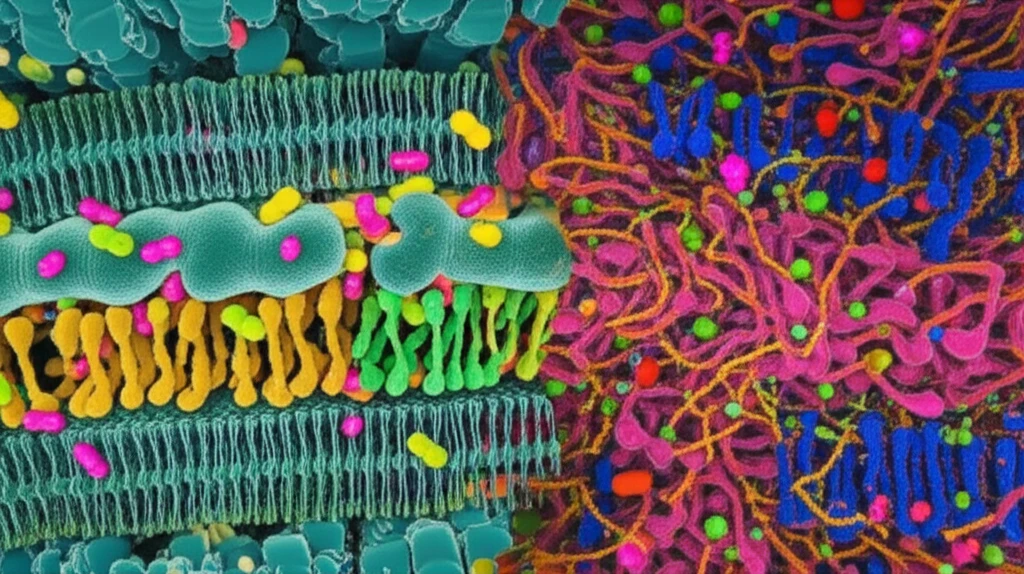
Illustration of a bacterial cell membrane comparing healthy and disrupted states due to the absence of SigX.

Decoding the Bacterial Bodyguard: How SigX Impacts Metabolism and Health

"New research unveils the crucial role of SigX in maintaining bacterial membrane health, potentially impacting how we fight infections."


Bacteria, like any living organism, need to adapt to their environment to survive. Pseudomonas aeruginosa, a common bacterium that can cause serious infections, is particularly good at this. It boasts a complex regulatory system that allows it to thrive in various conditions, even those that are harsh or nutrient-poor.

Among the key players in this adaptability are sigma factors, which are proteins that control gene expression. One such sigma factor, called SigX, has been found to play a crucial role in maintaining the integrity of the bacterial cell membrane. New research sheds light on exactly how SigX does this, revealing its impact on bacterial metabolism and opening potential new avenues for fighting bacterial infections.

This article will explore the findings of a recent scientific study that investigated the role of SigX in Pseudomonas aeruginosa. We'll break down the complex science and explain how SigX influences the bacterium's metabolism and membrane fluidity, and why this is important for human health.

SigX: The Membrane's Gatekeeper and Metabolism's Conductor

Illustration of a bacterial cell membrane comparing healthy and disrupted states due to the absence of SigX.

The research team discovered that when SigX is absent, Pseudomonas aeruginosa struggles to regulate genes involved in essential processes like nutrient transport and energy production. Many of these genes are typically controlled by a system called carbon catabolite repression (CCR), which ensures the bacteria use their preferred food sources first. Without SigX, this system goes haywire.

Think of CCR as a traffic controller for the cell's metabolism. When it's functioning correctly, the cell efficiently uses its resources. But without SigX, the traffic signals are broken, leading to metabolic chaos. This disruption particularly affects the bacterium's ability to take up nutrients effectively.

Here's a breakdown of SigX's key roles:
  • Regulating Nutrient Transport: SigX helps control the expression of genes responsible for bringing nutrients into the cell. Without it, the cell struggles to take up essential resources.
  • Managing Energy Production: SigX influences genes involved in energy metabolism, ensuring the cell has the fuel it needs to function.
  • Maintaining Membrane Fluidity: SigX plays a role in keeping the cell membrane at the right consistency. This is vital for proper cell function and nutrient uptake.
To confirm their findings, the researchers used a detergent called polysorbate 80 (PS80). This substance can temporarily loosen the bacterial envelope, allowing for increased nutrient intake. Remarkably, when they added PS80 to the growth medium of bacteria lacking SigX, it restored growth, membrane fluidity, and the expression of the previously dysregulated genes. This suggests that SigX indirectly affects CCR regulation by influencing membrane integrity and fluidity.

A New Target for Fighting Infection?

The discovery that SigX influences both metabolism and membrane health makes it a potential target for new antibacterial strategies. By disrupting SigX's function, scientists may be able to weaken bacteria, making them more vulnerable to existing antibiotics or the body's immune system.

However, it's important to remember that this research is still in its early stages. More studies are needed to fully understand the role of SigX and how it can be effectively targeted without harming the host.

Nevertheless, this research provides a valuable insight into the complex workings of bacterial cells and highlights the importance of understanding fundamental biological processes in the fight against infectious diseases. As antibiotic resistance continues to grow, new approaches like targeting SigX are crucial in the search for effective treatments.

About this Article -

This article was crafted using a human-AI hybrid and collaborative approach. AI assisted our team with initial drafting, research insights, identifying key questions, and image generation. Our human editors guided topic selection, defined the angle, structured the content, ensured factual accuracy and relevance, refined the tone, and conducted thorough editing to deliver helpful, high-quality information.See our About page for more information.

This article is based on research published under:

DOI-LINK: 10.1038/s41598-018-35503-3, Alternate LINK

Title: The Absence Of Sigx Results In Impaired Carbon Metabolism And Membrane Fluidity In Pseudomonas Aeruginosa

Subject: Multidisciplinary

Journal: Scientific Reports

Publisher: Springer Science and Business Media LLC

Authors: Maud Fléchard, Rachel Duchesne, Ali Tahrioui, Emeline Bouffartigues, Ségolène Depayras, Julie Hardouin, Coralie Lagy, Olivier Maillot, Damien Tortuel, Cecil Onyedikachi Azuama, Thomas Clamens, Cécile Duclairoir-Poc, Manuella Catel-Ferreira, Gwendoline Gicquel, Marc G. J. Feuilloley, Olivier Lesouhaitier, Hermann J. Heipieper, Marie-Christine Groleau, Éric Déziel, Pierre Cornelis, Sylvie Chevalier

Published: 2018-11-21

Everything You Need To Know

1

What exactly is SigX and what does it do?

SigX is a protein, a specific sigma factor, within the bacterium Pseudomonas aeruginosa. It's a key player in maintaining the integrity of the bacterial cell membrane. This is critical for the bacterium's survival because the membrane controls what enters and exits the cell, directly influencing its metabolism.

2

How does SigX impact bacterial metabolism?

The primary role of SigX is to ensure the proper functioning of essential processes like nutrient transport and energy production within Pseudomonas aeruginosa. Without SigX, the bacterium struggles to regulate genes involved in these processes. Specifically, SigX influences a system called carbon catabolite repression (CCR), which acts as a metabolic traffic controller within the cell. When SigX is absent, CCR becomes dysregulated, leading to metabolic chaos. This negatively impacts the bacterium's ability to effectively take up nutrients and produce energy.

3

What is the relationship between SigX and the cell membrane's fluidity?

The connection between SigX and membrane fluidity is crucial. SigX plays a role in maintaining the cell membrane at the right consistency. The cell membrane's fluidity affects nutrient uptake and overall cell function. When SigX is absent, the membrane's fluidity can be compromised. Polysorbate 80 (PS80), a detergent, can restore the membrane fluidity in bacteria lacking SigX, suggesting that SigX indirectly affects CCR regulation by influencing membrane integrity.

4

Why is understanding SigX's role important for human health?

The potential implications of understanding SigX's function are significant for human health. By targeting SigX, scientists may be able to weaken bacteria like Pseudomonas aeruginosa, making them more susceptible to existing antibiotics or the body's immune system. This could lead to the development of new antibacterial strategies to combat infections, given the importance of Pseudomonas aeruginosa as a cause of serious infections.

5

How does Polysorbate 80 (PS80) help in understanding SigX's function?

Polysorbate 80 (PS80) is a detergent used by researchers to study the effects of SigX on the bacterium Pseudomonas aeruginosa. PS80 can temporarily loosen the bacterial envelope, which allows for increased nutrient intake. By adding PS80 to bacteria lacking SigX, researchers observed restored growth, membrane fluidity, and the expression of previously dysregulated genes. This experiment helped confirm the role of SigX in maintaining membrane integrity and its influence on nutrient transport and metabolism. This suggests that SigX indirectly affects CCR regulation by influencing membrane integrity and fluidity. This is important because it provides more insight into the complex relationship between SigX, the bacterial membrane, and bacterial survival.

Newsletter Subscribe

Subscribe to get the latest articles and insights directly in your inbox.