
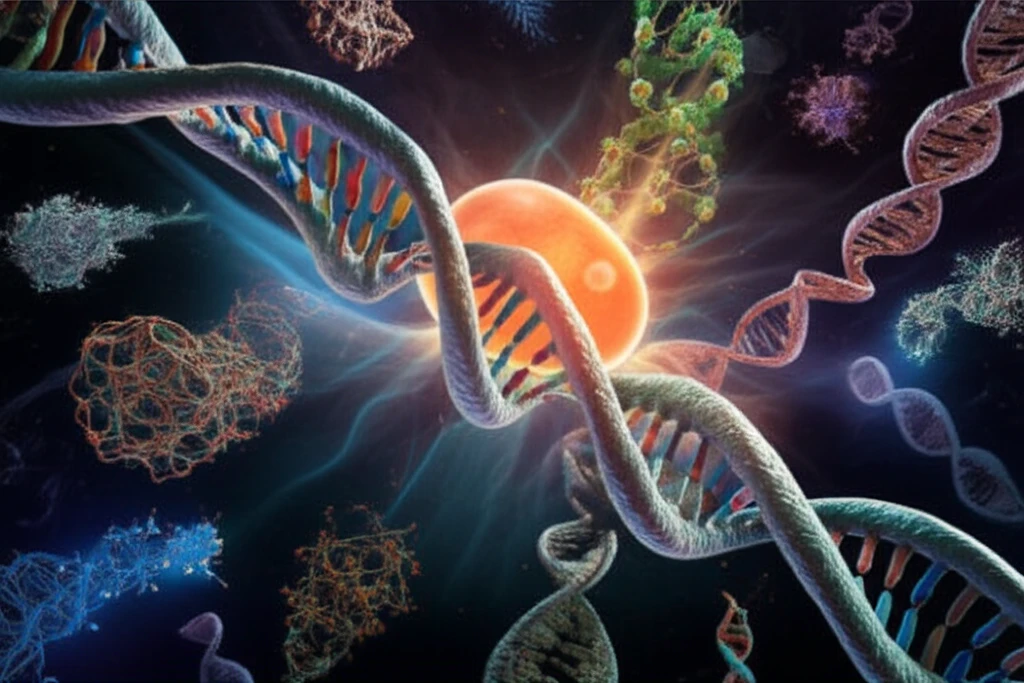
3D rendering of DNA folding within a cell nucleus.

Decoding the 3D Genome: How Our DNA Organizes Itself

"Unraveling the organizational principles behind our 3D genome could revolutionize how we understand gene expression and its impact on health."


Our genetic material, DNA, isn't just a long, linear sequence; it's meticulously folded and arranged within the nucleus of each cell. This three-dimensional organization, or 3D genome architecture, plays a crucial role in how our genes are expressed and regulated. Think of it as a highly organized library, where the location of each book (gene) determines how easily it can be accessed and read.

For years, scientists have been working to understand the organizational principles behind this complex architecture. Early studies suggested a hierarchical model, with chromosomes neatly divided into compartments and smaller domains called topologically associating domains (TADs). However, recent research is challenging these established ideas, revealing a more dynamic and interconnected view of the 3D genome.

The latest findings suggest that the 3D organization of our genome is an emergent property of chromatin and its components and may not be a determinant but a consequence of its function. Rather than a rigid, pre-determined structure, the 3D genome may be constantly adapting and responding to cellular needs.

Challenging the Traditional Model: Small Compartments and Dynamic Interactions

3D rendering of DNA folding within a cell nucleus.

Contact maps of Hi-C data provided the first genome-wide view of interactions between all sequences in the mammalian genome. The initial maps displayed a plaid pattern of chromatin interactions, suggesting the segregation of the genome into two compartments, named A and B. Sequences in the A compartment generally contain transcribed genes and active histone modifications, while the B compartment contains inactive genes with histone modifications associated with a transcriptionally repressed state.

As sequencing technologies advanced, Hi-C data sets became richer, allowing for the partitioning of data into smaller bins. This smaller bin size allowed the identification of topologically associating domains (TADs) as structures in the 0.2-1.0 Mb range. Whereas A and B compartments correspond to domains that interact preferentially with sequences in other A or B compartment regions, respectively, TADs correspond to sequences that interact preferentially with themselves rather than with other regions of the genome. TADs are separated by boundaries that are enriched in CTCF binding sites and highly transcribed genes.

  • Smaller Compartments: High-resolution Hi-C data suggests that compartments are smaller than previously thought, as small as a single active or inactive locus.
  • Transcriptional Influence: These smaller compartments, or compartmental domains, are likely formed by the segregation of active and inactive chromatin.
  • CTCF Loops: In addition to compartmental domains, CTCF loops contribute to genome organization, with CTCF binding sites often found at the boundaries of TADs.
The close correlation between A and B compartmental domains and the transcriptionally active or inactive state of chromatin suggests a possible causal relationship between the two. Indeed, the correspondence between 3D chromatin organization and transcriptional state is sufficiently precise to accurately predict Hi-C maps in many different organisms using global run-on sequencing (GRO-seq), RNA sequencing (RNA-seq) or histone modifications.

Looking Ahead: New Technologies and Future Directions

The latest research underscores that the genomes of all organisms examined to date are organized into compartmental domains. In vertebrates, an additional level of organization is established as a result of the extrusion process mediated by cohesin and perhaps also condensin. Understanding how these processes interact and influence gene expression will be a crucial step forward. Technical innovations such as shrinking genome organization, visualizing loop extrusion, and population versus single-cell chromatin organization are key to moving the field forward.

About this Article -

This article was crafted using a human-AI hybrid and collaborative approach. AI assisted our team with initial drafting, research insights, identifying key questions, and image generation. Our human editors guided topic selection, defined the angle, structured the content, ensured factual accuracy and relevance, refined the tone, and conducted thorough editing to deliver helpful, high-quality information.See our About page for more information.

This article is based on research published under:

DOI-LINK: 10.1038/s41576-018-0060-8, Alternate LINK

Title: Organizational Principles Of 3D Genome Architecture

Subject: Genetics (clinical)

Journal: Nature Reviews Genetics

Publisher: Springer Science and Business Media LLC

Authors: M. Jordan Rowley, Victor G. Corces

Published: 2018-10-26

Everything You Need To Know

1

What is the 3D genome architecture, and why is it important?

The 3D genome architecture is the three-dimensional organization of DNA within the cell's nucleus. It's not just a linear sequence but a complex, folded structure. Its significance lies in its role in gene expression and regulation. It acts like an organized library, where the location of a gene determines its accessibility for reading. Understanding this architecture is crucial for understanding how genes are turned on or off, impacting cellular function and health.

2

How is the 3D genome organized, according to early models?

Early models suggested a hierarchical structure with chromosomes divided into compartments and smaller structures known as Topologically Associating Domains (TADs). Compartments are larger regions, like A and B compartments, which are separated by their activity levels. A compartments contain active genes and B compartments contain inactive genes. TADs are smaller domains where DNA sequences interact more frequently with each other than with sequences outside the TAD. They are often bordered by CTCF binding sites and highly transcribed genes.

3

How does the latest research challenge the traditional view of the 3D genome?

The latest research indicates that the 3D genome organization may be an emergent property of chromatin and its components. It's a consequence of its function rather than a rigid structure. This means the 3D genome is dynamic, constantly changing and adapting to the cell's needs. Smaller compartmental domains, as small as a single active or inactive locus, are formed by the segregation of active and inactive chromatin.

4

How does Hi-C data help us understand the 3D genome?

Hi-C data provides genome-wide views of interactions between DNA sequences, resulting in contact maps. The initial maps revealed a plaid pattern, highlighting the segregation of the genome into A and B compartments. These compartments correlate with gene activity. Active genes are in A compartments, while inactive genes are in B compartments. As resolution improved, Topologically Associating Domains (TADs) were identified, representing regions that interact preferentially with themselves. These domains are separated by boundaries enriched with CTCF binding sites and highly transcribed genes.

5

What are the future directions in the study of the 3D genome?

New technologies like shrinking genome organization and visualizing loop extrusion are driving advancements. The genomes of all organisms are organized into compartmental domains. In vertebrates, cohesin and condensin mediate an additional level of organization, which affects gene expression. Understanding how these processes interact will be critical. Analyzing chromatin organization at the single-cell level will also lead to new insights, helping to understand the heterogeneity and dynamics of the 3D genome in different cells and conditions.

Newsletter Subscribe

Subscribe to get the latest articles and insights directly in your inbox.