
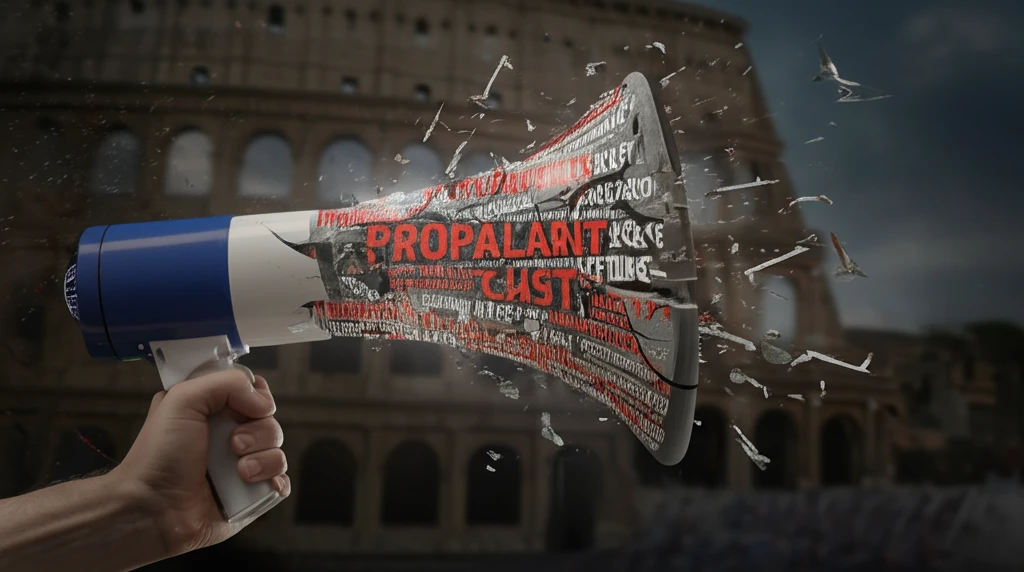
Decoding Terror: What the Red Brigades' Propaganda Reveals About Political Violence

"A Deep Dive into the Language and Strategies of a Notorious Terrorist Group"
In an era saturated with information, understanding the power of propaganda—especially when linked to violence—is more critical than ever. The Red Brigades (BR), an Italian terrorist organization active from the 1970s to the late 1980s, provides a stark case study. By meticulously analyzing their communiqués, we can dissect the anatomy of their messaging, revealing how they justified violence, mobilized support, and ultimately, shaped their own narrative.
This article delves into the linguistic and rhetorical strategies employed by the Red Brigades, drawing from a comprehensive study of 181 of their communiqués. The goal is to illuminate how terrorist groups use language not just to communicate, but to manipulate, recruit, and legitimize their actions. Understanding these methods is crucial for countering extremist ideologies and building resilience against radicalization.
We will explore the evolution of the Red Brigades' propaganda, its key themes, and its targets. By examining their rhetoric, we can gain insights into the mindset of a terrorist organization and the dangerous power of words to incite violence.
Scale and Violence
The Red Brigades was the largest left-wing terrorist organization in Italy, with 400 to 500 full-time members during its active years from 1970 to the early 1980s. The group carried out kidnappings, murders, and sabotage, including the June 1974 killing of two members of the neo-fascist Movimento Sociale Italiano during a raid on their Padua headquarters. Their self-proclaimed aim was to undermine the Italian state and pave the way for a Marxist upheaval led by a revolutionary proletariat. The Brigades' violent trajectory defined Italy's Years of Lead, leaving a lasting imprint on the country's political landscape.
Methodological Notes
Scholarly analysis of the Red Brigades typically relies on historical case study methods, drawing on communiqués, court records, and participant accounts to reconstruct the group's evolution. These approaches face inherent limitations: primary sources from clandestine organizations are fragmentary and often self-serving, while state counterterrorism archives may remain classified or selectively released. Comparative frameworks help contextualize the Italian experience but risk flattening distinct national dynamics. Researchers must therefore triangulate cautiously, acknowledging gaps where evidence is thin or contested.
Origins and Ideology
The Red Brigades emerged in 1970, founded by former students and factory workers who had abandoned the official Italian Communist Party, claiming to follow a pure Marxist-Leninist doctrine in which a small revolutionary vanguard would inspire mass worker uprisings through attacks on the political structure. Since World War II, the Italian Communist Party had been a potent political force, but the Brigades rejected its parliamentary path as betrayal. The group gained notoriety throughout the 1970s for kidnappings, murders, and sabotage, explicitly seeking to undermine the Italian state and trigger a revolutionary upheaval. Their formation reflected a broader rupture on the Italian left, where extra-parliamentary militancy filled a vacuum left by institutional compromise.
The Evolution of Terrorist Messaging: Key Propaganda Techniques of the Red Brigades
The Red Brigades' propaganda evolved through distinct phases, mirroring their strategic shifts and internal developments. Initially, their communiqués were characterized by raw, spontaneous language, filled with insults and direct threats. This "armed propaganda" phase aimed to intimidate opponents and recruit new members by showcasing their defiance.
- Anti-Fascism: Initially a core theme, the BR used 'fascism' as a broad label for anyone they opposed, from factory managers to the government. This created a sense of historical struggle and righteous indignation.
- Repression as Justification: The BR portrayed themselves as victims of state and corporate repression, framing their violence as self-defense. This narrative aimed to garner sympathy and legitimacy among the working class.
- Resistance Movement: Drawing parallels to historical resistance movements, like those against the Nazis, the BR sought to position themselves as heroic fighters against oppression. This was more of a symbolic comparison as they were not directly connected.
- Attack the Heart of the State: This later phase marked a shift towards direct attacks on the government and its representatives, signaling a more aggressive and uncompromising stance.
Recent Scholarship
Contemporary research on the Red Brigades continues to refine understanding of the group's internal dynamics, propaganda strategies, and state responses, though much work remains synthetic rather than archival. Scholars increasingly emphasize the communicative dimension of the Brigades' violence — how communiqués and symbolic targeting functioned as political theater. Newer studies also revisit the relationship between the organization and broader social movements, probing the porous boundaries between activism and armed struggle. Gaps persist in accessing sealed judicial files and in integrating local-level analyses with national narratives.
Dynamics of Decline
The rise and fall of the Red Brigades is widely treated as a classic case study for understanding the lifecycle of a political terrorist organization. Analysis of their propaganda reveals an evolving communication strategy that shifted in tone, targets, and rhetorical framing as state pressure mounted and internal fractures deepened. The group's failure to catalyze the mass uprising it anticipated — and its eventual fragmentation into competing factions — underscores the strategic limits of vanguardist violence in an advanced industrial democracy. These patterns offer cautionary insight into the self-defeating logic of terrorist escalation.
Transnational Parallels
The Red Brigades and West Germany's Red Army Faction emerged simultaneously in 1970, both rooted in left-wing revolutionary ideology and both operating within Western Europe's democratic states. Unlike transnational terrorist networks, neither group crossed national borders, involved foreign perpetrators, or targeted international entities — they were distinctly domestic in scope. Comparative studies highlight shared features: student-worker origins, Marxist-Leninist framing, symbolic targeting of state and capitalist figures, and ultimate isolation from the constituencies they claimed to represent. The parallel trajectories suggest structural conditions — economic crisis, generational rupture, institutional illegitimacy — that enabled left-wing militancy across Europe's 1970s.
Lessons from the Red Brigades: Countering Violent Extremism Today
The Red Brigades may be a group from the past, but their propaganda techniques remain relevant in understanding contemporary extremism. By analyzing their use of language, their manipulation of narratives, and their targeting of specific groups, we can better equip ourselves to identify and counter similar tactics used by terrorist organizations today. Promoting media literacy, critical thinking, and inclusive narratives are essential steps in building resilience against violent ideologies and fostering a more peaceful society.
Propaganda as Data
The most systematic analysis of Red Brigades propaganda draws on 181 communiqués circulated between 1970 and 1988, spanning the organization's entire active lifespan. These texts reveal deliberate rhetorical strategies: legitimizing violence through historical analogy to the partisan resistance, constructing enemy categories through legalistic language, and staging the group as the authentic voice of the proletariat. After the armed conflict ended, imprisoned members reframed their participation as continuous with the anti-fascist partisan struggle, suggesting a persistent narrative architecture. The communiqués function not merely as claims of responsibility but as a sustained effort to shape political meaning.
Emerging Directions
Future research on the Red Brigades will likely benefit from progressive declassification of Italian state archives, enabling finer-grained analysis of intelligence operations, infiltration, and decision-making on both sides. Digital humanities methods — network analysis of militant trajectories, topic modeling of communiqués, geographic mapping of attacks — promise new patterns invisible to traditional close reading. Comparative work linking the Italian case to contemporary far-left and far-right radicalization could clarify enduring mechanisms of political violence. The field remains open for interdisciplinary synthesis connecting history, criminology, and communication studies.
Lessons for Global Counterterrorism
Scholars have explicitly sought to apply findings from the Red Brigades case to the fight against global terrorism, working from hypotheses about organizational lifecycle, state response efficacy, and the role of ideological narrative in mobilization and decline. The Italian experience — a democracy confronting an internal armed challenge without suspending constitutional order — offers a distinct model from wartime or authoritarian counterterrorism. Key transferable insights include the importance of delegitimizing terrorist narratives through legal process, the risks of overreaction that fuels recruitment, and the strategic value of encouraging factional splits. These lessons remain contested in contexts where state capacity and democratic legitimacy differ sharply from 1970s Italy.
Societal Consequences
The Red Brigades' trajectory represents a classic case study for understanding not only the internal dynamics of a terrorist organization but also its effects on society as a whole. Beyond the direct victims — kidnapped, murdered, injured — the Years of Lead eroded public trust, polarized political discourse, and triggered security legislation that reshaped Italian democracy. Families of militants and targets alike bore lasting trauma, while the cultural memory of the period continues to inform Italian politics. The human cost extends past body counts to the corrosion of civic fabric that ideological violence invariably produces.