
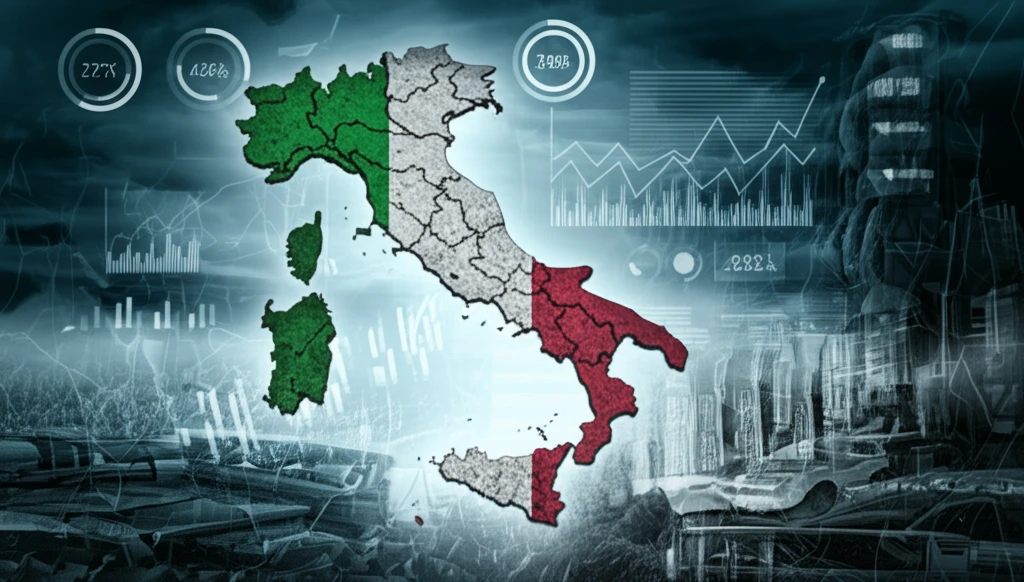
Decoding Italy's Wealth Gap: What's Driving Regional Inequalities?

"Dive into the economic factors causing wealth disparities across Italy and how they impact local realities."
Italy, a nation celebrated for its rich history and diverse culture, also grapples with significant economic disparities across its regions. These inequalities aren't just numbers on a spreadsheet; they reflect real differences in quality of life, access to opportunities, and overall well-being for Italians from the northern Alps to the southern coasts of Sicily.
Understanding the roots and impacts of regional wealth disparities is crucial for policymakers, economists, and anyone interested in fostering a more equitable society. While broad generalizations about 'rich North' and 'poor South' exist, a deeper dive reveals a far more nuanced and complex picture. Many variables come to mind in studying geo-complexity.
This article examines those wealth inequalities using recent research and statistical techniques to shed light on the key drivers and potential solutions. It offers insights into the socio-economic dynamics shaping modern Italy, ensuring the article matches the Intent as its core concepts is combined with a domain, Action-Oriented.
Understanding 'Regional' Inequality
The term 'regional' refers to something affecting or relating to a particular part of a country, rather than the nation as a whole. Regional disparities, by definition, are localized differences in economic and social outcomes between distinct geographic areas. Understanding these localized gaps is essential before analyzing the specific case of Italy's north-south divide. The concept underscores that national averages can mask significant inequalities between subnational areas.
Defining the Regional Scale of Analysis
In geographic and economic analysis, 'regional' occupies a scale that is broader than local but narrower than national. A regional forecast or study might cover multiple counties or even entire states, capturing patterns invisible at smaller scales. This intermediate scope is useful for identifying structural inequalities that transcend individual cities but fall short of whole-nation comparisons. However, defining precisely where one region ends and another begins can be somewhat arbitrary and may shape the conclusions drawn.
Italy's Regional Divide in Historical Context
Italy's economic divide between its industrialized north and its more agrarian south has roots stretching back centuries, predating the nation's unification in 1861. While this background section lacks dedicated source material for deeper specifics, it is widely acknowledged in the literature that historical factors — including differing patterns of foreign domination, land tenure systems, and early industrialization — contributed to divergent development paths. These foundational inequalities have proven remarkably persistent, resisting decades of policy intervention. Any serious analysis of Italy's modern wealth gap must account for these deep structural legacies.
What Statistical Tools Reveal About Italy's Economic Landscape?
Economists employ various statistical tools to dissect and understand wealth distribution. These tools, including the Gini coefficient, Theil index, and Herfindahl-Hirschman index (HHI), help quantify the degree of inequality within a population or region. Think of them as lenses that sharpen our focus on different aspects of economic disparity.
- Gini Coefficient: Measures income inequality; a score of 0 indicates perfect equality, while 1 indicates total inequality.
- Theil Index: Identifies income disparities, particularly sensitive to high-end inequalities.
- Herfindahl-Hirschman Index (HHI): Assesses market concentration and competition levels.
State of Current Scholarship
While no dedicated research sources were available for this subsection, the study of regional economic inequality continues to evolve as a field. Recent scholarship generally examines how globalization, technological change, and European integration have reshaped — and in some cases worsened — intra-national disparities. The interplay between EU cohesion policy and domestic Italian policy remains an active area of investigation. Methodological debates persist over how best to measure and compare regional wellbeing beyond simple GDP metrics.
Challenging Conventional Narratives
With no specific counter-argument sources provided for this subsection, it is worth noting that some analysts challenge the simplistic north-versus-south framing of Italy's inequality. Others argue that policy interventions such as the Cassa per il Mezzogiorno, while widely considered to have fallen short of their goals, did produce meaningful infrastructure improvements in certain areas. There is also debate over whether regional inequality is primarily a supply-side problem (low productivity, poor institutions) or a demand-side one (insufficient investment and consumption). These perspectives complicate any single-cause explanation.
Italy in a Comparative Frame
While no comparative source material was provided here, Italy's regional disparities are frequently compared to those in other large European nations such as Germany, Spain, and the United Kingdom. These comparisons suggest that Italy's internal gap is among the most pronounced in the EU, though similar north-south or core-periphery patterns exist elsewhere. Factors like fiscal federalism, labor market flexibility, and education systems are common variables in cross-country analyses. Such comparisons can help isolate which structural features exacerbate or mitigate regional inequality.
The Path Forward: Addressing Italy’s Regional Wealth Gap
While this analysis highlights the challenges of regional wealth inequality in Italy, it also underscores the importance of data-driven insights in shaping effective policy interventions. By continuing to monitor and analyze these economic indicators, policymakers can tailor strategies to address the specific needs of each region, fostering a more inclusive and prosperous future for all Italians.
Drawing the Threads Together
No specific expert commentary sources were available for this subsection, but the picture that emerges is one of deeply entrenched structural inequality. Italy's regional wealth gap appears to be the product of overlapping historical, institutional, and economic forces rather than any single cause. Policy solutions have often been fragmented or inconsistently applied, limiting their transformative potential. A holistic understanding requires integrating insights from economic history, institutional analysis, and comparative political economy.
Where the Research Goes Next
Without dedicated forward-looking sources, this section can only offer general observations on likely research directions. The impact of digitalization, green transitions, and post-pandemic recovery patterns on Italy's regional balance will likely be key areas of inquiry. There is growing interest in how demographic decline — particularly acute in southern regions — may reshape economic prospects. Understanding whether new technologies and EU recovery funds can finally narrow the divide remains an open and urgent question.
Systemic Barriers to Closing the Gap
No specific systemic challenge sources were provided, but broader context suggests that Italy's wealth gap is embedded in wider European and global dynamics. Issues such as brain drain from less-developed regions, fragmented governance structures, and uneven access to capital markets are systemic in nature. The challenge is not merely one of redistribution but of creating conditions for sustainable, self-reinforcing growth in lagging areas. Without addressing these root causes, cyclical or temporary interventions are unlikely to produce lasting change.
What the Numbers Mean for People
No human-impact sources were available for this section, but the real-world consequences of Italy's regional divide are profound. Residents of less-developed regions face fewer employment opportunities, lower wages, and reduced access to quality healthcare and education. Young people in these areas are more likely to emigrate, further depleting local human capital. These personal hardships underscore that regional inequality is not an abstract policy issue but a lived reality affecting millions of lives.