
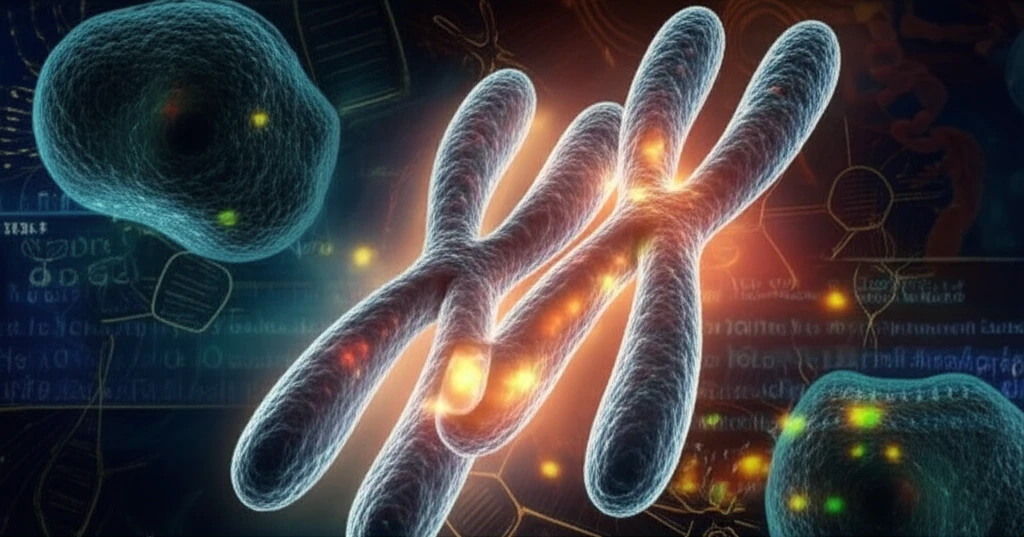
Chromosomes 8 and 16 intertwined, translocation t(8;16)(p11;p13)

Decoding t(8;16)(p11;p13): Understanding Leukemia Linked to Treatment

"A deep dive into the genetic anomaly t(8;16)(p11;p13), its causes, effects, and prognosis in treatment-related leukemia."


In the realm of cancer research, understanding the underlying genetic mechanisms of leukemia is crucial for developing effective treatments and improving patient outcomes. Among the various genetic anomalies associated with leukemia, chromosomal translocations play a significant role. One such translocation, t(8;16)(p11;p13), has garnered attention for its association with treatment-related leukemia, a secondary malignancy that arises as a consequence of prior cancer therapy.

The translocation t(8;16)(p11;p13) involves the exchange of genetic material between chromosomes 8 and 16 at specific locations, namely, bands p11 on chromosome 8 and p13 on chromosome 16. This translocation leads to the fusion of two genes, MOZ (MYST3 or KAT6A) on chromosome 8 and CBP (CREBBP) on chromosome 16, resulting in the formation of a hybrid MOZ-CBP fusion gene. The resulting aberrant protein disrupts normal cellular processes, driving leukemogenesis.

This article delves into the intricacies of t(8;16)(p11;p13), shedding light on its genetic origins, clinical implications, and prognostic outcomes in the context of treatment-related leukemia. By unraveling the complexities of this translocation, we aim to provide clinicians and researchers with a deeper understanding of this rare but clinically significant genetic anomaly.

What is the Significance of t(8;16)(p11;p13) in Leukemia?

Chromosomes 8 and 16 intertwined, translocation t(8;16)(p11;p13)

The translocation t(8;16)(p11;p13) is specifically associated with treatment-related myelodysplastic syndrome (t-MDS) and acute non-lymphocytic leukemia (t-ANLL). These secondary malignancies occur in patients who have previously undergone treatment for other cancers, such as solid tumors.

A study of nine cases of t-MDS/t-ANLL revealed that the translocation was more frequently associated with t-ANLL (8 cases) than with t-MDS progressing to ANLL (1 case). This suggests that t(8;16)(p11;p13) may play a more prominent role in the development of acute leukemia following cancer therapy.

  • Genetic Fusion: t(8;16)(p11;p13) results in the fusion of the MOZ and CBP genes.
  • Leukemia Subtypes: Predominantly found in treatment-related myelodysplastic syndrome (t-MDS) and acute non-lymphocytic leukemia (t-ANLL).
  • Age Factor: Affects individuals across a wide age range, from children to older adults.
The research indicated that the median age at diagnosis of the primary disease was 33 years (ranging from 6 to 70), while the median age at diagnosis of t-MDS/t-ANLL was 41 years (ranging from 7 to 71). The median interval between the primary disease diagnosis and the development of t-MDS/t-ANLL was 17 months (ranging from 13 to 202 months). Solid tumors were the primary disease in all nine cases. Treatments for the primary conditions varied, including radiotherapy, chemotherapy, or both. Topoisomerase II inhibitors and alkylating agents were commonly used in the treatment regimens.

What Does This Mean for Patients and Future Research?

In conclusion, the translocation t(8;16)(p11;p13) is a rare but significant genetic anomaly associated with treatment-related leukemia. Understanding its clinical and biological characteristics is crucial for improving the diagnosis, treatment, and prognosis of patients with this secondary malignancy. Further research is needed to unravel the precise mechanisms by which the MOZ-CBP fusion gene drives leukemogenesis and to develop targeted therapies that specifically disrupt the aberrant protein function.

About this Article -

This article was crafted using a human-AI hybrid and collaborative approach. AI assisted our team with initial drafting, research insights, identifying key questions, and image generation. Our human editors guided topic selection, defined the angle, structured the content, ensured factual accuracy and relevance, refined the tone, and conducted thorough editing to deliver helpful, high-quality information.See our About page for more information.

This article is based on research published under:

DOI-LINK: 10.4267/2042/38048, Alternate LINK

Title: T(8;16)(P11;P13) In Treatment Related Leukemia

Subject: Cancer Research

Journal: Atlas of Genetics and Cytogenetics in Oncology and Haematology

Publisher: INIST-CNRS

Authors: Jl Huret

Published: 2011-02-01

Everything You Need To Know

1

What exactly is the t(8;16)(p11;p13) translocation?

The translocation t(8;16)(p11;p13) is a genetic anomaly where parts of chromosomes 8 and 16 switch places at specific locations. This results in the fusion of the MOZ gene on chromosome 8 and the CBP gene on chromosome 16, creating the MOZ-CBP fusion gene. This abnormal gene disrupts normal cell functions and leads to the development of leukemia. Understanding this translocation is crucial because it's linked to treatment-related leukemia.

2

Why is the t(8;16)(p11;p13) translocation important in the context of leukemia?

The t(8;16)(p11;p13) translocation is clinically significant because it is specifically associated with treatment-related myelodysplastic syndrome (t-MDS) and acute non-lymphocytic leukemia (t-ANLL), which are cancers that arise after treatment for a previous cancer. Recognizing this translocation helps in diagnosing and understanding the prognosis of these secondary leukemias. This is very important, as treatment-related leukemia may require a different therapeutic approach compared to primary leukemia.

3

How does the MOZ-CBP fusion gene contribute to the development of leukemia?

The MOZ-CBP fusion gene, resulting from the t(8;16)(p11;p13) translocation, is a key driver in the development of leukemia. The fusion of the MOZ and CBP genes creates an abnormal protein that interferes with normal cellular processes, ultimately leading to uncontrolled growth of blood cells, which is characteristic of leukemia. The MOZ gene is involved in gene regulation, and CBP is an important regulator of transcription. This fusion disrupts normal gene expression and cellular differentiation.

4

What causes the t(8;16)(p11;p13) translocation to occur?

While the exact mechanisms are still under investigation, research suggests that prior cancer therapies, such as radiotherapy and chemotherapy (including topoisomerase II inhibitors and alkylating agents), can induce genetic changes that lead to the t(8;16)(p11;p13) translocation. These treatments can cause DNA damage, increasing the likelihood of chromosomal abnormalities like translocations. It is important to note that not everyone exposed to these treatments will develop this translocation; other genetic and environmental factors likely play a role.

5

What are the treatment options for leukemia associated with t(8;16)(p11;p13) and what future treatments are being researched?

Currently, treatment options for leukemia associated with t(8;16)(p11;p13) typically involve chemotherapy and stem cell transplantation. However, because the MOZ-CBP fusion protein plays a central role, future research is focused on developing targeted therapies that specifically disrupt the function of this aberrant protein. This approach aims to be more effective and less toxic than conventional chemotherapy. Further research is needed to identify specific drug targets and develop personalized treatment strategies for patients with this translocation.

Newsletter Subscribe

Subscribe to get the latest articles and insights directly in your inbox.