
Decoding Superbugs: How to Protect Yourself from Antibiotic-Resistant Infections

"A simple guide to understanding multidrug-resistant Enterobacteriaceae and what you can do to stay safe."
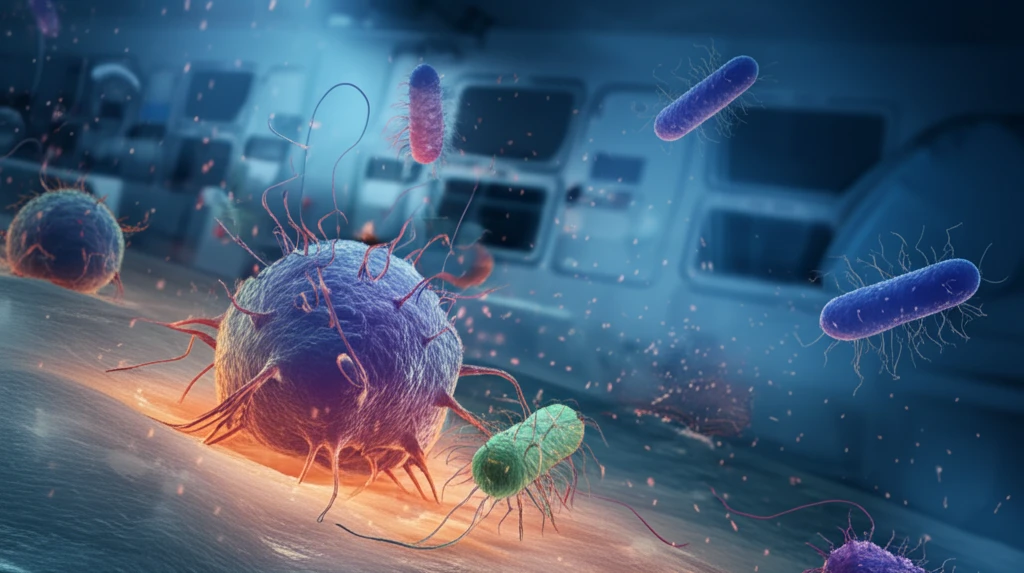
In a world increasingly threatened by antibiotic resistance, understanding how to protect ourselves from multidrug-resistant organisms is more critical than ever. Among these, Enterobacteriaceae, a common family of bacteria, have developed resistance to multiple drugs, posing a significant challenge to healthcare systems worldwide. These 'superbugs' are not just a concern for hospitals; they're a growing threat to public health.
Multidrug-resistant Enterobacteriaceae (MRE) are recognized as one of the most significant threats to human health globally. The prevalence of these bacteria, which resist many common antibiotics, is increasing, making infections harder to treat. This rise is fueled by factors like antibiotic overuse and the ease with which these bacteria can spread, particularly in hospital environments.
While the science behind antibiotic resistance can seem complex, understanding the basics can empower you to take meaningful steps to protect yourself and your community. This article breaks down the key information about MRE, offering practical advice and insights to help you navigate this growing health challenge.
A Growing Global Toll Measured by Surveillance
The World Health Organization's Global Antimicrobial Resistance and Use Surveillance System (GLASS) now provides a global analysis of antibiotic resistance, supporting countries in building national surveillance systems and generating standardized data to guide public health action. Independent data aggregation efforts note that statistics are compiled from peer-reviewed studies, official statistics, and recognized institutions, with some databases cross-referenced across at least two independent sources to verify figures. These reports also find that antibiotic resistance costs are soaring, but that better stewardship and regulation could cut misuse and reduce hospital impacts. Together, the sources point to both a worsening burden and measurable levers for intervention.
Standard Antibiotics, Phenotypic Testing, and the Limits of the Status Quo
Antibiotic resistance occurs when bacteria change and can resist the effects of an antibiotic, so the bacteria are not killed and continue to grow, producing infections known as resistant infections. Standard antibiotics often cannot kill these resistant bacteria, and many of these germs have already spread all over the world. While phenotypic methods remain the clinical standard for detecting resistance, their inherent limitations in speed and mechanistic resolution have driven the development of molecular-based approaches that directly target resistance determinants at the genetic level. Public health experts add that the rapid global spread of multidrug-resistant bacteria now causes infections that cannot be treated with current antimicrobials, making a One Health approach increasingly important.
From Battlefield Penicillin to a Race Against Resistance
The danger of antibiotic resistance became clear soon after the drugs became widely available. During World War II, British and American researchers figured out how to make enough penicillin to cure battlefield infections, ushering in the modern antibiotic era. Yet histories of the field emphasize that bacteria are able to develop resistance within a few years after the development of a new antibiotic. Bacteria can achieve this through mechanisms such as altering the target site for the antibiotic or producing enzymes that inactivate it, and these histories stress responsible use as essential to combating resistance.
Understanding the Threat: How Superbugs Spread
The gut flora, a complex community of microorganisms in our digestive system, serves as a primary reservoir for MRE, particularly in hospitalized individuals. This reservoir is dynamic, influenced by factors like exposure to antibiotics and other health conditions. While our bodies naturally work to restore balance, the presence of antibiotics can create an environment where resistant bacteria thrive.
- Inadequate hand hygiene among healthcare workers
- Contamination of surfaces and equipment
- Overuse of broad-spectrum antibiotics
- Close proximity of patients with weakened immune systems
New Tools and Renewed Calls for Stewardship
Recent research news includes an infrared-activated hydrogel that uses lysozyme 'nets' to combat resistant bacteria, an example of novel approaches being explored beyond traditional antibiotics. Aggregated research portals continue to catalog the latest published documents on antibiotic resistance, tracking hot topics, top authors, and the most cited documents in the field. Meanwhile, medical commentators note that the critical problem of antibiotic misuse and consequent resistance is well documented. They argue that healthcare providers, agricultural stakeholders, and pharmaceutical companies must work together to eliminate the threat of antibiotic resistance.
Resistance That Defies the Antibiotic Exposure Assumption
A key counterintuitive finding is that while antibiotic resistance traditionally develops from bacteria being exposed to an antibiotic, bacteria can acquire the NDM gene via a plasmid — or any other resistance gene — and become resistant without ever having encountered an antibiotic. This has contributed to 'nightmare' scenarios in U.S. hospitals, according to reporting from CIDRAP. Health experts clarify that antibiotic resistance occurs when bacteria gradually evolve to survive exposure to antibiotics, and although this resistance occurs naturally over time, the misuse and overuse of antibiotics in both humans and livestock have accelerated the process. Together these sources show that resistance is driven both by natural evolution and by human practices, with horizontal gene transfer enabling it to bypass the usual exposure pathway.
Comparing Environmental Drivers Beyond the Hospital
Antibiotic resistance is often associated with hospitals and the overuse of antibiotics in agriculture, but scientists are increasingly comparing other environmental drivers. One line of research reported a link between increases in local temperature and antibiotic resistance, challenging the assumption that repeated exposure through over-prescribing is the sole or primary cause. Separate new research suggests that droughts caused by climate change may also be worsening antibiotic resistance, a culprit that many people have not considered. Viewed together, these reports point to temperature and water stress as additional, under-appreciated environmental factors shaping resistance trends.
Staying Ahead of the Curve: Practical Steps for Prevention
While the challenge of antibiotic resistance is significant, there are concrete steps we can take to protect ourselves and our communities. The key is a multi-faceted approach that combines individual responsibility with systemic changes in healthcare and public health policy. By working together, we can slow the spread of superbugs and ensure a healthier future for everyone.
What Experts Say About the Burden and the Path Forward
Expert commentary highlights both the clinical and economic burden of bacterial antimicrobial resistance and reviews different approaches to fight it. Attention turned to the United States when scientists confirmed, for the first time in the U.S., a strain of E. coli resistant to colistin, the antibiotic of last resort; in an interview published in JAMA, expert Dr. Barbara Murray weighed in on the discovery. Genetic analyses have also shown that resistance traits such as fluoroquinolone resistance and ESBL production can be acquired by multiple sublineages of a single clone through independent genetic events, illustrating how complex the problem has become. Collectively, experts frame antibiotic resistance as a model problem whose impact spans clinical, economic, and societal dimensions.
Markets, Mechanisms, and 'Time-Travelling' Bugs
The antibiotic resistance market is experiencing dynamic growth driven by innovation and rising infection rates, with North America remaining the largest market for antibiotic resistance solutions amid substantial investment in research and development. Market analysts also note that the increasing prevalence of antibiotic-resistant bacteria poses a significant challenge to existing drug classes such as cephalosporins. On the science side, researchers describe how natural resistance may be intrinsic — always expressed in a species — or induced, where naturally occurring genes are only expressed to resistance levels after antibiotic exposure. Adding a striking frontier, soil bacteria collected in the 1960s and 70s have shown extreme resistance to six common antibiotics including ciprofloxacin, which was not sold until 1989, suggesting resistance can predate the drugs that fight it.
Beyond the Hospital: Water Systems and Prescribing Habits
Efforts to tackle antibiotic resistance have largely focused on hospitals and clinics, where antibiotic use is highest and resistant infections often emerge, but the problem is not confined to healthcare settings. A study reports that antibiotic resistance is spreading through South Africa's water systems, expanding the map of where resistant bacteria can be found. Médecins Sans Frontières has worked on antibiotic resistance since 2015 in collaboration with the Ministry of Health in West Bengal, India, where a baseline audit of district hospital doctors' prescribing practices revealed the scale of the stewardship challenge in routine care. These examples show that containing resistance requires action across healthcare systems, environmental monitoring, and prescribing practice.
Climate, Pollution, and Hidden Health Costs
Beyond the clinical setting, researchers report that the past eight decades of the Earth's warming climate were strongly linked to a 10% increase in the quantity of Salmonella strains carrying antimicrobial resistance genes worldwide. Air pollution has also been implicated: researchers' calculations indicate that in 2018 alone, approximately 480,000 premature deaths were linked to antibiotic-resistant cases caused by air pollution. Some analyses argue that deaths from superbugs are just a small part of the story, with links being drawn between antibiotic overuse and the epidemic of chronic diseases such as cancer and diabetes, and with resistance affecting human, wildlife, and environmental sectors alike. These reports together emphasize that the burden of resistance extends far beyond treated patients to encompass climate, pollution, and ecosystem health.