
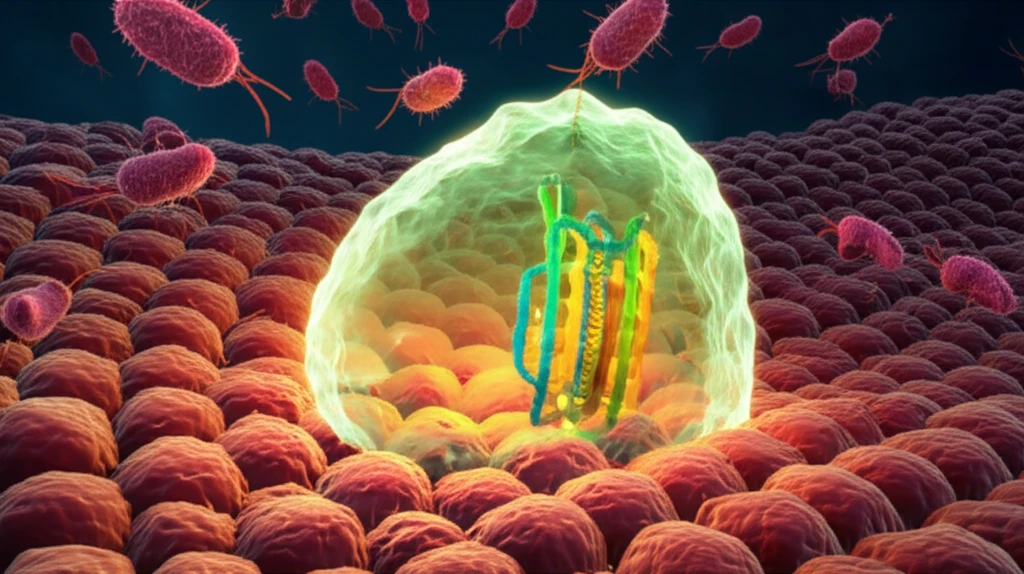
Silkworm cell membrane defended by Bmtutl-519 protein against parasites.

Decoding Silkworm Immunity: How a Key Protein Battles Microscopic Parasites

"Unraveling the mysteries of Bmtutl-519 and its crucial role in defending silkworm cells against Nosema bombycis infections."


For centuries, silkworms (Bombyx mori) have been prized for their silk production, a cornerstone of global textiles. However, these delicate creatures are susceptible to Pébrine disease, caused by the microsporidian parasite Nosema bombycis. This devastating disease, transmitted both vertically and horizontally, poses a significant threat to the silk industry, causing substantial economic losses.

Understanding the intricate dance between the parasite and its host is paramount to developing effective strategies against Pébrine disease. The initial interaction dictates whether the parasite can establish itself and cause infection, triggering a complex interplay of attack and defense mechanisms. Among the key players in this molecular battlefield are the surface proteins of both the parasite and the host.

Recent research has illuminated the critical role of a silkworm protein, Bmtutl-519, in the fight against Nosema bombycis. This protein, an isoform of Bombyx Turtle and a member of the immunoglobulin superfamily, experiences a significant surge in expression when silkworm cells are infected. This article will delve into the function of Bmtutl-519, exploring its interactions with the parasite and its impact on the infection process, offering insights into novel approaches for combating parasitic infections.

Bmtutl-519: A Cellular Gatekeeper in Silkworm Defense?

Silkworm cell membrane defended by Bmtutl-519 protein against parasites.

Researchers have discovered that Bmtutl-519 isn't confined to a single location within the silkworm cell. Instead, it strategically positions itself in both the cytoplasm and the cell membrane of BmN cells. This dual location suggests that Bmtutl-519 might act as a crucial cell surface receptor, directly interacting with the parasite, or as a regulatory factor, orchestrating the cellular defense response.

To understand how Bmtutl-519 functions, scientists investigated its interactions with NbSWP26, a spore wall protein of Nosema bombycis known to be involved in attaching to and infecting host cells. The findings revealed a critical piece of the puzzle: the C-terminal heparin-binding motif (HBM) of NbSWP26 acts as the key that unlocks the interaction with Bmtutl-519.

  • HBM's Role: This motif, typically involved in protein-heparin interactions, is essential for NbSWP26 to bind to Bmtutl-519.
  • Mutation Impact: When researchers altered the HBM in NbSWP26, mutating specific lysine residues to glycine, the protein lost its ability to connect with Bmtutl-519.
  • Binding Boost: Bmtutl-519 enhances the ability of N. bombycis to attach to the surface of the host cell.
While Bmtutl-519 enhances the initial attachment of the parasite to the cell, surprisingly, it doesn't facilitate the parasite's entry into the cell. In fact, sustained high levels of Bmtutl-519 within BmN cells appear to inhibit the proliferation of Nosema bombycis spores. This suggests a complex role for Bmtutl-519, acting as an initial alarm signal that, when prolonged, ultimately hinders the parasite's ability to multiply and spread.

Future Directions: Unraveling the Full Potential of Bmtutl-519

This research sheds light on the intricate mechanisms silkworms employ to defend against parasitic attacks. Bmtutl-519 emerges as a key player, orchestrating a complex response that involves both enhancing initial parasite attachment and, ultimately, limiting its proliferation. The discovery of the interaction between Bmtutl-519 and NbSWP26, mediated by the HBM motif, provides a crucial target for future interventions.

Further research is needed to fully elucidate the precise mechanisms by which Bmtutl-519 inhibits parasite proliferation. Understanding these mechanisms could pave the way for developing novel strategies to combat Pébrine disease and protect silkworm populations.

Ultimately, this research contributes to a deeper understanding of invertebrate immunity and highlights the potential for harnessing natural defense mechanisms to combat parasitic infections, offering promise not only for silkworm protection but potentially for broader applications in disease control.

About this Article -

This article was crafted using a human-AI hybrid and collaborative approach. AI assisted our team with initial drafting, research insights, identifying key questions, and image generation. Our human editors guided topic selection, defined the angle, structured the content, ensured factual accuracy and relevance, refined the tone, and conducted thorough editing to deliver helpful, high-quality information.See our About page for more information.

Everything You Need To Know

1

What is Bmtutl-519, and what role does it play in silkworms?

Bmtutl-519 is a protein found in silkworms (Bombyx mori) that plays a crucial role in their defense against the microsporidian parasite Nosema bombycis, the cause of Pébrine disease. Specifically, Bmtutl-519 is an isoform of Bombyx Turtle and belongs to the immunoglobulin superfamily. Its expression significantly increases when silkworm cells are infected with Nosema bombycis. It strategically positions itself in both the cytoplasm and the cell membrane of BmN cells, suggesting it acts as a cell surface receptor or a regulator of the cellular defense response. While Bmtutl-519 enhances the initial attachment of the parasite to the cell, it ultimately inhibits the proliferation of Nosema bombycis spores.

2

How does Bmtutl-519 interact with the parasite Nosema bombycis, and what is the significance of NbSWP26 and its HBM motif?

Researchers discovered that Bmtutl-519 interacts with NbSWP26, a spore wall protein of Nosema bombycis. This interaction is mediated by the C-terminal heparin-binding motif (HBM) of NbSWP26. The HBM acts as the key that unlocks the interaction with Bmtutl-519, allowing NbSWP26 to bind. When researchers mutated the HBM, specifically altering lysine residues to glycine, NbSWP26 lost its ability to connect with Bmtutl-519. This interaction is essential for the parasite's initial attachment to the host cell.

3

Does Bmtutl-519 help or hinder Nosema bombycis?

The research indicates that Bmtutl-519 enhances the initial attachment of Nosema bombycis to silkworm cells. This might seem counterintuitive, but sustained high levels of Bmtutl-519 within BmN cells inhibit the parasite's proliferation. So, Bmtutl-519 acts as an initial alarm signal, alerting the cell to the presence of the parasite and triggering a defense response. While it initially helps the parasite attach, prolonged presence hinders the parasite's ability to multiply and spread, limiting the infection.

4

How might the discovery of the interaction between Bmtutl-519 and NbSWP26 be used to combat Pébrine disease?

Targeting the interaction between Bmtutl-519 and NbSWP26, specifically the HBM motif on NbSWP26, could lead to novel interventions against Pébrine disease. By disrupting this interaction, it might be possible to prevent the initial attachment of Nosema bombycis to silkworm cells or to enhance the inhibitory effect of Bmtutl-519 on parasite proliferation. Future research could focus on developing molecules or strategies that interfere with the HBM-Bmtutl-519 interaction, providing new tools to combat this devastating disease.

5

Why is Pébrine disease such a problem for the silk industry, and what are the current strategies to combat it?

Pébrine disease, caused by the microsporidian parasite Nosema bombycis, poses a substantial threat to the silk industry, causing significant economic losses. The disease is transmitted both vertically (from parent to offspring) and horizontally (between individuals). Understanding the interactions between Nosema bombycis and its host is essential for developing effective strategies against Pébrine disease. The discovery of Bmtutl-519 and its role in the silkworm's defense mechanisms is a step towards creating these strategies. Further study could focus on how other proteins interact with Bmtutl-519 to further defend from this disease.

Newsletter Subscribe

Subscribe to get the latest articles and insights directly in your inbox.