
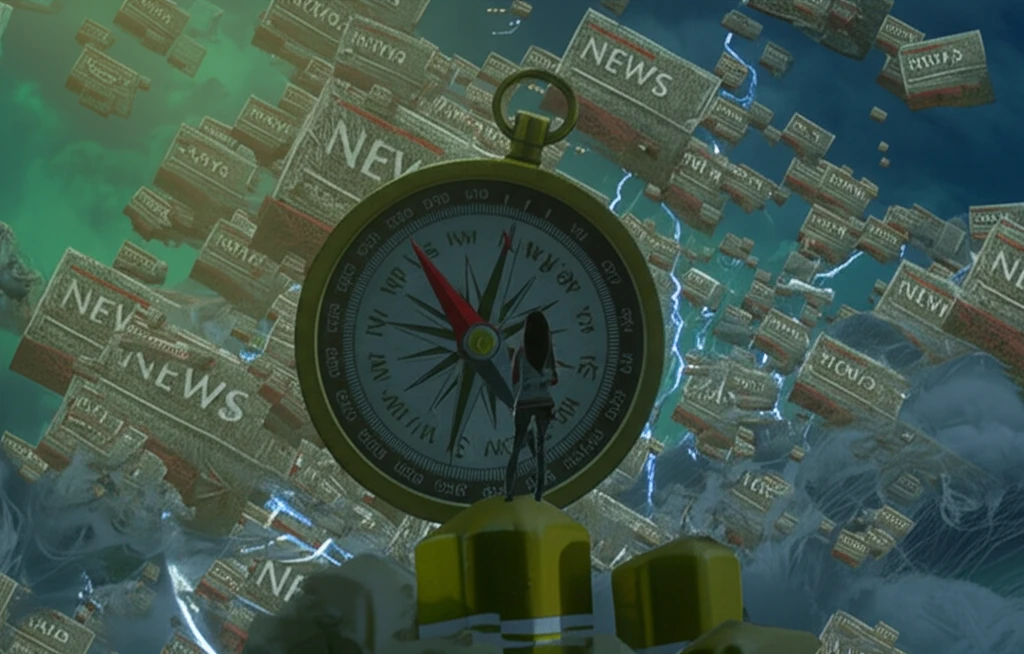
Decoding Political Messages: How to Stay Informed in a World of Information Overload

"Navigate the noise and understand the real story behind the headlines."
In today's fast-paced world, staying informed about politics can feel like an overwhelming task. With countless news sources, social media debates, and opinions flying from every direction, it's easy to feel lost in the noise. But understanding the political landscape is more crucial than ever. This article will guide you through the essential skills and strategies for navigating the complex world of political communication, ensuring you stay informed without getting stressed.
Political communication has transformed dramatically over the decades. Early researchers like Walter Lippmann and Harold Lasswell focused on how the media shaped public opinion, assuming that media influence could not be understood without knowing how media operated. Today, we face an environment saturated with information, where specialization in institutions and behavior has somewhat fragmented the field.
The challenge now lies in merging the valuable lessons of the past with the analytical tools of the present. We need to understand not just what information is presented, but also how it is strategically crafted and disseminated by politicians and the media alike. This article will help you develop a holistic view, enabling you to analyze political messages effectively.
Statistical Storytelling in Political Communication
Political communication of official statistics often relies on 'exciting numbers' and storytelling practices to frame labor market data for public consumption. This approach transforms raw statistics into narratives that shape political understanding and public opinion. The method emphasizes fact-checking and strategic presentation of data to support political messages. Such statistical storytelling is a key component of how governments and institutions communicate economic realities.
Framing Theory and AI-Driven Sentiment Analysis
Political communication scholars frequently employ framing theory to analyze rhetorical pieces such as speeches and social media posts, establishing it as a 'gold standard' in the field. In parallel, AI-driven political sentiment analysis offers a data-driven storytelling approach that transforms campaigns into emotionally intelligent narratives. However, each method has distinct advantages and limitations in political interpretation. These tools collectively represent the spectrum of analytical approaches used to decode political messaging.
Evolution from Early Communication to Political Milestones
The history of political communication is deeply connected to broader developments in human communication methods from ancient times to the present. Key political milestones such as the French Revolution, 19th-century national unifications in Italy and Germany, and anti-colonial movements have significantly shaped the structures of political discourse. These events established foundational frameworks for how political messages are constructed, disseminated, and interpreted across societies. Understanding this historical context is essential for analyzing modern political communication patterns.
The Three Generations of Political Communication Research
To better understand where we are today, it's helpful to look back at the evolution of political communication research. The field can be broadly divided into three generations, each influenced by the changing media landscape and the development of social science methodologies:
- Focused on propaganda and its effects.
- Assumed a direct impact of media.
- Limited methodological rigor.
Emerging Research Areas in Political Communication
Recent research in political communication explores the significant role of gender stereotypes, demonstrating that gender remains a key variable in both political messaging and communicator perception. Another expanding research area examines the influence of non-Western English-language state-funded international broadcasters on shaping international audiences' political views. These studies collectively highlight the broadening scope of political communication research beyond traditional Western contexts and media outlets. The field continues to evolve with new actors and dimensions being identified in the communication process.
Critiques of Habermasian Political Communication Theory
Much research on communication and democracy continues to rely on Jürgen Habermas's theoretical framework, but his emphasis on rational consensus as the goal of public communication has faced intense criticism. Critics problematize his approach in both communication studies and political theory, pointing to significant shortcomings when applied to political and social reality. These debates highlight tensions between ideal communicative models and the actual practice of political communication in complex societies. The critiques suggest that alternative theoretical frameworks may be needed to better capture the dynamics of contemporary political discourse.
Cross-National Political Communication Research
Comparative analysis in political communication research is increasingly emphasized as a valuable methodological approach. Studies like 'Communicating Politics: Political Communication in the Nordic Countries' encourage scholars to publish internationally and focus on cross-national comparisons. This comparative perspective aims to influence international political communication literature by systematically examining regional differences and similarities in political messaging strategies. Such research contributes to a more nuanced understanding of how political communication varies across different cultural and institutional contexts.
Embracing a Holistic Approach
The study of political communication presents a seemingly limitless scope of inquiry. From local zoning problems to international conflicts, nearly every conceivable topic falls under its umbrella. By embracing a holistic view of the information environment, developing critical analysis skills, and understanding the strategic interactions between politicians and the media, you can become a more informed and engaged citizen.
Expert Pundits in Post-Fact Political Communication
In the context of post-fact politics, expert pundits play a crucial role in accurately communicating public opinion poll results to the broader public. Their evidence-based explanations are considered persuasive and help maintain the importance of opinion reports in American political communication. This underscores the value of expert analysis in synthesizing complex political data and making it accessible. The ability of experts to contextualize and explain polling data remains vital for informed public discourse.
AI Integration in Political Communication Strategies
To effectively harness the transformative power of AI in political communication, organizations must prioritize the integration of advanced data analytics into their strategic frameworks. This future outlook emphasizes the need for adaptive approaches to leverage AI for analyzing political trends and movements with greater precision. As AI technologies continue to evolve, their role in shaping political discourse and campaign strategies is expected to expand significantly. The successful integration of these tools will likely define competitive advantages in future political communication efforts.
Geopolitics and Systemic Political Crises
Geopolitics examines how factors like location, climate, and resources impact a country's politics and foreign policy, having gained prominence in the early 20th century. Systemic challenges become evident in crises such as Pakistan's flood devastation, where political system flaws and leadership challenges exacerbate impacts on the economy and common people. These examples illustrate how broader geopolitical and systemic issues fundamentally shape political communication patterns and policy responses. The intersection of environmental, economic, and political factors creates complex communication challenges for governments and societies.
Scope of Political Communication and Linguistic Tools
The broad scope of political communication encompasses the study of political messages, public opinion formation, political news coverage, and the increasingly important role of social media in political discourse. Real-world impact is demonstrated through linguistic tools like deictic expressions, which are strategically employed to construct political stance in high-level speeches such as those at the United Nations General Assembly. These elements highlight the human dimension of political communication and its direct influence on public perception and behavior. The field continues to expand as scholars examine how communication shapes political realities across different contexts and platforms.