
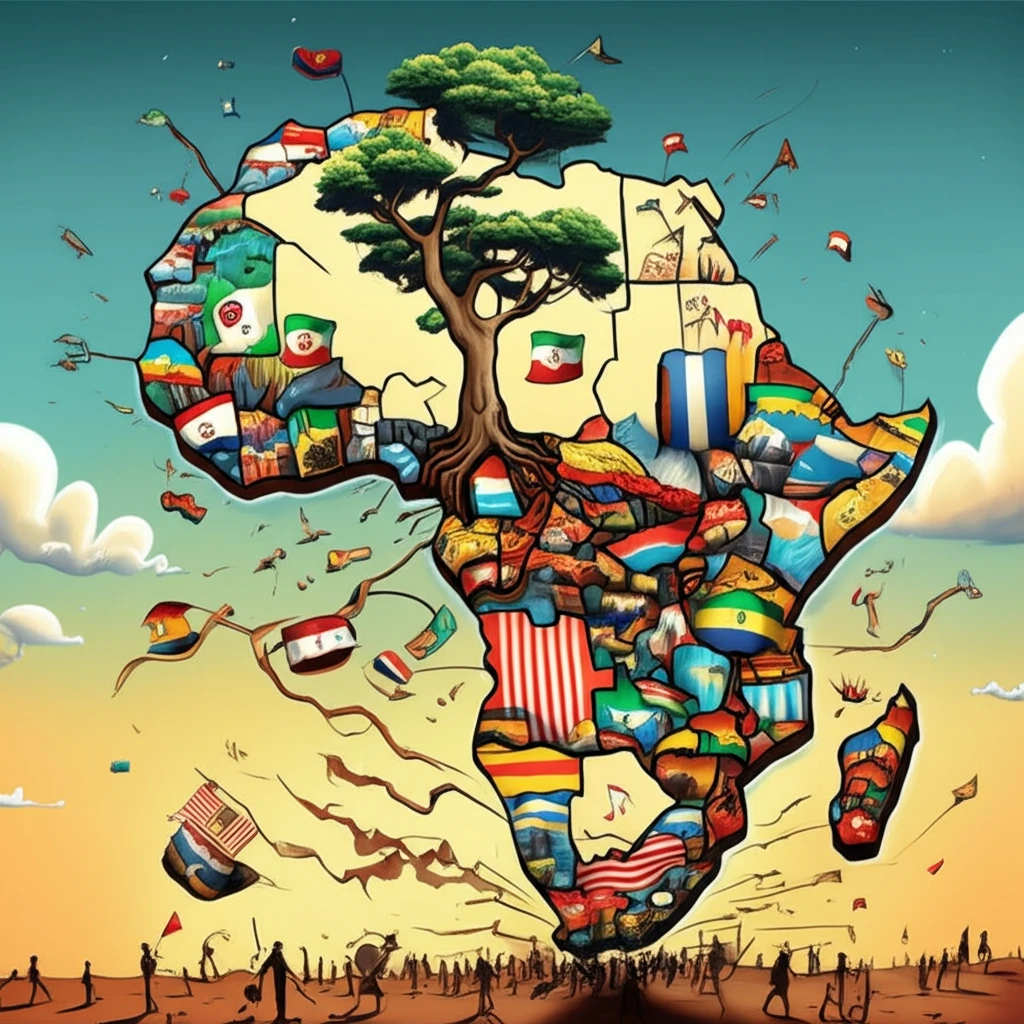
Decoding Political Instability: Why Party Proliferation Matters for African Democracies

"A deep dive into Senegal's political landscape reveals the hidden dynamics of party proliferation and its impact on democratic stability."
In the vibrant tapestry of African politics, the proliferation of registered political parties has become a striking phenomenon. From Cameroon, boasting over 250 parties, to Senegal and Madagascar, each with over 150, the sheer number raises critical questions about the quality and stability of opposition forces on the continent. Is this a sign of democratic vitality, or does it mask deeper issues of fragmentation and instability?
Catherine Lena Kelly's comparative analysis of Senegal offers valuable insights into this complex issue. By examining the trajectories of political parties in Senegal, Kelly challenges conventional wisdom and sheds light on the often-overlooked dynamics of party proliferation in competitive authoritarian regimes. Her work invites us to look beyond simple numbers and consider the underlying incentives and resources that shape the behavior of political actors.
This article will explore Kelly's findings, providing an accessible overview of her research and its implications for understanding African politics. We'll delve into the unique case of Senegal, unpack the concept of 'competitive authoritarianism,' and examine the factors that determine whether a political party becomes a force for consistent opposition or simply fades into the background.
A Global Pattern of Party Proliferation
The proliferation of political parties is a widespread phenomenon across diverse democracies. Research on Nigeria's Fourth Republic has examined the unabated proliferation of parties and its effects on electoral democracy. In sub-Saharan Africa more broadly, the proliferation of registered political parties began with post-Cold War transitions to multiparty politics. Outside Africa, Turkey has seen more than 400 political parties established since 1923, with parliament reaching its highest party diversity since 1950, while in the United States the number of political independents has ballooned.
Challenges of Managing Party Proliferation
Trends toward party proliferation, increased intra-party competition, and enhanced grassroots control of leaders have been characterized by some scholars as unfortunate developments for governance stability. In India, scholars have studied the relationship between party organization and party proliferation to understand how institutional structures shape this phenomenon. Nepal illustrates the scale of the challenge: there were only 10-12 political parties before the Panchayat system, but over 75 years the number has risen to 137, excluding six parties recently deregistered by the Election Commission.
The 1990s Multiparty Turn in Africa
The proliferation of political parties took hold in sub-Saharan Africa after many countries transitioned to multiparty politics in the 1990s, a trend that scholars have examined through both political science and anthropological lenses. Senegal has emerged as an especially useful case study of political party formation and proliferation, combining original party-level data gathered in West Africa with over one hundred elite interviews. In the Philippines, party dynamics have been shaped by constitutional frameworks, with only the Nacionalista Party and Liberal Party dominating elections from 1935 until martial law was imposed in 1972.
Senegal: A Case Study in Party Proliferation
Senegal, often hailed as one of Africa's oldest electoral democracies, presents a fascinating paradox. Despite its early embrace of multiparty politics, the country has experienced a surge in the number of registered parties, tripling to 174 by 2010. This proliferation has occurred within a context of what scholars term 'competitive authoritarianism,' a system where elections are held but the playing field is far from level.
- Many parties serve primarily as vehicles for patronage, with leaders using their parties to negotiate access to state resources rather than seriously contesting elections.
- The uneven playing field makes it difficult for opposition parties to gain traction, leading to a high degree of co-optation and tactical alliances with the ruling party.
- Consistent opposition is rare, with only a small fraction of parties maintaining a sustained commitment to challenging the incumbent government.
New Scholarship on African Party Systems
Recent academic work continues to deepen understanding of party proliferation on the continent. A review of Catherine Lena Kelly's book 'Party Proliferation and Political Contestation in Africa: Senegal in Comparative Perspective' has been featured in Foreign Affairs, signaling the topic's growing prominence in policy circles. This scholarship examines how the proliferation of parties affects political contestation across different African contexts.
Proliferation Beyond Africa
Party proliferation is not unique to African contexts and can occur in post-authoritarian transitions globally. In post-Hasina Bangladesh, political parties have proliferated following a period of political upheaval, raising questions about whether such proliferation strengthens or fragments democratic institutions. The pattern suggests that party proliferation may be a structural feature of democratic transitions rather than a phenomenon with a single regional explanation.
Multi-Party Systems in Comparative Perspective
Senegal stands out as an especially useful and salient case study of political party formation and proliferation, according to scholars including Matthew T. Page of Chatham House. A multi-party system constitutes a form of party competition in which three or more political parties maintain viable prospects of attaining legislative seats or executive influence through electoral processes. Understanding how such systems function across different national contexts is essential for grasping the implications of party proliferation for democratic governance.
The Path Forward: Strengthening Opposition and Promoting Democratic Stability
Kelly's analysis offers valuable lessons for policymakers and activists seeking to strengthen democratic governance in Africa. By understanding the dynamics of party proliferation and the challenges faced by opposition parties, we can develop more effective strategies for promoting political accountability and fostering a more level playing field. This may involve reforms to campaign finance regulations, media access, and electoral rules, as well as efforts to empower civil society organizations and promote greater citizen engagement in the political process.
Constitutional Rights and Proliferation
Namibia's constitutional framework illustrates the tension between democratic freedoms and party proliferation. Article 17 of the constitution guarantees political freedom and the right to form and join political parties at will, provided it is done peacefully. The understanding of this article is reflected in the number of political parties registered for elections, demonstrating how constitutional protections can enable proliferation while posing governance challenges.
Looking Ahead at Party Proliferation
The trajectory of party proliferation across African democracies remains uncertain as countries continue to navigate the balance between pluralism and governability. Future research will need to assess whether the post-1990s wave of party formation has stabilized or continues to accelerate, and what institutional reforms might address fragmentation without restricting democratic participation. The long-term effects on policy coherence and electoral accountability remain underexplored frontiers in comparative politics.
Structural Pressures on Party Systems
Party proliferation often reflects deeper structural challenges including weak party institutions, ethnic or regional mobilization, and legal frameworks that lower barriers to party registration. In many African democracies, the proliferation of parties has outpaced the development of robust internal party democracy, raising questions about whether new parties genuinely represent distinct policy alternatives or primarily serve elite interests. Addressing these systemic challenges requires understanding both the institutional and socioeconomic drivers of party formation.
Proliferation's Impact on Citizens
At the grassroots level, party proliferation shapes how citizens engage with democratic processes, from voter education to campaign dynamics. When parties multiply rapidly, voters may face information overload and struggle to distinguish between genuine policy differences, potentially undermining informed participation. The proliferation of parties can also fragment opposition to incumbents, paradoxically strengthening entrenched power even as it appears to broaden democratic competition.