
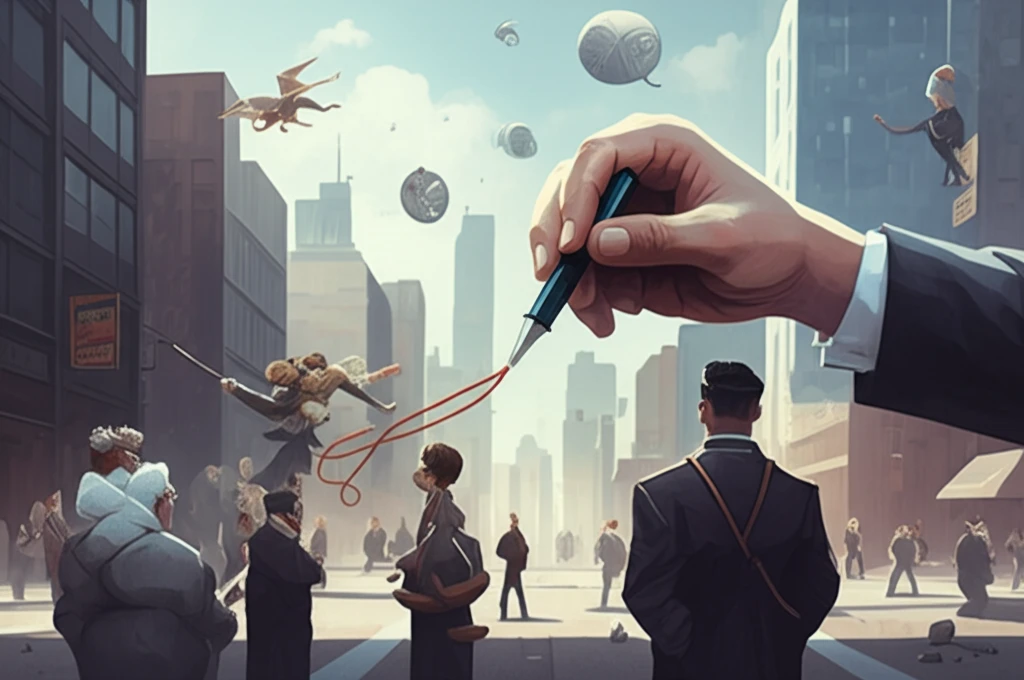
Decoding Political Cartoons: How Satire Shapes Our Views

"Uncover the layered meanings behind political cartoons and their surprising influence on public opinion and cultural narratives."
Political cartoons are more than just funny drawings; they are potent forms of social and political commentary. Combining artistry with satire, these cartoons distill complex issues into easily digestible visual narratives, capable of swaying public opinion and shaping cultural discourse. From newspapers to digital platforms, their reach is extensive, making them a significant force in modern media.
Throughout history, political cartoons have played a pivotal role in reflecting and influencing societal attitudes. Whether lampooning political figures, critiquing policies, or highlighting social injustices, these cartoons offer a unique lens through which to view the world. Their impact lies in their ability to cut through the noise and present a clear, often humorous, perspective on pressing issues.
This article delves into the world of political cartoons, exploring their historical significance, analyzing their persuasive techniques, and examining their lasting impact on public perception. By understanding how these cartoons operate, we can become more critical consumers of media and better appreciate the subtle yet powerful ways in which our opinions are shaped.
Cartoons as a Daily Fixture of Political Coverage
Major news organizations continue to feature political cartoons as a regular part of their political coverage, with outlets like POLITICO publishing cartoons from staff artist Matt Wuerker and RealClearPolitics curating a weekly "Cartoons of the Week" selection. These weekly roundups frequently organize cartoons around tracking polls such as the "direction of the country" and favorability ratings of political leaders. On independent platforms, cartoonists publish and rate their work publicly; one "statistics" cartoon by toonman on TOONPOOL, for example, carries a 5.00/5.00 rating in the politics category. Syndication services such as ArcaMax continue to distribute editorial cartoons to readers seeking daily commentary on current events.
Cartoons in the Classroom and the Editing Room
Political cartoons are a standard teaching instrument: educators use them to build on-demand writing skills and standardized-test prompts, as one teacher described handing students two cartoons on high-stakes testing and Common Core State Standards. The approach also appears in formal curricula, including cartoon-based questions in class 12 political science examinations. The method has limits, however, because cartoons can become flashpoints for controversy. Michael Ramirez's cartoon "The Last Refuge," for instance, was a "direct response" to the Washington Post pulling his anti-Hamas cartoon, as Ramirez told Fox News Digital.
From Franklin's Serpent to Nast's Elephant
The American tradition of political cartooning dates to 1754, when Benjamin Franklin published "Join, or Die" in the Pennsylvania Gazette, a woodcut of a severed snake whose segments represented the colonies, urging unity against French military threats. Throughout American history, such cartoons have not only influenced political opinions but also played a significant role in social movements, including the abolitionist movement. Thomas Nast cemented the visual language of modern party symbolism, using an elephant to represent Republicans in an 1874 Harper's Weekly cartoon, a device other cartoonists adopted by 1880. These works function as illustrated editorials providing visual commentary on political events, and as commentators have noted, the target of the humor may complain but can seldom fight back.
The Art of Persuasion: How Cartoons Shape Opinions
Political cartoons are masters of persuasion, employing a range of techniques to influence viewers. Caricature, exaggeration, and symbolism are common tools used to amplify certain traits or aspects of a subject, often to comedic or critical effect. These visual cues can create immediate emotional responses, bypassing rational thought and directly influencing opinion. For example, a politician might be drawn with exaggerated features to highlight perceived flaws or weaknesses.
- Caricature: Exaggerating physical features to emphasize traits.
- Symbolism: Using objects or figures to represent abstract ideas.
- Irony: Employing humor to highlight contradictions or absurdities.
- Stereotypes: Relying on oversimplified representations of groups.
Editorial Cartooning Across Today's Newsrooms
Political cartooning remains an active daily genre in newsrooms worldwide, with The Hindu providing cartoons on all the latest topics spanning politics, business, and current affairs. The New York Times maintains a dedicated topic page for cartoons and cartoonists, collecting commentary and archival articles, and has also covered a wave of animated political satire series available for streaming. Syndication continues to move cartoonists between major dailies; one profile notes a cartoonist who served as staff political cartoonist for The San Diego Union-Tribune and The New Orleans Times-Picayune before starting at the Post-Gazette in November 2018. Together these outlets show both print and digital platforms sustaining editorial cartoons as a running commentary on the news.
When Satire Crosses the Line
Political cartoons sometimes fail badly, crossing into imagery that critics argue fuels hatred rather than critique. In one prominent case, critics argued that a cartoon went far beyond legitimate political criticism and instead relied on imagery historically used to incite hatred and violence against Jews; the publication issued an apology and removed the cartoon, yet commentators noted the same underlying problem remained. The genre has a long history of loaded wartime imagery, as seen in Dr. Seuss's World War II cartoons, where Hitler appeared as a villain in many forms, including a mad scientist amputating limbs, a bureaucrat giving orders to the devil, and a trophy hunter after a Russian bear. By contrast, the same cartoons depicted Mussolini as a bumbling idiot. These examples illustrate both the rhetorical power of cartoon imagery and the boundaries it can cross.
Cartoonist Versus Animator
Cartoonists create static illustrations, often humorous or satirical, that comment on political, social, and cultural issues, and their cartoons become both artistic expressions and acts of political resistance. To convey complex geopolitical ideas succinctly, they employ caricature, symbolism, and visual metaphors. Animators, by contrast, work in motion, building on the same satirical instincts through sequential frames and movement. Definitions of the form emphasize that a political cartoon provides a humorous or critical opinion about political events or persons and aims to convince the audience to take a particular view on a historical event.
The Enduring Legacy of Political Cartoons
Political cartoons remain a vital form of expression, offering a unique blend of art, humor, and social critique. As visual narratives, they have the power to shape our perceptions, influence public opinion, and spark important conversations. By understanding the techniques and messages embedded within these cartoons, we can become more informed and engaged citizens, better equipped to navigate the complexities of the modern media landscape. In a world saturated with information, the ability to critically analyze and interpret visual messages is more important than ever.
The Craft and the Daily Deadline
Political cartoons remain a signature feature of major political outlets, with POLITICO continuing to publish work by staff cartoonist Matt Wuerker amid its broader political news coverage. Local newspapers likewise keep the genre alive in their opinion sections, running daily political cartoons alongside editorials and columns. The craft itself has become a subject of instruction, with tutorials circulating that offer step-by-step guidance on drawing politicians and creating engaging political cartoons. Meanwhile, Sunday morning news analysis programs continue the conversation verbally, featuring hosts and guests who discuss and share opinions on current political events in a format distinct from hard news reporting.
Digital Communities and Emerging Tools
Political cartoons are increasingly circulating through online community spaces, such as Reddit's r/politics, which hosts a regular Saturday Morning Political Cartoon Thread where readers gather to share and discuss the week's cartoons. As digital content creation evolves, reports on industry trends describe how AI is transforming digital marketing and shaping 2024 trends and insights, pointing toward new production possibilities for visual content. Global economic institutions, meanwhile, continue to publish regular projections and analyses of world economic conditions that provide raw material for political commentary. These shifts suggest the genre's future lies in platform-native distribution and, possibly, machine-assisted production rather than the newspaper page alone.
Systemic Problems Demand Systemic Responses
Commentators in fields far beyond journalism argue that entrenched social problems resist isolated fixes. Dr. Tim Murphy, a former congressman and author, has discussed the systemic challenges in addressing serious mental illness, underscoring how difficult institutional problems defeat piecemeal solutions. Similarly, work on agroecology and climate change adaptation frames environmental problems as "systemic challenges" that demand "systemic responses," with the authors cautioning that their views do not necessarily reflect those of FAO or BMZ. The same logic applies to political satire, which operates within larger institutional, legal, and market structures that shape what is published and how audiences respond.
Cartoons as a Mirror of Public Feeling
Political cartoons capture the human impact of major events and let audiences encounter widely differing viewpoints; studying cartoons of the Berlin Airlift, including work by cartoonist David Low, allows students to observe the impact an event made on the peoples of many nations. The genre spans humorous captioned illustrations and satirical political drawings, all serving as forms of expression and communication. In recent elections, cartoons have shown their reach in real time, as Maharashtra cartoons went viral during the state's elections, reflecting public opinions and frustrations and demonstrating the potency of caricature in digital discourse. Observers note the influence of such cartoons on political campaigns, underscoring satire's concrete effects beyond mere commentary.