
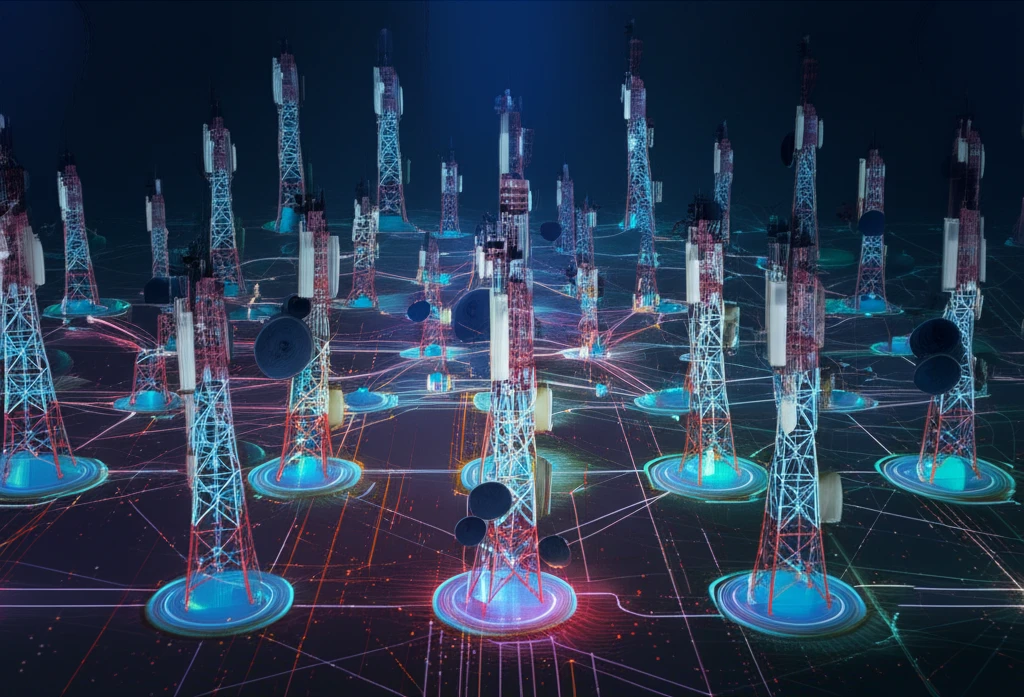
Indonesian telecommunications towers forming a Self-Organizing Map (SOM) grid

Decoding MSME Success: How Data Clustering Can Boost Indonesian Telematics

"Unlock the secrets to empowering Indonesian telematics MSMEs through the strategic application of Self-Organizing Maps (SOM) for data-driven decision support."


Indonesia's information technology and communication (telematics) sector is experiencing rapid growth, playing a vital role in the nation's development across economic, social, and political spheres. Yet, despite this potential, many micro, small, and medium-sized enterprises (MSMEs) within the telecommunications industry struggle to thrive. A key challenge lies in effectively targeting support and resources to the businesses that need them most.

Traditional approaches to understanding the telecommunications landscape often rely on qualitative assessments, which can be limited in scope and depth. To address this, researchers are turning to data mining techniques, particularly clustering algorithms, to uncover hidden patterns and relationships within the sector. By grouping businesses with similar characteristics, these methods can reveal valuable insights for policymakers and support organizations.

This article explores how Self-Organizing Maps (SOM), a type of artificial neural network, can be used to create a data-driven decision support system for Indonesian telematics MSMEs. We'll delve into the methodology behind SOM clustering, examine the results of a real-world application, and discuss the potential for this approach to empower businesses and drive economic growth.

Unlocking Insights: How SOM Clustering Works

Indonesian telecommunications towers forming a Self-Organizing Map (SOM) grid

The study leverages Self-Organizing Maps (SOM), a type of artificial neural network, to analyze data from the National Census of Economic (Susenas 2006) and identify distinct clusters of telematics businesses. SOM operates by organizing high-dimensional data into a lower-dimensional grid, where similar data points are grouped together. This allows for the visualization and interpretation of complex relationships within the data.

The SOM algorithm works through a process of iterative learning. Initially, each node in the grid is assigned a random weight vector. During training, data points are fed into the network, and the node whose weight vector is most similar to the input data point is declared the "winner." The winning node, and its neighboring nodes, then have their weight vectors adjusted to be more similar to the input data point. This process is repeated for all data points, gradually organizing the network so that similar data points cluster together.

  • Data Preprocessing: The raw data undergoes cleaning, description, discretization, and transformation to prepare it for the SOM algorithm.
  • Network Training: The SOM network is trained using the preprocessed data, with the algorithm adjusting the weights of the nodes to form clusters.
  • Model Evaluation: The resulting clusters are evaluated using the Davies-Bouldin Index (IDB), a metric that measures the compactness and separation of clusters. A lower IDB indicates better clustering performance.
  • Validation and Analysis: The clusters are validated and analyzed to identify key characteristics and patterns within the Indonesian telematics services sector.
The accuracy level of the cluster model is evaluated using the Index of Davies Bouldin (IDB). Based on Index of Davies Bouldin (IDB), the accuracy level of the cluster model is 0.37 or can be categorized as good. The cluster model is developed to find out telecommunication business clusters that has influence towards the national economy so that it is easier for the government to supervise telecommunication business.

Data-Driven Empowerment: A Path Forward

The research demonstrates the potential of SOM clustering to provide valuable insights into the Indonesian telematics MSME sector. By identifying distinct clusters of businesses with shared characteristics, this approach can inform targeted support programs and policies that are tailored to the specific needs of different groups.

For example, the study identified a cluster of Computer Settings Services and Internet businesses that exhibited strong growth potential but required specific interventions to enhance their competitiveness. These interventions could include initiatives to improve human resource skills or promote marketing and competitive strategies.

While the study provides a promising framework, it's important to acknowledge limitations, such as potential data imbalances. Future research should focus on refining data preprocessing techniques and exploring other clustering algorithms to further enhance the accuracy and robustness of the results. By embracing data-driven approaches, Indonesia can unlock the full potential of its telematics MSME sector and drive sustainable economic growth.

About this Article -

This article was crafted using a human-AI hybrid and collaborative approach. AI assisted our team with initial drafting, research insights, identifying key questions, and image generation. Our human editors guided topic selection, defined the angle, structured the content, ensured factual accuracy and relevance, refined the tone, and conducted thorough editing to deliver helpful, high-quality information.See our About page for more information.

This article is based on research published under:

DOI-LINK: 10.1088/1757-899x/166/1/012017, Alternate LINK

Title: Implementation Of Self Organizing Map (Som) As Decision Support: Indonesian Telematics Services Msmes Empowerment

Subject: General Medicine

Journal: IOP Conference Series: Materials Science and Engineering

Publisher: IOP Publishing

Authors: E.T. Tosida, S. Maryana, H. Thaheer, Hardiani

Published: 2017-01-01

Everything You Need To Know

1

How do Self-Organizing Maps actually group data? Can you explain the algorithm's steps?

Self-Organizing Maps, or SOM, works by organizing high-dimensional data onto a lower-dimensional grid. Initially, nodes on the grid are assigned random weights. Then, data points are fed into the network, and the node most similar to the input becomes the 'winner'. The 'winner' and its neighbors adjust to become more like the input. This iterative process groups similar data points together, revealing patterns.

2

What does the Index of Davies-Bouldin tell us about the clusters created by Self-Organizing Maps?

The Index of Davies-Bouldin, or IDB, assesses the quality of the clusters created by Self-Organizing Maps. It measures how compact and well-separated the clusters are. A lower IDB score signifies better clustering performance, indicating that the clusters are tightly grouped and distinct from each other.

3

What exactly is involved in preparing the data before it's used in the Self-Organizing Maps algorithm?

Data preprocessing for Self-Organizing Maps involves several crucial steps. Raw data undergoes cleaning to remove inconsistencies and errors. It's then described and transformed into a suitable format. Discretization might also be applied to convert continuous data into discrete intervals. These steps prepare the data for effective analysis by the Self-Organizing Maps algorithm.

4

How can Indonesian telematics MSMEs actually use the information from Self-Organizing Maps to make better decisions?

Self-Organizing Maps offers Indonesian telematics MSMEs a data-driven way to understand their operational landscape. By using Self-Organizing Maps to cluster MSMEs with similar characteristics, policymakers and support organizations can gain insights into the specific needs of different groups of businesses. This approach facilitates the creation of targeted support programs and policies, optimizing resource allocation and promoting sustainable growth in the telecommunications industry.

5

What aspects of data-driven empowerment for Indonesian telematics MSMEs does the study not explore, and how might they be addressed in future research?

While the study highlights the potential of Self-Organizing Maps, it does not explicitly delve into real-time applications of the model, such as immediate strategic decision-making or predictive analytics for emerging market trends. Furthermore, the absence of integration with other machine learning models limits the scope of the cluster model. However, the cluster model helps government supervise telecommunication business and provides a foundation for further research into combining Self-Organizing Maps with other analytic techniques to enhance its insights and predictive capabilities.

Newsletter Subscribe

Subscribe to get the latest articles and insights directly in your inbox.