
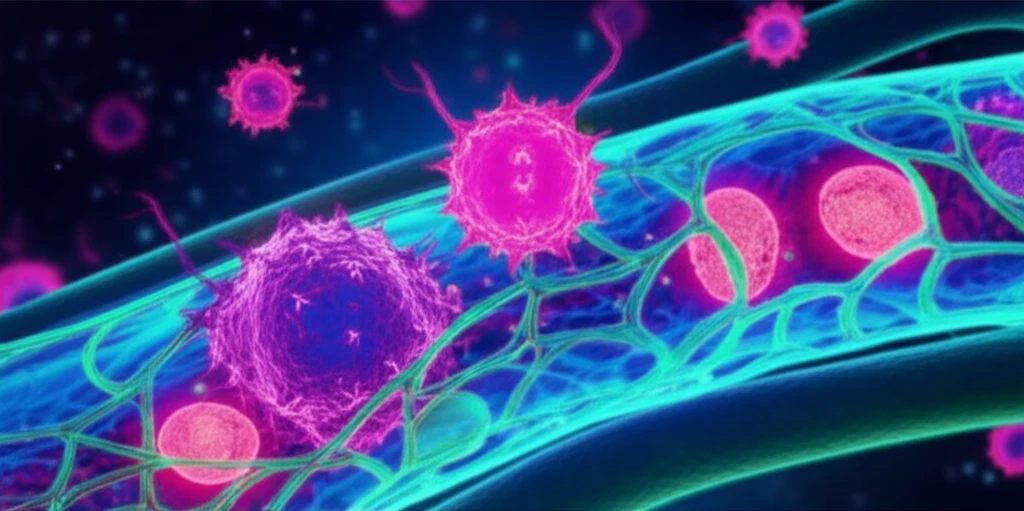
Microscopic view of liver cancer cells invading blood vessels, highlighted by PET scan colors.

Decoding Microvascular Invasion in Liver Cancer: A Comprehensive Guide

"Understand the cutting-edge research into microvascular invasion (MVI) in hepatocellular carcinoma (HCC) and how it's shaping diagnosis and treatment strategies for better outcomes."


Hepatocellular carcinoma (HCC), the most common primary liver tumor, accounts for approximately 90% of all liver cancer cases. Its prevalence has steadily increased, making it the fifth most common cancer and the second leading cause of cancer-related deaths worldwide. While surgical resection and liver transplantation offer curative potential, challenges remain. Surgical options are often limited by tumor-related cirrhosis, and liver transplantation faces organ shortages and a high recurrence rate, affecting up to 75% of patients.

The Milan Criteria (MC), introduced in 1996, aimed to improve patient selection for liver transplantation. However, these criteria have been criticized for being overly conservative, potentially excluding suitable candidates. Beyond lesion size, number, and biomarker levels, vascular invasion significantly impacts prognosis and recurrence rates after transplantation. Microvascular invasion (MVI), in particular, is a sign of poor prognosis but is difficult to detect before transplant. This highlights the critical need for effective preoperative tools to assess MVI risk.

Diagnostic imaging and tumor markers are increasingly important in defining microvascular invasion. Techniques like computed tomography (CT), magnetic resonance imaging (MRI), and positron emission tomography (PET) offer promising avenues for MVI detection. This article explores the potential of 18F-FDG PET as a preoperative imaging biomarker to predict MVI in HCC patients, thus refining patient selection for liver transplantation.

What Makes Microvascular Invasion So Important in Liver Cancer?

Microscopic view of liver cancer cells invading blood vessels, highlighted by PET scan colors.

Microvascular invasion (MVI) and low tumor differentiation are now recognized as critical prognostic factors. These are alongside serum levels of alphafetoprotein (AFP) and response to neoadjuvant locoregional tumor treatment (LRTT). Studies, like one by Lim et al., have shown that MVI is a stronger predictor of tumor recurrence after surgical resection than the Milan Criteria alone. The presence of MVI is linked to poorer outcomes and lower survival rates following liver transplantation. Early detection of MVI is crucial for patient management, but current conventional imaging struggles to identify it reliably.

Conventional imaging methods can only indirectly suggest MVI, looking at signs like capsule disruption, irregular tumor margins, and unusual enhancement patterns around the tumor. Nuclear medicine offers a significant change in how neoplasms are assessed because it can assess the tumor's metabolism in real-time. While 18F-fluorodeoxyglucose positron emission tomography with computed tomography (18F-FDG PET/CT) has lower sensitivity compared to other solid tumors, it can reflect glucose tumor metabolism. Clinically, it can stage, restage, stratify prognosis and follow up with HCC cases.

  • AFP Levels: Patients with AFP levels below 200 µg/L showed better biological behavior and recurrence-free survival rates, reaching up to 90% at 5 years. In contrast, patients with AFP values higher than 800 µg/L face increased MVI risk and a 40% 5-year recurrence-free survival rate.
  • Total Tumor Volume (TTV) and AFP: Only total tumor volume (TTV) and AFP level showed a statistically significant relationship. Patients with TTV lower than 115 cm³ and AFP lower than 400 ng/mL being inside criteria versus patients with higher values.
  • Des-y-carboxyprothrombin (DCP): Apart from AFP, another important biomarker useful for the early diagnosis of HCC is protein induced by absence of vitamin K or antagonist II (PIVKA-II), also known as des-y-carboxyprothrombin (DCP).
Researchers like Fujiki et al. have proposed the Kyoto criteria, which involves testing both DCP and AFP alongside tumor size and number, to improve selection criteria for liver transplantation. Their ROC curve-based analysis indicated that preoperative DCP and AFP levels were better than tumor size or number at predicting HCC recurrence after liver transplant. They found optimal cutoff values for predicting recurrence: 400 mAU/mL for DCP and 800 ng/mL for AFP. DCP offers additional information on tumor biological behavior and aid in expanding selection criteria for LT.

Looking Ahead: Optimizing Liver Cancer Treatment Strategies

The identification and understanding of microvascular invasion are crucial for improving outcomes in liver cancer treatment. While challenges remain in accurately detecting MVI preoperatively, advancements in imaging techniques, biomarker analysis, and downstaging strategies offer hope for more personalized and effective treatment plans. By integrating these tools, medical professionals can refine patient selection for liver transplantation and ultimately improve survival rates and quality of life for individuals battling HCC.

About this Article -

This article was crafted using a human-AI hybrid and collaborative approach. AI assisted our team with initial drafting, research insights, identifying key questions, and image generation. Our human editors guided topic selection, defined the angle, structured the content, ensured factual accuracy and relevance, refined the tone, and conducted thorough editing to deliver helpful, high-quality information.See our About page for more information.

This article is based on research published under:

DOI-LINK: 10.1155/2018/9487938, Alternate LINK

Title: Microvascular Invasion In Hcc: The Molecular Imaging Perspective

Subject: Radiology, Nuclear Medicine and imaging

Journal: Contrast Media & Molecular Imaging

Publisher: Hindawi Limited

Authors: Vincenzo Cuccurullo, Giuseppe Danilo Di Stasio, Giuseppe Mazzarella, Giuseppe Lucio Cascini

Published: 2018-10-04

Everything You Need To Know

1

What is Microvascular Invasion (MVI) and why is it so crucial in the context of Hepatocellular Carcinoma (HCC)?

Microvascular Invasion (MVI) refers to the presence of cancer cells within the small blood vessels (microvessels) of the liver tumor. In Hepatocellular Carcinoma (HCC), MVI is a significant indicator of poor prognosis. Its presence suggests a higher likelihood of tumor recurrence after surgical resection or liver transplantation. It's a crucial factor because it influences treatment strategies and patient outcomes. Early detection of MVI is critical for effective patient management, helping to refine patient selection for liver transplantation and potentially improve survival rates.

2

How do diagnostic imaging techniques, like 18F-FDG PET/CT, contribute to detecting Microvascular Invasion (MVI) in HCC, and what are its limitations?

Diagnostic imaging, including techniques like computed tomography (CT), magnetic resonance imaging (MRI), and positron emission tomography (PET), plays a pivotal role in detecting MVI. 18F-FDG PET/CT specifically assesses the glucose metabolism of the tumor. Since cancer cells often have higher metabolic rates, they take up more of the radioactive glucose analog (18F-FDG), revealing the tumor's presence. However, 18F-FDG PET/CT has limitations; its sensitivity is lower compared to other solid tumors, making it challenging to detect MVI reliably compared to other methods. Conventional imaging methods can only indirectly suggest MVI, using signs like capsule disruption or irregular tumor margins.

3

What role do biomarkers, such as Alpha-fetoprotein (AFP) and Des-y-carboxyprothrombin (DCP), play in assessing the risk of Microvascular Invasion (MVI) and predicting outcomes in HCC?

Biomarkers like Alpha-fetoprotein (AFP) and Des-y-carboxyprothrombin (DCP) are crucial in assessing the risk of MVI and predicting HCC outcomes. Elevated AFP levels, particularly above 800 µg/L, correlate with an increased risk of MVI and a lower 5-year recurrence-free survival rate. DCP, another biomarker, provides additional insights into the tumor's biological behavior and can be used alongside AFP and tumor size to improve selection criteria for liver transplantation, according to the Kyoto criteria. Fujiki et al. found optimal cutoff values: 400 mAU/mL for DCP and 800 ng/mL for AFP to predict HCC recurrence.

4

How have the Milan Criteria (MC) been utilized in Liver Transplantation (LT) and what are their limitations concerning Microvascular Invasion (MVI)?

The Milan Criteria (MC) were introduced to improve patient selection for Liver Transplantation (LT). They considered factors such as tumor size, number, and biomarker levels to identify suitable candidates. However, the MC have been criticized for being overly conservative, potentially excluding patients who could benefit from transplantation. One significant limitation is that the MC do not directly account for Microvascular Invasion (MVI), which significantly impacts the prognosis and recurrence rates after LT. MVI is often difficult to detect before transplantation, highlighting the need for improved preoperative tools to assess this risk.

5

How can the integration of imaging techniques, biomarker analysis, and other strategies, such as downstaging, improve outcomes in liver cancer treatment?

The integration of advanced imaging techniques, like 18F-FDG PET/CT, biomarker analysis (e.g., AFP and DCP), and downstaging strategies offers the potential to significantly improve outcomes in liver cancer treatment. By combining these tools, medical professionals can refine patient selection for liver transplantation, leading to more personalized and effective treatment plans. Accurate preoperative detection of Microvascular Invasion (MVI) allows for better risk stratification, potentially increasing survival rates and improving the quality of life for individuals battling HCC. The use of biomarkers like AFP and DCP, along with imaging, allows for a more comprehensive assessment of the tumor's characteristics and behavior, thereby guiding treatment decisions.

Newsletter Subscribe

Subscribe to get the latest articles and insights directly in your inbox.