
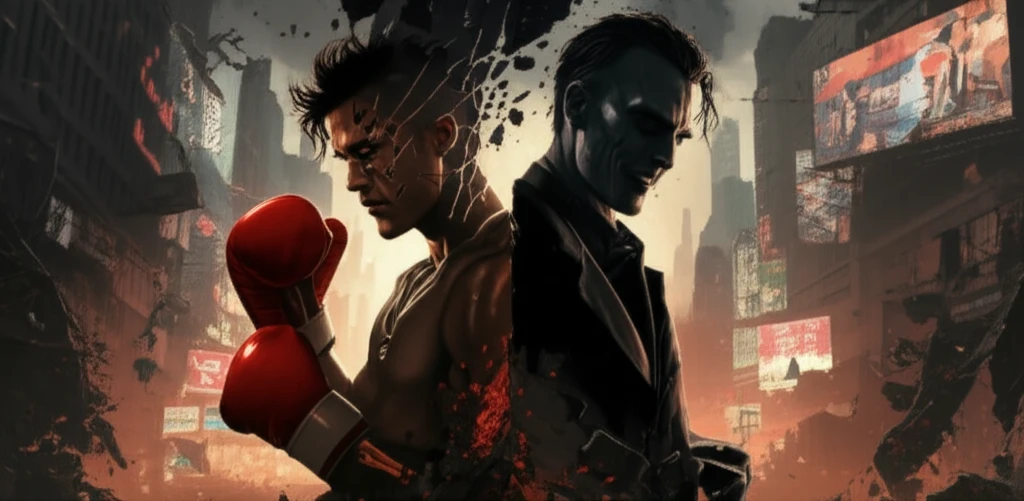
Fight Club: Duality of Man

Decoding Masculinity: Violence, Identity, and the Fight for Self in 'Fight Club'

"A deep dive into David Fincher's 'Fight Club' explores the film's complex portrayal of masculinity, violence, and the search for identity in a consumer-driven world."


David Fincher’s 'Fight Club', released in 1999, remains a potent cultural touchstone, sparking conversations about masculinity, consumerism, and the search for meaning in a seemingly hollow world. More than two decades after its debut, the film's raw portrayal of male angst and its critique of societal norms continue to resonate with audiences.

This article embarks on a hermeneutic journey into 'Fight Club', drawing upon psychoanalytic and Queer theories to dissect the film's representation of masculinity. The analysis will uncover the strategies employed to manage the pervasive fear of emasculation that simmers beneath the surface of the narrative.

Based on Chuck Palahniuk's equally provocative novel, 'Fight Club' centers on an unnamed narrator, Jack, who battles insomnia and a sense of profound dissatisfaction with his life. He finds an outlet in support groups for men with terminal illnesses, but his world is upended by the arrival of the enigmatic Tyler Durden. Together, they form an underground fight club that quickly spirals into a radical anti-consumerist movement known as Project Mayhem.

The Anxious Male: Castration Fears and Compensatory Fetishism

Fight Club: Duality of Man

The film subtly links its portrayal of masculinity to castration anxiety, a deep-seated fear of losing power and control. This anxiety manifests in recurring allusions to emasculation, ranging from parodic to subliminal. The characters grapple with feelings of inadequacy and vulnerability, fueling their need to assert dominance and reclaim their sense of self.

The characters often adopt fetishistic strategies as a means of compensation. These strategies involve fixating on objects or symbols that represent power and control, such as muscular bodies, violent acts, and anti-establishment rhetoric. These fetishes serve as a defense mechanism against the underlying fear of emasculation.

  • The Insomnia of Jack: Jack’s insomnia is presented as more than just sleeplessness; it symbolizes a deeper dysfunction tied to his masculinity. His doctor's suggestion to attend a testicular cancer support group underscores this connection.
  • Bob's Transformation: The character of Bob, a former bodybuilder whose testicles are removed due to cancer, embodies the literal emasculation that Jack fears. Bob’s embrace of Jack, with his enlarged breasts offering a grotesque parody of maternal comfort, highlights the anxieties surrounding lost virility.
  • Tyler's Reassurance: After Jack's apartment burns down, Tyler attempts to console him by referencing his anatomical integrity, stating, "Worse would have been if a bitch cut off your cock while you were sleeping and threw it in a garbage disposal." This remark emphasizes the ever-present fear of castration.
In 'Fight Club', the characters strive to construct and maintain a hegemonic vision of masculinity that is constantly threatened by the taboo of homosexuality. The film explores the eroticization of male masochism, revealing how it can be used as a performative strategy to reinforce heteronormative ideals. The violence and self-destruction displayed in the fight clubs become a way for men to prove their strength and dominance, while simultaneously suppressing any homoerotic desires.

Deconstructing the Fight: A Lasting Impact

Ultimately, 'Fight Club' serves as a powerful commentary on the anxieties and contradictions of modern masculinity. While the film can be interpreted as a critique of consumer culture and societal expectations, it also reveals the underlying fears and insecurities that drive men to seek validation through violence and dominance. The film's enduring popularity lies in its ability to tap into these deep-seated anxieties and spark conversations about the meaning of identity in a rapidly changing world. By unpacking the complex layers of masculinity and violence in 'Fight Club', we can gain a deeper understanding of the challenges and pressures faced by men in contemporary society.

About this Article -

This article was crafted using a human-AI hybrid and collaborative approach. AI assisted our team with initial drafting, research insights, identifying key questions, and image generation. Our human editors guided topic selection, defined the angle, structured the content, ensured factual accuracy and relevance, refined the tone, and conducted thorough editing to deliver helpful, high-quality information.See our About page for more information.

Everything You Need To Know

1

What are the core themes explored in David Fincher's 'Fight Club'?

The film 'Fight Club' delves into the complex interplay of masculinity, violence, identity, and consumer culture. It critiques societal norms and explores the anxieties of modern men, particularly focusing on themes like the fear of emasculation, the search for meaning in a consumer-driven world, and the struggle for self-identity. It also touches upon anti-consumerist sentiments and the impact of societal expectations on men.

2

How does the film 'Fight Club' portray the concept of castration anxiety and its impact on the characters?

In 'Fight Club', castration anxiety is a recurring theme, representing the characters' deep-seated fear of losing power and control. This fear manifests through various symbols and actions. The film subtly links masculinity to this anxiety through recurring allusions to emasculation. Characters like Bob, whose body is altered due to illness, embody literal emasculation. This anxiety fuels their need to assert dominance and reclaim their sense of self through compensatory strategies like fetishism. The unnamed narrator, Jack, and Tyler Durden's actions are heavily influenced by the desire to combat this fear.

3

How does 'Fight Club' use violence and the fight clubs to comment on masculinity?

The violence within 'Fight Club', especially in the fight clubs, is used to explore and critique hegemonic masculinity. The fight clubs provide a space where men can prove their strength and dominance, serving as a performative strategy to reinforce heteronormative ideals. The film explores the eroticization of male masochism, which allows men to express and manage their anxieties. The self-destructive acts and violence within these clubs become a way to assert masculinity while simultaneously suppressing any homoerotic desires. The film shows that the violence is a response to internal insecurities.

4

How does Jack's insomnia and experiences in support groups relate to his struggle with masculinity in 'Fight Club'?

Jack's insomnia in 'Fight Club' symbolizes a deeper dysfunction related to his masculinity. His doctor's suggestion to attend a testicular cancer support group underscores this connection, highlighting his subconscious anxieties. Jack’s experiences in these support groups, before meeting Tyler Durden, provide a contrast between his detached life and the raw emotional vulnerabilities of others. The shared experiences within these groups, though initially providing solace, ultimately prove insufficient, leading Jack to seek a more extreme outlet through Tyler and the fight clubs. This demonstrates a search for identity and meaning, as well as a struggle with internal dissatisfaction tied to societal expectations of masculinity.

5

What role does Tyler Durden play in the film's exploration of masculinity, and how does he contrast with Jack?

Tyler Durden serves as a catalyst in 'Fight Club' for the film's exploration of masculinity, representing an idealized, rebellious, and hyper-masculine persona. He embodies the anxieties of modern man. Tyler's influence leads Jack to create the fight clubs and Project Mayhem, which offer a means of reclaiming agency and expressing suppressed emotions. In contrast, Jack starts as an insomniac, passive, and dissatisfied individual. He is drawn to Tyler's confidence and ability to break societal norms. However, as the story unfolds, Jack begins to question Tyler's methods and the destructive nature of their actions, forcing him to confront the complexities and contradictions of his own masculinity and the consequences of unchecked dominance.

Newsletter Subscribe

Subscribe to get the latest articles and insights directly in your inbox.