
Decoding Market Chaos: How Social Learning Can Backfire and Individual Thinking Can Save the Day

"Dive into the fascinating world of the Minority Game and discover how blindly following the crowd can lead to market inefficiency, and why a little independent thought might be the best strategy."
The financial markets are complex adaptive systems, where the actions of countless individuals intertwine to create booms, busts, and everything in between. Understanding the dynamics of these markets is a constant challenge, and researchers are always seeking new ways to model and interpret market behavior. One such model, the Minority Game, offers valuable insights into how individual and collective learning can shape market outcomes.
Inspired by the El Farol Bar problem, the Minority Game is a simplified model of financial markets where agents (representing buyers and sellers) try to predict the minority action – whether to buy or sell. Success in the game depends on being in the minority, reflecting the real-world principle that profits are often made by going against the prevailing sentiment. However, what happens when agents start learning from each other, or developing their own strategies? Does it lead to a more efficient market, or does it create unintended consequences?
New research explores the roles of social and individual learning within the Minority Game framework. Social learning occurs when agents adopt the strategies of their neighbors within a social network, while individual learning involves agents independently changing their strategies. The findings reveal a surprising twist: while social learning might seem like a smart way to improve decision-making, it can actually undermine market efficiency. Fortunately, the research also suggests that individual learning can act as a corrective force, rescuing markets from the pitfalls of collective behavior.
The Perils of Following the Crowd: How Social Learning Can Wreck a Market
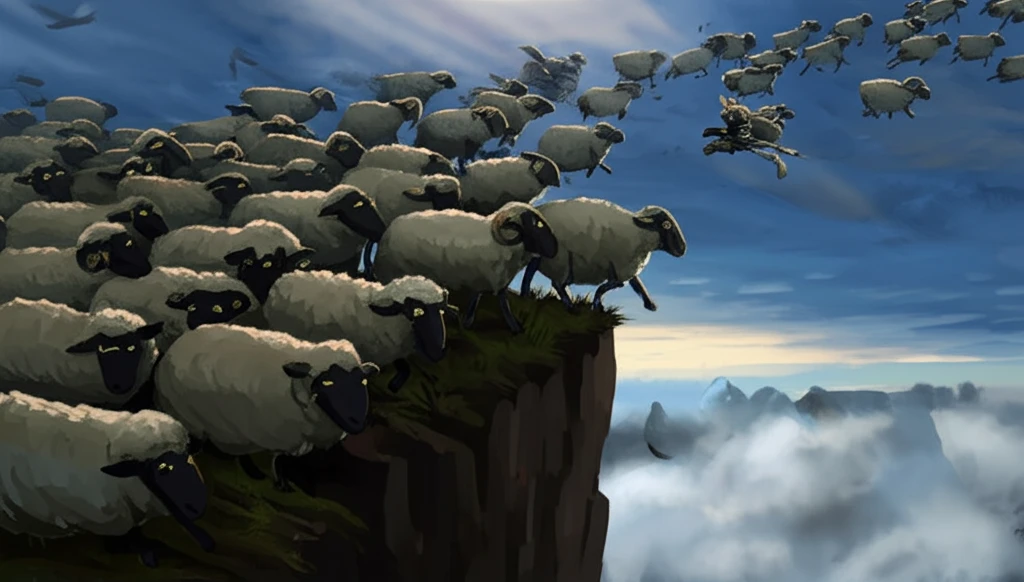
Imagine a group of investors, all connected through social media and constantly sharing their investment ideas. It sounds like a recipe for informed decision-making, right? However, this is where the research reveals a potential pitfall. The study demonstrates that social learning can decrease market efficiency due to negative frequency-dependent selection and a loss of strategy diversity. In simpler terms, when everyone copies everyone else, the market loses its ability to adapt and becomes vulnerable to instability.
- Loss of Diversity: When everyone imitates each other, the market loses its diversity of strategies. This makes the market less resilient and more prone to shocks.
- Herding Behavior: Social learning can lead to herding, where everyone follows the same trend, regardless of its underlying value. This creates bubbles and crashes.
- Negative Frequency Dependence: Strategies become less effective as more people adopt them, creating instability.
The Power of Independent Thought: Rescuing Markets Through Individual Learning
Fortunately, the research offers a solution to the problems created by excessive social learning: individual learning. The study demonstrates that individual learning can rescue a population engaged in social learning from such inefficiencies. By independently exploring new strategies and adapting to changing market conditions, individual learners can reintroduce diversity and stability into the market. This suggests that the most successful investors are not simply those who follow the crowd, but those who are willing to think for themselves and develop their own unique perspectives.