
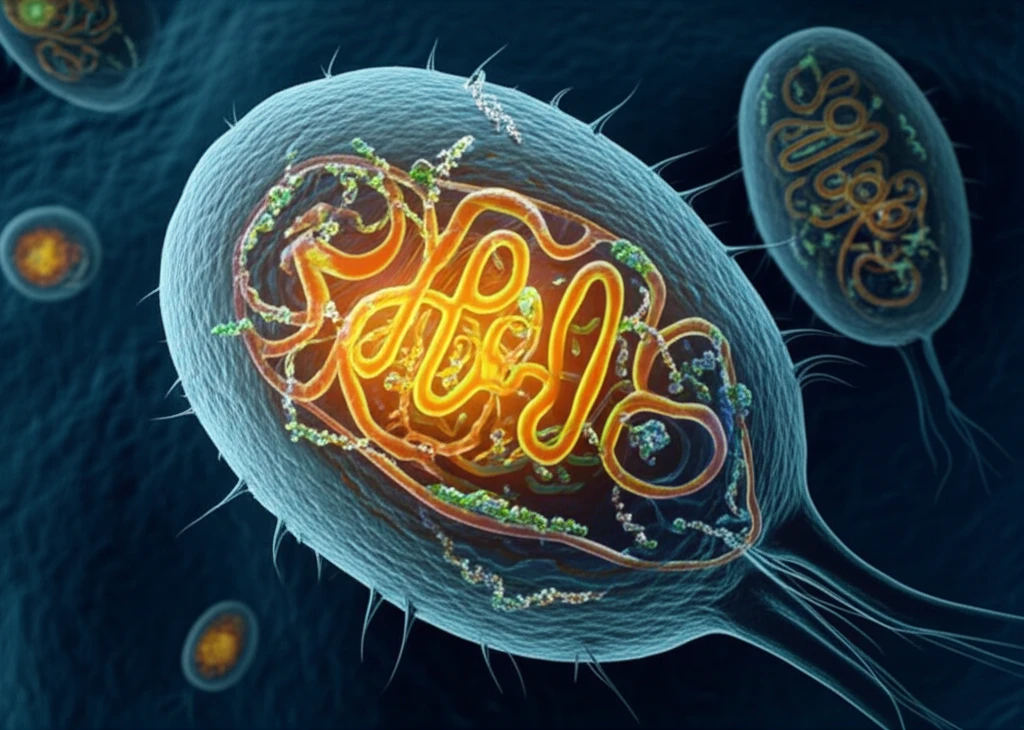
Decoding Malaria: How New Tech Unlocks the Secrets of Parasite's Cellular Hideout

"Scientists combine cutting-edge proteomics and AI to map the elusive apicoplast, revealing potential drug targets and rewriting our understanding of malaria parasite biology."
The fight against malaria is a constant race against resistance. As existing drugs lose their effectiveness, scientists urgently seek new ways to attack this deadly disease. One promising strategy lies in understanding the apicoplast, a unique organelle found in malaria parasites and related pathogens.
Think of the apicoplast as a cellular hideout with a fascinating history. It's essentially a non-photosynthetic plastid – a distant relative of chloroplasts in plants – acquired through a complex process called secondary endosymbiosis. This means a eukaryote engulfed another eukaryote that already had a plastid, resulting in a fascinating mix of bacterial and algal pathways within the parasite. Because these pathways are different from those in humans, the apicoplast represents a goldmine of potential drug targets.
However, unlocking the apicoplast's secrets has been challenging. An accurate inventory of its components, particularly its proteins, has been lacking. Now, a groundbreaking study combines proximity-based proteomics (BioID) with a new machine learning algorithm to create the most detailed map yet of the apicoplast proteome, paving the way for new antimalarial drug development and a deeper understanding of parasite biology.
Mapping the Unseen: A High-Confidence Apicoplast Proteome
The research team, led by scientists at Stanford University and the University of Melbourne, employed a clever strategy to overcome previous limitations. They used BioID, a technique where a promiscuous biotin ligase (an enzyme) is fused to a target protein – in this case, a protein known to reside in the apicoplast. This ligase then tags neighboring proteins with biotin, allowing scientists to identify them.
- Unprecedented Accuracy: The team identified 346 high-confidence apicoplast proteins, significantly outperforming previous prediction methods and other BioID studies.
- Novel Discoveries: Half of the identified proteins have unknown functions, hinting at previously undiscovered pathways within the apicoplast.
- Essential for Survival: A remarkable 77% of the identified proteins are predicted to be important for normal blood-stage growth, highlighting their potential as drug targets.
A New Era in Malaria Research
This high-confidence apicoplast proteome represents a significant leap forward in our understanding of malaria parasites. By providing a comprehensive map of the apicoplast's protein components, this research opens up exciting new avenues for drug discovery.
Scientists can now focus on elucidating the functions of the novel proteins identified in this study, potentially revealing unique pathways that can be targeted with new antimalarial drugs. The discovery of ABCF1's role in apicoplast biogenesis is just one example of the potential for these findings to revolutionize our understanding of parasite biology.
With resistance to existing drugs on the rise, this detailed map of the apicoplast provides a much-needed resource for developing the next generation of antimalarial therapies. The apicoplast, once a mysterious cellular hideout, is now firmly in the spotlight as a key to defeating malaria.