
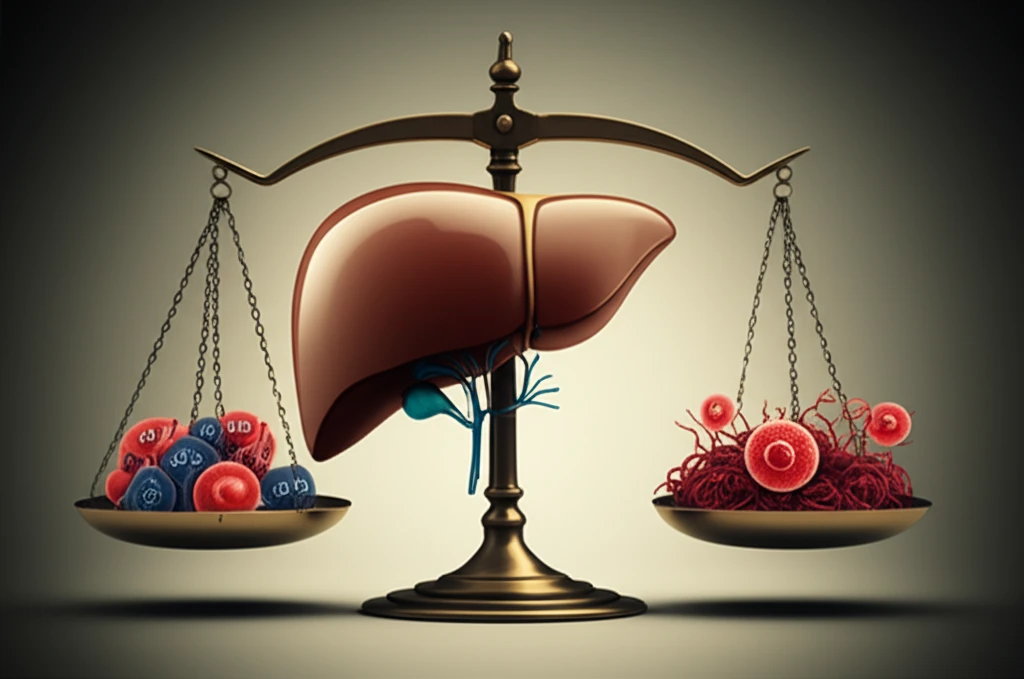
Surreal illustration depicting the balance of SRC-1 and SRC-3 proteins in a healthy liver versus the imbalance in liver cancer.

Decoding Liver Cancer: Why Balancing These Key Proteins Could Be Your Best Defense

"New research reveals how imbalances in steroid receptor coactivators SRC-1 and SRC-3 may fuel liver cancer development, offering potential new avenues for treatment and prevention."


Steroids play a vital role in how our livers function, both when healthy and when disease strikes. These powerful chemicals exert their influence through receptors, which in turn require the help of partner molecules called coactivators to activate genes. Think of it like a lock and key: the steroid is the key, the receptor is the lock, and the coactivator is what turns the lock to open the door to gene expression.

Among these coactivators, Steroid Receptor Coactivator-1 (SRC-1) and Steroid Receptor Coactivator-3 (SRC-3) have been linked to various cancers. However, their specific roles in liver cancer, including hepatocellular carcinoma (HCC) and cholangiocellular carcinoma (CCC), have remained unclear – until now.

Recent research has shed light on the intricate relationship between SRC-1 and SRC-3 in liver cancer. By examining tissue samples from normal livers, HCC, and CCC, scientists have uncovered an imbalanced expression pattern of these two coactivators, suggesting this disruption could be a key player in the development and progression of the disease. This article breaks down these findings, explores what they mean for your liver health, and discusses potential future implications.

SRC-1 vs. SRC-3: What's the Imbalance and Why Does It Matter?

Surreal illustration depicting the balance of SRC-1 and SRC-3 proteins in a healthy liver versus the imbalance in liver cancer.

The study employed a technique called tissue microarray immunohistochemistry to analyze the presence and location of SRC-1 and SRC-3 in liver tissue samples. Here's a breakdown of what they found:

In healthy liver tissue and HCC samples, SRC-1 was primarily found outside the cell nucleus. In CCC samples, SRC-1 was mainly located within the nucleus. SRC-3 was consistently found within the nucleus in all tissue types.

  • No significant changes in overall expression: The total amount of SRC-1 and SRC-3 wasn't drastically different between normal liver tissue and liver cancer tissue (HCC and CCC).
  • Key difference in CCC: SRC-3 expression was significantly higher in CCC compared to HCC.
  • The SRC-1/SRC-3 ratio imbalance: Although the total amount of SRC-1 and SRC-3 may be similar in normal liver tissue, HCC, and CCC, the balance between the two was disrupted in liver cancer. Specifically, SRC-1 expression was significantly decreased compared to SRC-3 expression in both HCC and CCC.
Further digging revealed that this imbalance was more pronounced in males with liver cancer. This disparity also appeared across all age groups in HCC, in younger CCC cases, and in all stages of liver cancer. This suggests the imbalance between SRC-1 and SRC-3 may affect hepatic function and contribute to liver carcinogenesis.

What This Means for You and the Future of Liver Cancer Research

This research highlights the importance of maintaining a balance between SRC-1 and SRC-3 in the liver. While we don't yet fully understand how to directly influence these protein levels through lifestyle or diet, the findings open exciting avenues for future research.

Researchers can now investigate how this SRC-1/SRC-3 imbalance impacts liver metabolism and contributes to tumor development. Understanding the precise mechanisms involved could lead to targeted therapies that restore balance and prevent or treat liver cancer.

While more research is needed, this study provides a valuable piece of the puzzle in understanding the complex landscape of liver cancer. By continuing to investigate the roles of SRC-1 and SRC-3, scientists hope to develop more effective strategies for preventing and treating this challenging disease, particularly for the populations most affected.

About this Article -

This article was crafted using a human-AI hybrid and collaborative approach. AI assisted our team with initial drafting, research insights, identifying key questions, and image generation. Our human editors guided topic selection, defined the angle, structured the content, ensured factual accuracy and relevance, refined the tone, and conducted thorough editing to deliver helpful, high-quality information.See our About page for more information.

This article is based on research published under:

DOI-LINK: 10.3892/ol.2018.9443, Alternate LINK

Title: Imbalanced Expression Pattern Of Steroid Receptor Coactivator‑1 And ‑3 In Liver Cancer Compared With Normal Liver: An Immunohistochemical Study With Tissue Microarray

Subject: Cancer Research

Journal: Oncology Letters

Publisher: Spandidos Publications

Authors: Shan Li, Huiyan Zhang, Yanlan Yu, Mengying Liu, Deyu Guo, Xuqing Zhang, Jiqiang Zhang

Published: 2018-09-17

Everything You Need To Know

1

What are SRC-1 and SRC-3, and what do they do?

The Steroid Receptor Coactivator-1 (SRC-1) and Steroid Receptor Coactivator-3 (SRC-3) are proteins that act as coactivators. They work with steroid receptors to help activate genes. Think of it like a lock and key: the steroid is the key, the receptor is the lock, and the coactivator (SRC-1 and SRC-3) turns the lock to open the door to gene expression. These coactivators play a role in various cancers, specifically in liver cancer.

2

How are SRC-1 and SRC-3 related to liver cancer?

The imbalance between SRC-1 and SRC-3, where SRC-1 expression is decreased compared to SRC-3, is linked to liver cancer development. This imbalance was observed in both hepatocellular carcinoma (HCC) and cholangiocellular carcinoma (CCC) samples. The disruption in the balance between the two proteins suggests that it may affect hepatic function and contribute to liver carcinogenesis.

3

What specific differences in SRC-1 and SRC-3 were found in different types of liver tissue?

The research found that in healthy liver tissue and HCC samples, SRC-1 was primarily found outside the cell nucleus. In CCC samples, SRC-1 was mainly located within the nucleus. SRC-3 was consistently found within the nucleus in all tissue types. It was also observed that SRC-3 expression was significantly higher in CCC compared to HCC. The balance between SRC-1 and SRC-3 was disrupted in liver cancer, with SRC-1 expression decreased compared to SRC-3.

4

Are there any particular groups of people who are more affected by the SRC-1 and SRC-3 imbalance?

The imbalance in SRC-1 and SRC-3 appears across all age groups in HCC, younger CCC cases, and all stages of liver cancer. This indicates that the balance between these two proteins is a key factor in liver cancer development. Further digging revealed that this imbalance was more pronounced in males with liver cancer, suggesting a potential gender-specific impact on the disease.

5

What are the potential future implications of this research on SRC-1 and SRC-3?

While there's no current method to directly control SRC-1 and SRC-3 levels through lifestyle or diet, these findings open new avenues for future research. Understanding the roles of SRC-1 and SRC-3 can lead to new treatments, prevention strategies, and improved ways to diagnose and manage liver cancer. This research highlights the importance of maintaining a balance between SRC-1 and SRC-3 in the liver.

Newsletter Subscribe

Subscribe to get the latest articles and insights directly in your inbox.