
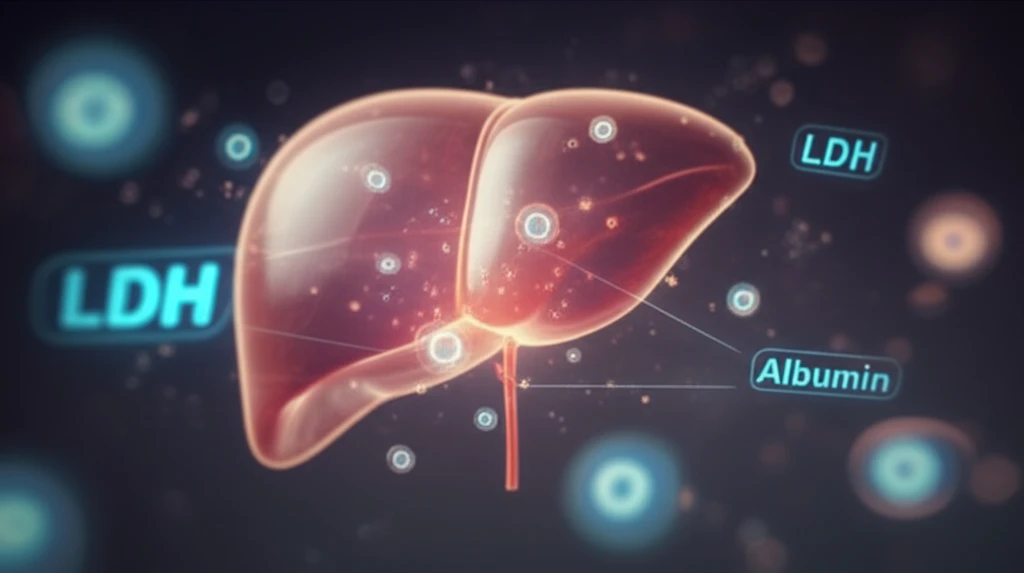
Surreal illustration of a liver with floating biomarkers.

Decoding Liver Cancer: How a Simple Ratio Could Save Lives

"New research highlights the importance of the lactic dehydrogenase to albumin ratio in predicting outcomes for liver cancer patients. Discover how this simple test can help personalize treatment and improve survival rates."


Liver cancer, particularly hepatocellular carcinoma (HCC), remains a significant global health challenge. Early detection and effective treatment strategies are crucial for improving patient survival rates. Recent research published in 'Cancer Management and Research' sheds light on a promising prognostic marker: the lactic dehydrogenase to albumin ratio (LAR).

The study, led by Gan W, Zhang MX, and Wang JX, investigates the impact of LAR in patients with Child-Pugh I HCC who underwent curative resection. This patient group represents those with relatively well-preserved liver function, making them ideal candidates for aggressive treatment approaches.

The findings suggest that LAR could serve as a valuable tool in predicting treatment outcomes and tailoring personalized treatment plans. By understanding the implications of this ratio, healthcare professionals can make more informed decisions, ultimately leading to better patient outcomes and improved survival rates.

What is the Lactic Dehydrogenase to Albumin Ratio (LAR)?

Surreal illustration of a liver with floating biomarkers.

The lactic dehydrogenase to albumin ratio (LAR) is a calculated value derived from two routinely measured blood tests: lactic dehydrogenase (LDH) and albumin. LDH is an enzyme found in nearly all living cells, and elevated levels in the blood can indicate tissue damage or disease. Albumin, on the other hand, is a protein produced by the liver and is a measure of liver function and overall nutritional status. A lower albumin level can indicate liver damage or malnutrition.

The ratio between these two markers provides a more nuanced understanding of a patient's condition than either marker alone. A high LAR suggests a combination of increased tissue damage (indicated by high LDH) and decreased liver function/nutritional status (indicated by low albumin). This combination can be particularly relevant in cancer patients, as it may reflect the tumor's metabolic activity and the body's ability to cope with the disease.

  • LDH (Lactic Dehydrogenase): An enzyme indicating tissue damage.
  • Albumin: A protein reflecting liver function and nutritional status.
  • LAR (LDH/Albumin Ratio): Provides a combined assessment of tissue damage and liver function.
In the context of hepatocellular carcinoma (HCC), LAR serves as a prognostic indicator. Studies have shown that patients with higher LAR values tend to have poorer outcomes, including shorter overall survival and increased risk of recurrence. This is because a high LAR can signify more aggressive tumor biology and compromised liver function, both of which hinder treatment effectiveness.

Moving Forward: The Future of Personalized Liver Cancer Treatment

The study by Gan W, Zhang MX, Wang JX, et al. underscores the potential of LAR as a simple yet powerful tool in predicting outcomes for liver cancer patients. By integrating LAR into routine clinical practice, healthcare professionals can make more informed decisions about treatment strategies, ultimately improving patient survival rates and quality of life. As research continues to evolve, personalized approaches that consider individual patient characteristics will pave the way for a brighter future in liver cancer management.

About this Article -

This article was crafted using a human-AI hybrid and collaborative approach. AI assisted our team with initial drafting, research insights, identifying key questions, and image generation. Our human editors guided topic selection, defined the angle, structured the content, ensured factual accuracy and relevance, refined the tone, and conducted thorough editing to deliver helpful, high-quality information.See our About page for more information.

This article is based on research published under:

DOI-LINK: 10.2147/cmar.s194035, Alternate LINK

Title: Prognostic Impact Of Lactic Dehydrogenase To Albumin Ratio In Hepatocellular Carcinoma Patients With Child&Amp;Ndash;Pugh I Who Underwent Curative Resection: A Prognostic Nomogram Study [Erratum]

Subject: Oncology

Journal: Cancer Management and Research

Publisher: Informa UK Limited

Authors: Wei Gan, Mei-Xia Zhang, Jia-Xing Wang, Yi-Peng Fu, Jin-Long Huang, Yong Yi, Chu-Yu Jing, Jia Fan, Jian Zhou, Shuang-Jian Qiu

Published: 2018-11-01

Everything You Need To Know

1

What is the Lactic Dehydrogenase to Albumin Ratio (LAR), and how is it calculated?

The Lactic Dehydrogenase to Albumin Ratio (LAR) is calculated using two blood tests: Lactic Dehydrogenase (LDH) and Albumin. LDH, an enzyme found in cells, indicates tissue damage when elevated. Albumin, a protein made by the liver, reflects liver function and nutritional status. LAR combines these to provide a comprehensive assessment. A high LAR suggests increased tissue damage (high LDH) and compromised liver function or nutritional status (low Albumin). This combination can be particularly relevant in cancer patients, as it may reflect the tumor's metabolic activity and the body's ability to cope with the disease.

2

Why is the Lactic Dehydrogenase to Albumin Ratio (LAR) important?

The Lactic Dehydrogenase to Albumin Ratio (LAR) is significant because it helps predict outcomes for liver cancer patients, particularly those with hepatocellular carcinoma (HCC). Patients with higher LAR values tend to have poorer outcomes, including shorter overall survival and increased risk of recurrence. This is because a high LAR can signify more aggressive tumor biology and compromised liver function, both of which hinder treatment effectiveness. This ratio provides a more nuanced understanding of a patient's condition than either marker alone, potentially aiding in personalized treatment strategies.

3

What are the implications of a high Lactic Dehydrogenase to Albumin Ratio (LAR) in liver cancer patients?

The implications of a high Lactic Dehydrogenase to Albumin Ratio (LAR) in liver cancer patients are significant. A high LAR suggests more aggressive tumor biology, indicating the tumor's metabolic activity and the body's limited ability to cope with the disease, and compromised liver function. This combination can lead to poorer outcomes, including shorter overall survival and increased risk of recurrence. Healthcare professionals can use the LAR to make more informed decisions about treatment strategies, ultimately improving patient survival rates and quality of life.

4

What does the Lactic Dehydrogenase (LDH) level indicate in the context of liver cancer?

Lactic Dehydrogenase (LDH) is an enzyme present in almost all living cells. Elevated levels of LDH in the blood usually indicate tissue damage or disease. This can be due to a variety of factors, including injury, infection, or cancer. When assessing liver cancer, LDH levels are one part of the Lactic Dehydrogenase to Albumin Ratio (LAR) that assists in giving a more complete understanding of the patient's status.

5

What is Albumin, and why is it relevant in the context of liver cancer treatment?

Albumin is a protein produced by the liver, serving as a measure of liver function and overall nutritional status. Lower albumin levels often indicate liver damage or malnutrition. In the context of the Lactic Dehydrogenase to Albumin Ratio (LAR), albumin is used in conjunction with Lactic Dehydrogenase (LDH) to assess the overall health of liver cancer patients. The ratio helps understand the interplay between tissue damage, indicated by LDH, and liver function and nutritional status, reflected by Albumin.

Newsletter Subscribe

Subscribe to get the latest articles and insights directly in your inbox.