
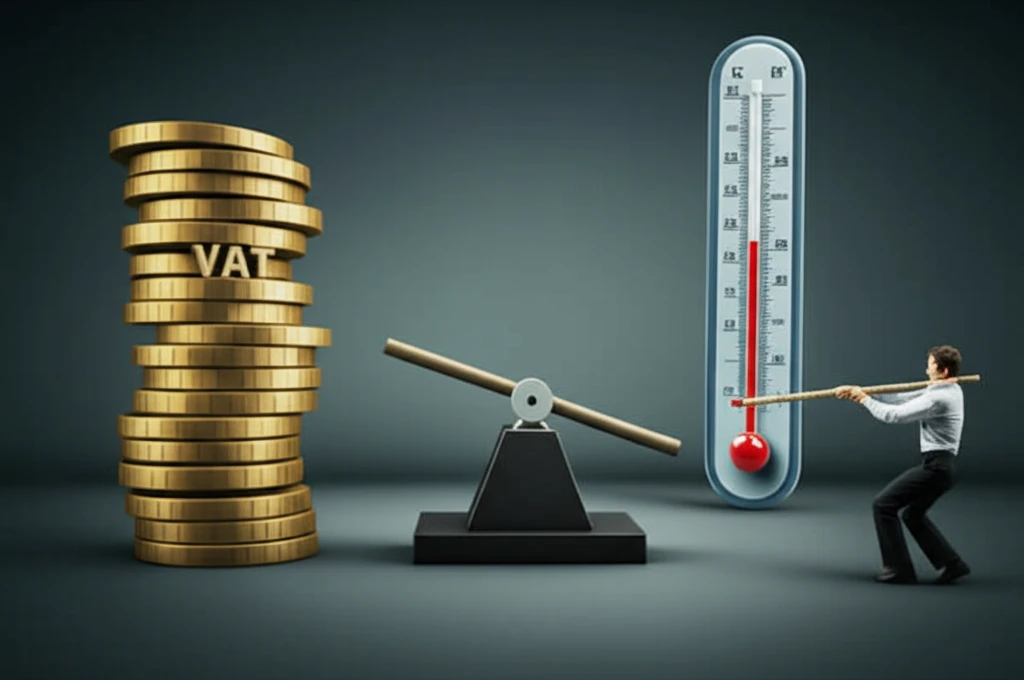
Illustration of VAT, Interest Rates, and Inflation in a tug-of-war, symbolizing the economic forces at play.

Decoding Inflation: How VAT and Interest Rates Impact Your Wallet

"A deep dive into the intricate relationship between fiscal policies, monetary tools, and their effects on inflation, KDV, and deposit interest rates in Turkey from 1985-2022."


In the realm of economics, a constant balancing act takes place to manage factors like employment, price stability, sustainable growth, and trade deficits. Governments often use fiscal policies—think public spending and taxation—to steer the economy. Value Added Tax (VAT), a consumption tax applied at each stage of production, is one key tool. But how exactly does VAT interact with other economic levers, like interest rates, to influence inflation?

Monetary policy, often managed by central banks, also plays a crucial role. By adjusting interest rates, central banks aim to control inflation and stimulate or cool down economic activity. Deposit interest rates, in particular, can influence savings and borrowing behavior, ultimately affecting the overall demand in the economy.

This article investigates the complex interplay between VAT, deposit interest rates, and inflation in Turkey from 1985 to 2022. By analyzing historical data, we will uncover how these factors have influenced each other and what implications these relationships have for individuals and businesses.

Understanding the VAT, Interest Rate, and Inflation Connection

Illustration of VAT, Interest Rates, and Inflation in a tug-of-war, symbolizing the economic forces at play.

To grasp the relationship between VAT, interest rates, and inflation, it's essential to first understand each concept individually and how they're traditionally used:

VAT (Value Added Tax): This is a consumption tax applied at each stage of the supply chain, from production to final sale. Governments often adjust VAT rates to influence consumer spending. Raising VAT can curb demand during inflationary periods, while lowering VAT can encourage spending during economic downturns. However, VAT can also be regressive, disproportionately affecting lower-income households.

  • Orthodox Approach: In an inflationary environment, governments and central banks often employ contractionary fiscal and monetary policies. This involves increasing taxes (like VAT) and raising interest rates to reduce spending and investment, thereby cooling down the economy.
  • Heterodox Approach: While less common, some economic schools advocate for alternative approaches, such as direct price controls or wage policies, to combat inflation. These methods are generally viewed as less effective in the long run.
The research paper employs several econometric models to analyze the relationship between VAT, deposit interest rates, and inflation in Turkey:

Policy Implications and the Road Ahead

The findings of this study highlight the intricate relationships between fiscal and monetary policies in managing inflation. Specifically, the research showed VAT income, interest rates, and the rate of inflation influence one another, for Turkey between 1985 and 2022. Coordinated and consistent application of monetary and fiscal tools are most effective. Central banks need to use tools like interest rates and governments use fiscal tools like VAT to have macroeconomic stability. Future research could explore the specific ways these policies interact and affect economic outcomes, leading to more informed and effective policymaking.

About this Article -

This article was crafted using a human-AI hybrid and collaborative approach. AI assisted our team with initial drafting, research insights, identifying key questions, and image generation. Our human editors guided topic selection, defined the angle, structured the content, ensured factual accuracy and relevance, refined the tone, and conducted thorough editing to deliver helpful, high-quality information.See our About page for more information.

Everything You Need To Know

1

What is Value Added Tax (VAT), and how do governments use it to influence consumer spending?

Value Added Tax (VAT) is a consumption tax applied at each stage of the supply chain, from production to the final sale. Governments often adjust VAT rates to manage consumer spending. Raising VAT can curb demand during inflationary periods, while lowering VAT can encourage spending during economic downturns. However, it's worth noting that VAT can disproportionately affect lower-income households, making it a regressive tax. The effectiveness of VAT adjustments depends on various factors, including the responsiveness of consumers to price changes and the overall economic climate.

2

How do central banks use deposit interest rates to manage inflation, and what impact does this have on the economy?

Central banks manage inflation by adjusting interest rates. Deposit interest rates, in particular, influence savings and borrowing behavior, ultimately affecting the overall demand in the economy. Higher deposit interest rates can incentivize saving, reducing the amount of money circulating and potentially cooling down inflation. Conversely, lower deposit interest rates can encourage borrowing and spending, stimulating economic activity. The effect of changes in deposit interest rates on the economy is also influenced by consumer confidence, investment opportunities, and global economic conditions. The analysis of Turkey from 1985-2022 indicated that interest rate policy and inflation were closely linked.

3

What is the 'orthodox approach' to managing inflation, and how does it involve VAT and interest rates?

The 'orthodox approach' to managing inflation involves contractionary fiscal and monetary policies. This typically means increasing taxes, like VAT, and raising interest rates. The goal is to reduce spending and investment, thereby cooling down the economy. Higher VAT increases the cost of goods and services, reducing consumer demand, while higher interest rates make borrowing more expensive, discouraging investment and spending. These measures aim to bring aggregate demand in line with aggregate supply, stabilizing prices. While generally considered effective, this approach can also lead to slower economic growth or even recession if implemented too aggressively. From 1985-2022, Turkey has often followed the orthodox approach.

4

Besides the orthodox approach, are there alternative (heterodox) strategies for combating inflation? What are their limitations?

Yes, some economic schools advocate for alternative, 'heterodox,' approaches to combat inflation, such as direct price controls or wage policies. Price controls involve setting maximum prices for certain goods and services, while wage policies may involve government intervention to control wage increases. However, these methods are generally viewed as less effective in the long run. Price controls can lead to shortages and black markets, while wage controls can distort labor markets and reduce productivity. These approaches often fail to address the underlying causes of inflation, such as excessive money supply or supply chain disruptions. The long-term effectiveness of these policies is debatable, and they often come with unintended consequences, making them less favored than orthodox measures.

5

What policy implications can be drawn from studying the relationship between VAT, interest rates, and inflation in Turkey from 1985 to 2022, and what areas could future research explore?

The study of VAT, interest rates, and inflation in Turkey from 1985 to 2022 highlights the intricate relationships between fiscal and monetary policies in managing inflation. The research demonstrated that VAT income, interest rates, and the rate of inflation influence one another, and the coordinated and consistent application of monetary and fiscal tools are most effective. For macroeconomic stability, central banks must use tools like interest rates, and governments must use fiscal tools like VAT. Future research could explore the specific ways these policies interact and affect economic outcomes in different contexts, considering factors like global economic shocks, political stability, and institutional quality. Additionally, investigating the distributional effects of these policies and their impact on different sectors of the economy could lead to more informed and effective policymaking.

Newsletter Subscribe

Subscribe to get the latest articles and insights directly in your inbox.