
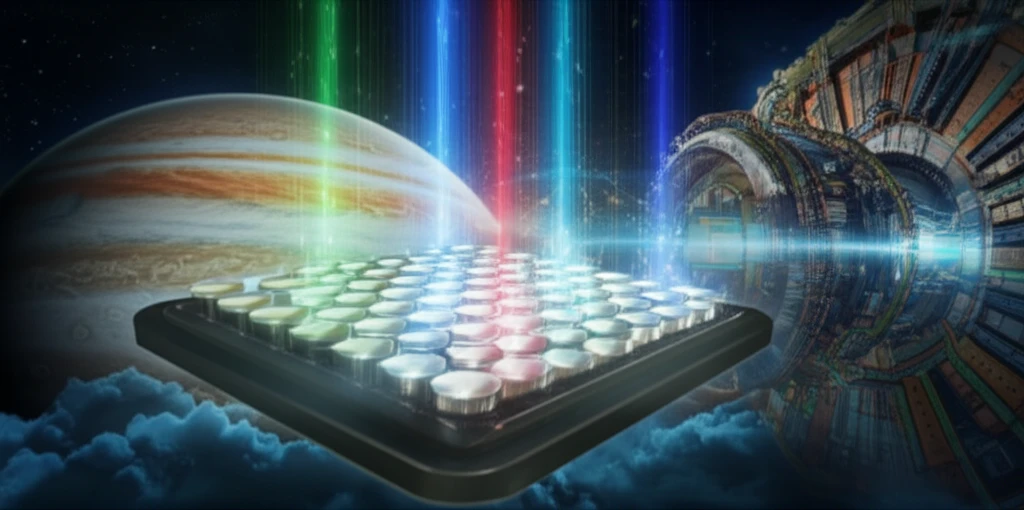
Decoding High-Energy Particle Detection: How Microchannel Plates Are Revolutionizing Physics

"Explore how microchannel plate detectors are boosting our understanding of particle behavior, impacting everything from space missions to high-energy experiments."
In the realm of particle physics and space exploration, detecting high-energy particles is crucial for unraveling the mysteries of the universe. Traditional detectors often face limitations in temporal resolution and efficiency, prompting the need for innovative solutions. Microchannel plates (MCPs) have emerged as a game-changing technology, offering high gain and exceptional spatial and temporal resolution for detecting various particles.
A recent study published in the Review of Scientific Instruments delves into the detection efficiency of MCPs for electrons and pions within a specific momentum range. This research not only enhances our understanding of particle detection but also has significant implications for optimizing radiation shielding in space missions and improving the accuracy of high-energy physics experiments.
This article will break down the key findings of this study, explaining how MCPs work, their applications in extreme environments like Jupiter's magnetic field, and their potential for advancing our knowledge of the cosmos and the fundamental laws of physics.
Unveiling Microchannel Plate Technology: How Does It Capture High-Speed Particles?
Microchannel plates function as compact electron multipliers, amplifying signals from individual particles with remarkable precision. These detectors consist of a matrix of tiny channels, each coated with a material that emits secondary electrons when struck by an incoming particle. This cascade effect amplifies the original signal, enabling the detection of even faint traces of radiation.
- High Gain: MCPs amplify signals significantly, allowing detection of even weak particle interactions.
- Excellent Resolution: They provide precise spatial and temporal resolution, capturing events with high fidelity.
- Versatile Applications: MCPs are used to detect a wide range of particles, including electrons, ions, photons, and even neutral atoms.
Impact and Future Directions: Why This Research Matters
The findings of this study have far-reaching implications. For space missions, understanding the detection efficiency of MCPs against high-energy radiation is vital for optimizing radiation shielding of sensitive instruments. By characterizing how MCPs respond to penetrating radiation, scientists can design more robust detectors for exploring harsh environments like Jupiter's magnetic field.
Moreover, the research demonstrates the potential of MCPs for measuring high-energy particle beams with exceptional temporal resolution. This opens new avenues for studying particle interactions and dynamics in high-energy physics experiments.
As technology advances, MCPs are poised to play an increasingly important role in unlocking the secrets of the universe. Continued research and development in this field will undoubtedly lead to even more sensitive and versatile detectors, pushing the boundaries of scientific discovery.