
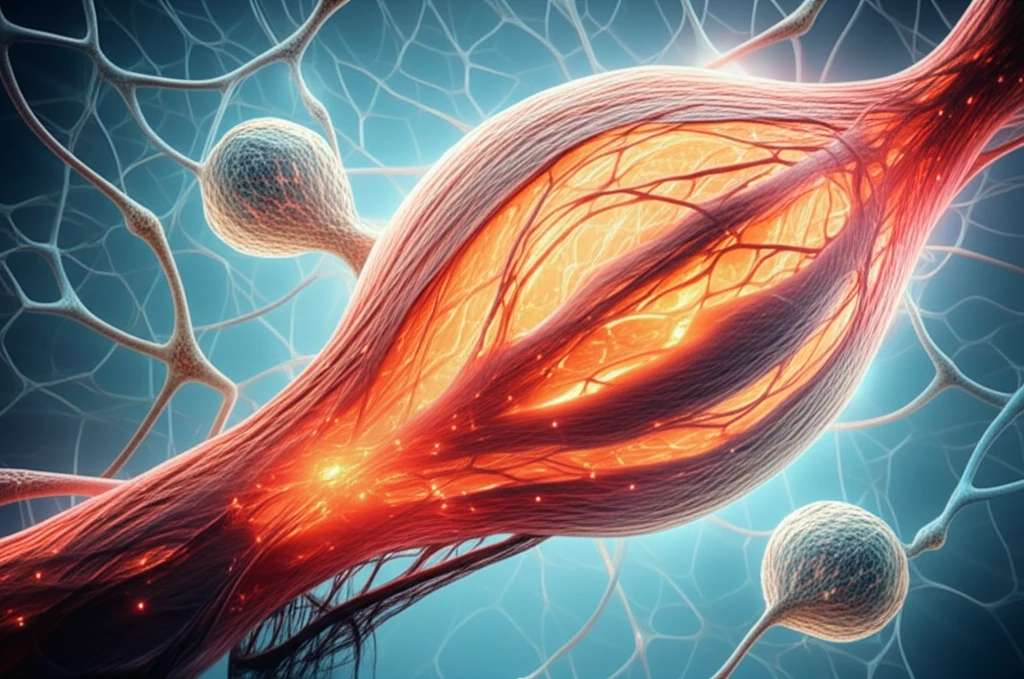
Interwoven heart muscle cells (cardiomyocytes) and supporting cells (fibroblasts).

Decoding Heart Health: How Fibroblasts and Cardiomyocytes Team Up (and Clash) in Engineered Tissue

"Unlocking the secrets of heart tissue engineering: A look at the surprising roles of fibroblasts and cardiomyocytes in creating functional heart muscle."


For years, scientists have strived to recreate the complex structure and function of the human heart in the lab. One promising approach is engineered heart muscle (EHM), which involves building functional heart tissue from cells and supportive materials. But how do these components work together to create a beating, force-generating tissue?

Recent research has shed light on the surprising roles of two key cell types: fibroblasts and cardiomyocytes. Cardiomyocytes are the heart muscle cells responsible for contraction, while fibroblasts are cells that provide structural support and produce the extracellular matrix (ECM), the scaffolding that holds cells together. It turns out that these cells have a complex and sometimes conflicting relationship that's crucial for EHM development.

This article explores the fascinating interplay between fibroblasts and cardiomyocytes in EHM, diving into the latest findings on how they influence tissue stiffening, cell organization, and overall heart muscle function. Understanding this cellular dance could pave the way for better heart disease treatments and regenerative therapies.

The Dynamic Duo: Fibroblasts as Architects, Cardiomyocytes as Regulators

Interwoven heart muscle cells (cardiomyocytes) and supporting cells (fibroblasts).

In the early stages of EHM formation, fibroblasts take center stage. They act as architects, compacting the surrounding collagen network, a key component of the ECM. This compaction process stiffens the tissue, providing a foundation for cardiomyocytes to organize and form a functional syncytium – a group of cells that act as a single unit.

However, cardiomyocytes play a critical role in regulating this stiffening process. They act as cellular antagonists, tempering the fibroblast-mediated tissue stiffening. This balance is essential for creating EHM that can contract effectively and generate force. Too much stiffness can hinder cardiomyocyte function, while too little can compromise tissue structure.

Here are some key points about their roles:
  • Fibroblasts:
    • Drive collagen compaction and tissue stiffening
    • Activate transcription profiles that support heart muscle development and ECM synthesis
  • Cardiomyocytes:
    • Attenuate fibroblast-mediated tissue stiffening
    • Enable the assembly of stably contracting, force-generating EHM
Researchers discovered that fibroblasts are highly sensitive to tissue compaction, quickly activating transcription profiles that promote heart muscle development and ECM synthesis. This highlights the importance of fibroblasts in creating a supportive environment for cardiomyocytes to thrive.

Looking Ahead: Optimizing EHM for Heart Repair and Disease Modeling

This research provides valuable insights into the complex interplay between fibroblasts and cardiomyocytes during EHM formation. By understanding how these cells interact to influence tissue stiffening and cell organization, scientists can fine-tune EHM development for various applications. This includes creating more effective heart repair therapies, developing better models for studying heart disease in vitro, and testing new drug candidates.

About this Article -

This article was crafted using a human-AI hybrid and collaborative approach. AI assisted our team with initial drafting, research insights, identifying key questions, and image generation. Our human editors guided topic selection, defined the angle, structured the content, ensured factual accuracy and relevance, refined the tone, and conducted thorough editing to deliver helpful, high-quality information.See our About page for more information.

Everything You Need To Know

1

What is engineered heart muscle, and why is it important?

Engineered heart muscle (EHM) refers to functional heart tissue that's constructed from cells and supportive materials in a laboratory setting. This approach aims to replicate the structure and function of natural heart tissue. The significance lies in its potential to revolutionize heart disease treatment, offering possibilities for heart repair therapies, disease modeling, and drug testing.

2

What are cardiomyocytes, and what role do they play in engineered heart muscle?

Cardiomyocytes are the heart muscle cells responsible for the heart's ability to contract and generate force. They are essential for the EHM's ability to function like natural heart tissue. Their role extends to regulating tissue stiffening, acting as antagonists to fibroblast-mediated stiffening. The implications are that functional EHM relies on healthy, well-functioning cardiomyocytes.

3

What are fibroblasts, and what is their role in the context of heart tissue engineering?

Fibroblasts are cells that provide structural support within the heart tissue. They produce the extracellular matrix (ECM), a scaffolding that holds cells together. Fibroblasts drive collagen compaction and tissue stiffening, activating transcription profiles that support heart muscle development and ECM synthesis. This makes them crucial in the early stages of EHM formation, creating a supportive environment for cardiomyocytes.

4

What is the extracellular matrix, and why is it important for creating heart tissue?

The extracellular matrix (ECM) is the scaffolding that holds cells together within heart tissue. In EHM, the ECM is crucial because it provides the structural support necessary for cells to organize and function properly. Fibroblasts play a key role in producing and maintaining the ECM. Without a functional ECM, the EHM would lack the necessary framework for cardiomyocytes to effectively contract and generate force.

5

How do fibroblasts and cardiomyocytes work together in engineered heart muscle, and why is their interaction so important?

In the creation of EHM, fibroblasts and cardiomyocytes interact in a complex way. Fibroblasts initially compact the collagen network, stiffening the tissue, while cardiomyocytes regulate this stiffening process. This balance is essential; too much stiffness hinders cardiomyocyte function, while too little compromises tissue structure. This interplay highlights the need to understand and control these interactions for successful EHM development. The interaction and ratios between the two cells is an on going area of research.

Newsletter Subscribe

Subscribe to get the latest articles and insights directly in your inbox.