
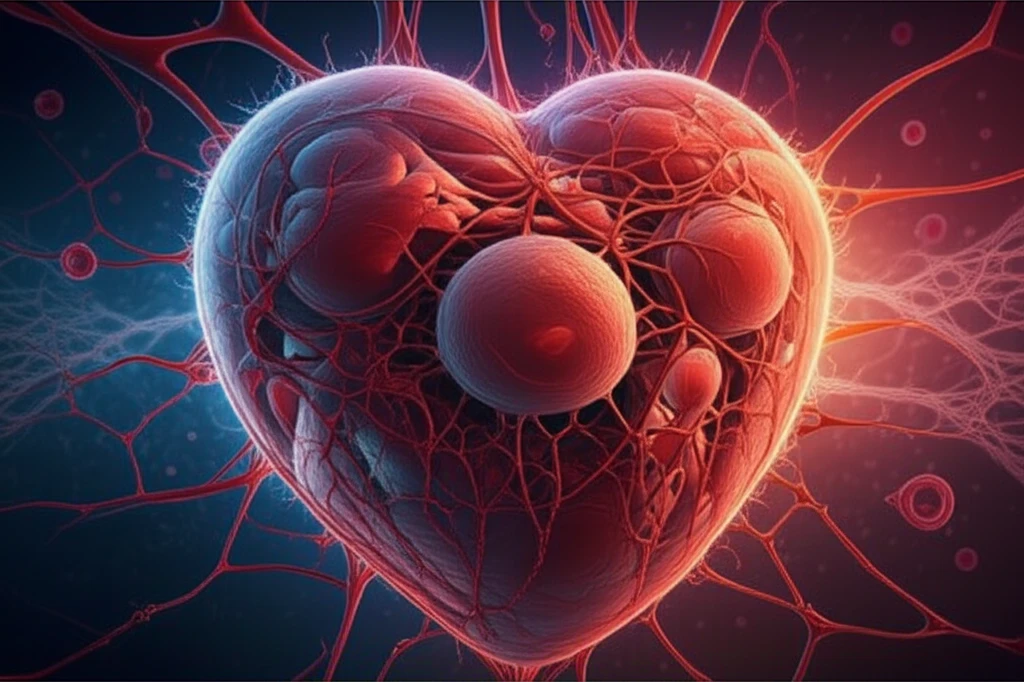
Interconnected heart cells forming resilient heart muscle

Decoding Heart Health: How Fibroblasts and Cardiomyocytes Collaborate for a Stronger Heart

"Unlocking the secrets of heart tissue engineering: A deep dive into the roles of fibroblasts and cardiomyocytes in creating resilient, functional heart muscle."


For years, scientists have been trying to unlock the complexities of the human heart. Creating functional heart muscle in the lab is a field of intense research that could transform how we treat heart disease. At the heart of this effort lies a fundamental question: How do the different cells within the heart work together to build a strong, resilient organ?

Two types of cells are especially important: cardiomyocytes, the cells responsible for contraction, and fibroblasts, which provide structural support. Think of cardiomyocytes as the engine of the heart, while fibroblasts are the scaffolding that holds everything in place. The interaction between these two cell types is crucial for creating healthy heart tissue, both in the body and in the lab.

New research is shedding light on the fascinating interplay between fibroblasts and cardiomyocytes. Scientists are exploring how these cells influence the stiffness and elasticity of engineered heart muscle, offering valuable insights for improving heart health and treating cardiac conditions.

The Dynamic Duo: Fibroblasts and Cardiomyocytes in Action

Interconnected heart cells forming resilient heart muscle

The heart isn't just a collection of individual cells; it's a carefully orchestrated community. Cardiomyocytes provide the force needed for each heartbeat, while fibroblasts maintain the structural integrity of the heart tissue. These cells work together, constantly communicating and adapting to their environment to keep your heart pumping smoothly.

Fibroblasts play a vital role in regulating the extracellular matrix (ECM), the network of proteins and other molecules that surrounds and supports cells. By compacting the collagen network within the ECM, fibroblasts contribute to the overall stiffness of heart tissue. This stiffness is essential for the heart to maintain its shape and efficiently transmit contractile forces.

  • The Yin and Yang of Stiffness: Researchers have discovered that while fibroblasts generally increase tissue stiffness, cardiomyocytes can counteract this effect. This delicate balance is crucial; too much stiffness can impair heart function, while too little can weaken the tissue.
  • Self-Organization: Fibroblasts help cardiomyocytes to assemble into a functional syncytium, a coordinated network that allows for synchronized contractions. Without fibroblasts, cardiomyocytes struggle to organize properly.
  • Early Compaction: The initial consolidation of heart tissue is largely driven by fibroblasts. This process sets the stage for the later development of a strong, force-generating heart muscle.
To study these interactions, scientists create engineered heart muscle (EHM) in the lab, combining cardiomyocytes and fibroblasts in a collagen hydrogel. By carefully controlling the ratio of these cells, researchers can mimic the natural environment of the heart and observe how they interact. These models are essential for understanding the complexities of heart tissue formation and identifying potential therapeutic targets.

The Future of Heart Health: Engineering Stronger Hearts

Understanding how fibroblasts and cardiomyocytes interact is crucial for developing new therapies for heart disease. By learning how to optimize the composition and mechanical properties of engineered heart muscle, scientists hope to create functional tissue that can be used to repair damaged hearts or even create entirely new organs. This research is not just about building better hearts in the lab; it's about improving the lives of millions affected by cardiac conditions.

About this Article -

This article was crafted using a human-AI hybrid and collaborative approach. AI assisted our team with initial drafting, research insights, identifying key questions, and image generation. Our human editors guided topic selection, defined the angle, structured the content, ensured factual accuracy and relevance, refined the tone, and conducted thorough editing to deliver helpful, high-quality information.See our About page for more information.

Everything You Need To Know

1

What are the primary roles of Cardiomyocytes and Fibroblasts in the heart?

Cardiomyocytes are the primary cells responsible for the heart's contractile function, acting as the engine that powers each heartbeat. Fibroblasts, on the other hand, provide structural support, forming the scaffolding that holds heart tissue together. They also regulate the extracellular matrix (ECM), influencing tissue stiffness and elasticity. The balance between these two cell types is crucial for maintaining healthy heart function and creating resilient heart muscle.

2

How do Fibroblasts influence the stiffness of heart tissue, and why is this important?

Fibroblasts influence the stiffness of heart tissue by compacting the collagen network within the extracellular matrix (ECM). This stiffness is essential for the heart to maintain its shape and efficiently transmit contractile forces. However, it's a delicate balance; too much stiffness can impair heart function, while too little can weaken the tissue. The interaction between Fibroblasts and Cardiomyocytes maintains the correct stiffness levels.

3

How do scientists study the interaction between Cardiomyocytes and Fibroblasts?

Scientists study the interactions between Cardiomyocytes and Fibroblasts by creating engineered heart muscle (EHM) in the lab. They combine Cardiomyocytes and Fibroblasts in a collagen hydrogel, carefully controlling the ratio of these cells to mimic the natural environment of the heart. These models allow researchers to observe how these cells interact, understand the complexities of heart tissue formation, and identify potential therapeutic targets for heart disease.

4

In what ways do Cardiomyocytes and Fibroblasts collaborate to maintain heart health, and what happens when this collaboration is disrupted?

Cardiomyocytes and Fibroblasts collaborate in several ways to maintain heart health. Cardiomyocytes provide the force for each heartbeat, while Fibroblasts maintain the structural integrity of the heart tissue. Fibroblasts help Cardiomyocytes assemble into a functional syncytium, a coordinated network that allows for synchronized contractions. Also, Fibroblasts are key for early compaction of heart tissue. If this collaboration is disrupted, for example, due to an imbalance in cell ratios or altered ECM regulation, it can lead to impaired heart function, potentially contributing to cardiac conditions.

5

What are the potential future implications of research on the interaction between Fibroblasts and Cardiomyocytes in treating heart disease?

Understanding the interaction between Fibroblasts and Cardiomyocytes is crucial for developing new therapies for heart disease. By learning how to optimize the composition and mechanical properties of engineered heart muscle, scientists hope to create functional tissue that can repair damaged hearts. This research could potentially lead to the creation of entirely new organs, improving the lives of millions affected by cardiac conditions. This also includes the development of targeted therapies that modulate the behavior of Fibroblasts and Cardiomyocytes to improve the function of the heart.

Newsletter Subscribe

Subscribe to get the latest articles and insights directly in your inbox.