
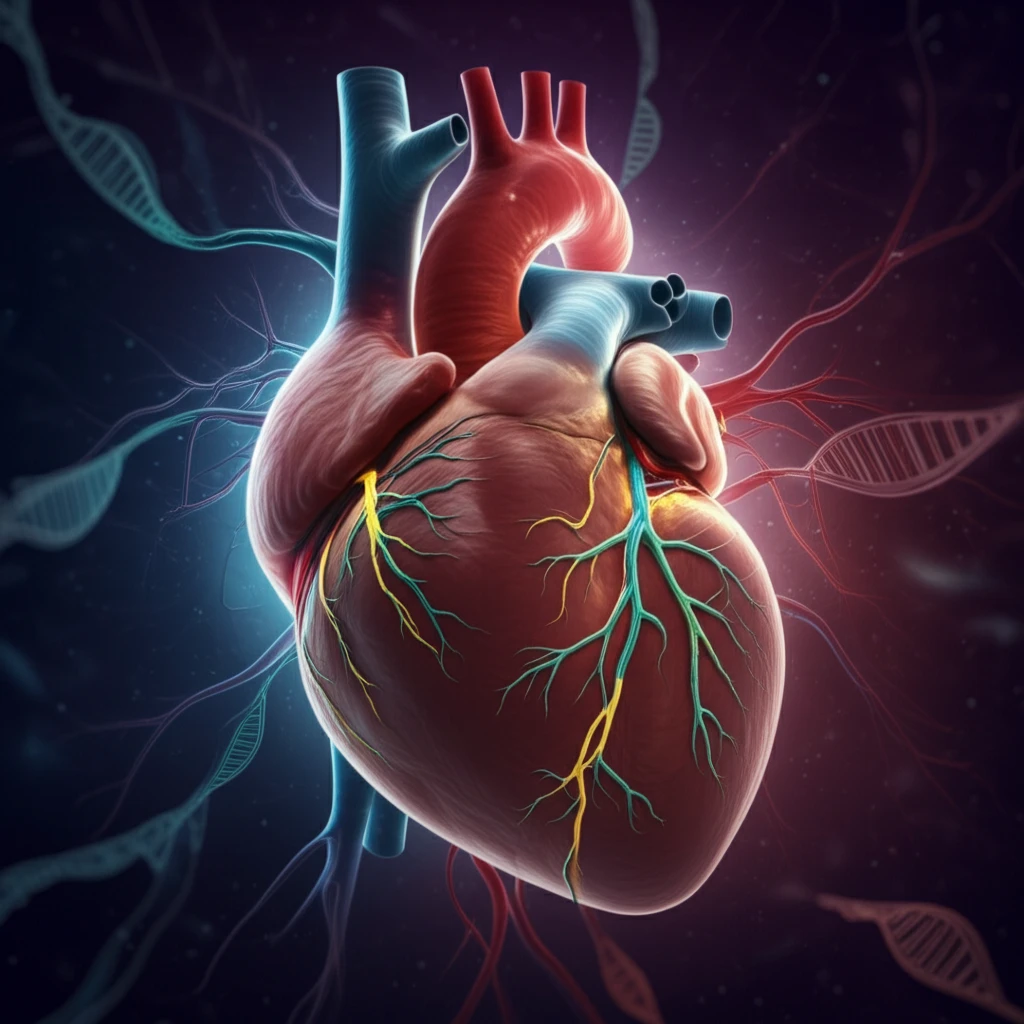
Microscopic heart with glowing microRNA strands, symbolizing heart failure treatment.

Decoding Heart Failure: Can MicroRNA Hold the Key to New Treatments?

"Unlocking the potential of miR-6321 in reversing heart failure and preventing myocardial fibrosis."


Heart failure (HF) is a complex condition, and scientists are constantly exploring the intricate processes that contribute to its development. MicroRNAs (miRNAs), tiny molecules that regulate gene expression, have emerged as key players in this field. Recent research has focused on the interplay between miRNAs and their target messenger RNAs (mRNAs) to better understand how heart failure progresses.

One miRNA, called miR-6321, has shown particularly interesting behavior in rat models of heart failure. Studies have revealed that levels of miR-6321 significantly decrease in HF rats. Further analysis suggests that the genes targeted by miR-6321, which are normally suppressed by it, become overactive in heart failure and are heavily involved in myocardial fibrosis – the thickening and stiffening of heart tissue.

This article will delve into the groundbreaking research investigating miR-6321 and its potential as a therapeutic target. We'll explore how scientists are working to validate these findings and understand the precise mechanisms by which miR-6321 influences the development of heart failure, potentially leading to new and effective treatments.

miR-6321: A Tiny Molecule with Big Implications

Microscopic heart with glowing microRNA strands, symbolizing heart failure treatment.

The study began with a crucial observation: miR-6321 levels drop in heart failure. To confirm this, researchers induced heart failure in rats through a procedure that mimics a heart attack. After 28 days, they assessed the rats' heart function using echocardiography and examined heart tissue samples. The results confirmed the initial findings: miR-6321 levels were significantly lower in the heart failure group.

But what happens when miR-6321 is missing? The researchers discovered that several genes, predicted to be targets of miR-6321, were significantly elevated in the heart failure group. These genes are involved in critical processes related to myocardial fibrosis, including:

  • Cell Adhesion: Genes like Itga11 and Cadm1, which help cells stick together and to the surrounding matrix.
  • Cell Proliferation: Genes like Ccnd2, Fgfr2, Egfr, and Fgf2, which control how cells grow and divide.
To further investigate the direct link between miR-6321 and these target genes, the scientists conducted experiments on cardiac fibroblasts – the cells responsible for producing the fibrous tissue that characterizes myocardial fibrosis. They manipulated miR-6321 levels in these cells and observed the corresponding changes in the target genes. The results provided compelling evidence that miR-6321 directly regulates the expression of these genes, effectively acting as a brake on processes that contribute to fibrosis.

A New Hope for Heart Failure Therapies

This research provides a significant step forward in our understanding of the complex mechanisms driving heart failure. By identifying miR-6321 as a key regulator of myocardial fibrosis, scientists have opened up new avenues for potential therapeutic interventions.

Imagine a future where heart failure patients could receive targeted therapies that restore miR-6321 levels, preventing or even reversing the progression of fibrosis. While still in the early stages, this research offers a glimmer of hope for developing more effective treatments for this debilitating condition.

Further studies are needed to fully elucidate the role of miR-6321 in human heart failure and to develop safe and effective methods for manipulating its levels. However, the insights gained from this research have laid a solid foundation for future investigations and hold promise for improving the lives of millions affected by heart disease.

About this Article -

This article was crafted using a human-AI hybrid and collaborative approach. AI assisted our team with initial drafting, research insights, identifying key questions, and image generation. Our human editors guided topic selection, defined the angle, structured the content, ensured factual accuracy and relevance, refined the tone, and conducted thorough editing to deliver helpful, high-quality information.See our About page for more information.

Everything You Need To Know

1

What is the role of miR-6321 in the context of heart failure, and why is it important?

Heart failure is a multifaceted condition where the heart struggles to pump blood effectively. Recent research emphasizes the role of microRNAs, particularly miR-6321, which appears to be crucial. In heart failure, miR-6321 levels decrease, leading to the overactivation of genes involved in myocardial fibrosis, a process where the heart tissue thickens and stiffens. Understanding this mechanism is key to developing new treatments.

2

What did the research on heart failure models reveal about the levels of miR-6321 and the activity of specific genes, such as Itga11, Cadm1, Ccnd2, Fgfr2, Egfr, and Fgf2?

Researchers found that in rat models of heart failure, the levels of miR-6321 were significantly lower compared to healthy hearts. When miR-6321 is deficient, genes that it normally suppresses become overactive. These genes include those involved in cell adhesion (like Itga11 and Cadm1) and cell proliferation (like Ccnd2, Fgfr2, Egfr, and Fgf2), all of which contribute to myocardial fibrosis.

3

How do genes such as Itga11, Cadm1, Ccnd2, Fgfr2, Egfr, and Fgf2 contribute to heart failure, specifically in relation to myocardial fibrosis?

Myocardial fibrosis is the thickening and stiffening of heart tissue, and it's a major problem in heart failure. Genes like Itga11 and Cadm1 (involved in cell adhesion), and Ccnd2, Fgfr2, Egfr, and Fgf2 (involved in cell proliferation) contribute to myocardial fibrosis. When miR-6321 levels are low, these genes become overactive, leading to excessive fibrosis and impaired heart function. Therefore, regulating miR-6321 can control or minimize myocardial fibrosis.

4

What experimental methods were used to determine the relationship between miR-6321 and genes involved in cell adhesion and cell proliferation?

The study involved inducing heart failure in rats to mimic a heart attack and then monitoring miR-6321 levels and the activity of its target genes. Researchers also manipulated miR-6321 levels in cardiac fibroblasts (cells responsible for producing fibrous tissue) to see how it affected the expression of genes involved in cell adhesion (Itga11 and Cadm1) and cell proliferation (Ccnd2, Fgfr2, Egfr, and Fgf2). This direct manipulation helped confirm that miR-6321 directly regulates these genes.

5

What are the potential therapeutic implications of discovering miR-6321's role in regulating myocardial fibrosis, and how might treatments be developed?

The finding that miR-6321 regulates genes involved in myocardial fibrosis opens potential new therapeutic strategies for treating heart failure. If scientists can find ways to increase miR-6321 levels or counteract the effects of the genes it regulates (such as Itga11, Cadm1, Ccnd2, Fgfr2, Egfr, and Fgf2), they might be able to prevent or reverse myocardial fibrosis, improving heart function and outcomes for patients with heart failure. Further research is needed to develop these strategies into effective treatments.

Newsletter Subscribe

Subscribe to get the latest articles and insights directly in your inbox.