
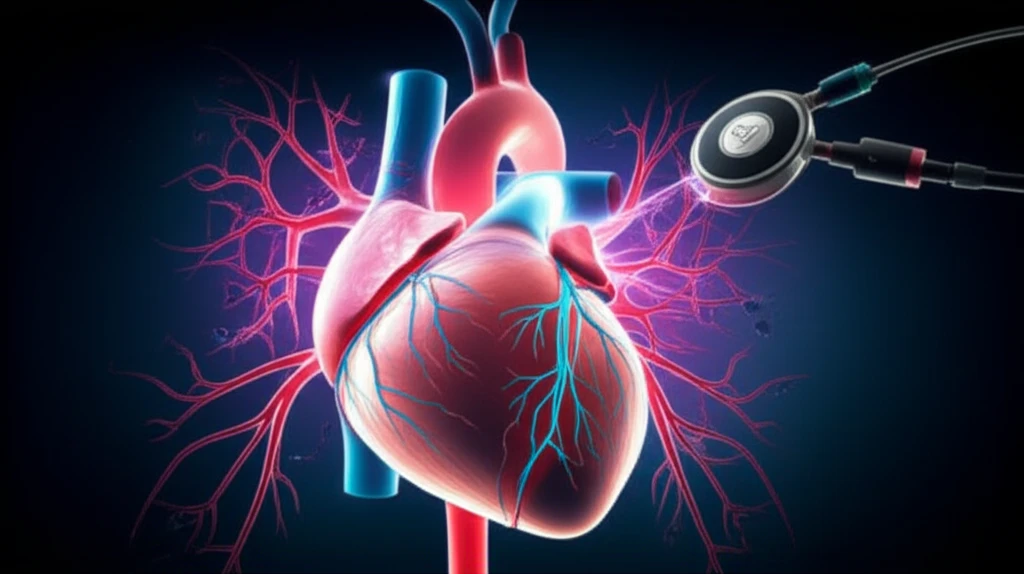
Digital illustration of a heart with disrupted electrical pathways, symbolizing ATP-induced ventricular tachycardia.

Decoding Heart Arrhythmias: What You Need to Know About ATP-Induced Ventricular Tachycardia

"Understanding the clinical significance, diagnosis, and management of ATP-induced ventricular tachycardia in patients with prior myocardial infarction."


For individuals with implantable cardioverter-defibrillators (ICDs), ventricular tachycardia (VT) can manifest in two primary ways: spontaneously or as a result of antitachycardia pacing (ATP). ATP is a programmed function in ICDs designed to deliver rapid electrical impulses to the heart, with the aim of terminating a tachycardia episode. However, in some instances, instead of resolving the arrhythmia, ATP can paradoxically induce a different form of VT. This phenomenon, known as ATP-induced VT, presents unique challenges in diagnosis and treatment.

The clinical significance of ATP-induced VT remains a topic of investigation. While spontaneous VT is generally well-understood, the implications and management strategies for ATP-induced VT are less clear. Specifically, there's ongoing debate about whether ATP-induced VTs carry the same prognostic weight as their spontaneous counterparts.

A recent study has explored the incidence, characteristics, and clinical impact of ATP-induced VTs in patients with prior myocardial infarction undergoing VT ablation. VT ablation is a procedure aimed at eliminating or modifying the heart tissue responsible for generating abnormal heart rhythms. The findings shed light on the role and management of ATP-induced VT in this specific patient population.

ATP-Induced VT: Unpacking the Research Findings

Digital illustration of a heart with disrupted electrical pathways, symbolizing ATP-induced ventricular tachycardia.

A study published in "Heart Rhythm" in 2018, led by Ghaith Sharaf-Dabbagh and colleagues, investigated the clinical relevance of ATP-mediated VTs in patients undergoing VT ablation procedures. The researchers analyzed stored ICD electrograms from 162 consecutive patients with prior myocardial infarction referred for VT ablation. The study aimed to classify clinical VTs as either spontaneous or ATP-induced and to understand their behavior during ablation procedures.

The study revealed several key findings:

  • Prevalence: Among 554 ICD-recorded clinical VTs, 157 (28%) were ATP-induced, affecting 63 patients. This highlights that ATP-induced VT is not an uncommon occurrence.
  • Characteristics: ATP-induced VTs were found to be faster (shorter cycle length) compared to spontaneous VTs. They were also less commonly inducible with invasive programmed stimulation and less likely to have identifiable target sites for ablation.
  • Recurrence: During a median follow-up of 368 days post-ablation, 71 VTs recurred in 39 patients. Notably, none of these recurrences were previously documented ATP-induced VTs. However, a history of ATP-induced VT was associated with an increased risk of overall VT recurrence.
These findings suggest that while ATP-induced VTs themselves may not directly recur after ablation, their presence indicates a higher likelihood of future VT events. The study concluded that ATP-induced VTs frequently occur in post-infarction patients presenting for VT ablation and are associated with a higher VT recurrence rate post-ablation.

Clinical Implications and Future Directions

The study by Sharaf-Dabbagh et al. has important clinical implications for managing patients with ICDs and a history of myocardial infarction. Understanding the characteristics and potential risks associated with ATP-induced VT can help healthcare providers tailor treatment strategies and optimize ICD programming. While ATP-induced VTs may not directly recur after ablation, their presence serves as a marker for increased arrhythmia risk. This underscores the need for comprehensive risk stratification and close monitoring in patients with a history of ATP-induced VT.

About this Article -

This article was crafted using a human-AI hybrid and collaborative approach. AI assisted our team with initial drafting, research insights, identifying key questions, and image generation. Our human editors guided topic selection, defined the angle, structured the content, ensured factual accuracy and relevance, refined the tone, and conducted thorough editing to deliver helpful, high-quality information.See our About page for more information.

Everything You Need To Know

1

What is ATP-induced ventricular tachycardia (VT), and how does it differ from spontaneous VT?

ATP-induced ventricular tachycardia (VT) is a form of irregular heart rhythm that occurs in individuals with implantable cardioverter-defibrillators (ICDs). Unlike spontaneous VT, which occurs without intervention, ATP-induced VT is triggered by the ICD's antitachycardia pacing (ATP) function. ATP delivers rapid electrical impulses to the heart to terminate a tachycardia episode, but sometimes paradoxically initiates a different form of VT. Spontaneous VT occurs naturally, while ATP-induced VT is a direct result of the ICD's treatment attempt. The study by Sharaf-Dabbagh et al. aimed to classify clinical VTs as either spontaneous or ATP-induced.

2

In the context of the study by Sharaf-Dabbagh et al., what were the key findings regarding ATP-induced VT?

The study by Sharaf-Dabbagh et al. revealed several key findings about ATP-induced VT. Firstly, it found that ATP-induced VT is not uncommon, affecting 63 patients among the 162 studied. Secondly, ATP-induced VTs were faster than spontaneous VTs, and they were less likely to have identifiable target sites for ablation. Thirdly, while ATP-induced VTs themselves did not recur after ablation, their presence indicated a higher risk of overall VT recurrence. This means that although the specific ATP-induced VT might be resolved, the underlying conditions that led to it increased the likelihood of future VT events.

3

How does ATP-induced VT impact the treatment strategies for patients with a history of myocardial infarction?

ATP-induced VT significantly impacts treatment strategies for patients with a history of myocardial infarction. The study by Sharaf-Dabbagh et al. highlights the need for a nuanced approach. The fact that ATP-induced VTs are associated with a higher overall VT recurrence rate underscores the importance of comprehensive risk stratification and close monitoring. Healthcare providers must understand the characteristics and potential risks associated with ATP-induced VT to tailor treatment strategies, optimize ICD programming, and consider VT ablation. This involves not only treating the immediate arrhythmia but also addressing the underlying conditions that predispose patients to future VT episodes.

4

What is the role of VT ablation in managing ATP-induced VT?

VT ablation is a procedure designed to eliminate or modify the heart tissue responsible for generating abnormal heart rhythms. In the context of ATP-induced VT, the study by Sharaf-Dabbagh et al. explored the impact of VT ablation on this specific type of arrhythmia. The study found that ATP-induced VTs may not directly recur after ablation. However, their presence serves as a marker for increased arrhythmia risk. This information helps physicians determine if ablation is necessary and understand that even after successful ablation of existing VTs, close monitoring is still essential. The main goal is to eliminate the source of the arrhythmia and reduce the likelihood of future VT events.

5

What are the clinical implications of the study findings by Sharaf-Dabbagh et al. regarding ATP-induced VT?

The study by Sharaf-Dabbagh et al. provides crucial insights into the clinical implications of ATP-induced VT. These findings have important clinical implications for managing patients with ICDs and a history of myocardial infarction. The research underscores the need for healthcare providers to understand the characteristics, prevalence, and potential risks associated with ATP-induced VT. This understanding is vital for tailoring treatment strategies, optimizing ICD programming, and implementing comprehensive risk stratification. This can include considering VT ablation and ensuring close monitoring. Since a history of ATP-induced VT suggests a higher overall VT recurrence rate, proactive management becomes essential to improve patient outcomes and reduce future arrhythmia events.

Newsletter Subscribe

Subscribe to get the latest articles and insights directly in your inbox.