
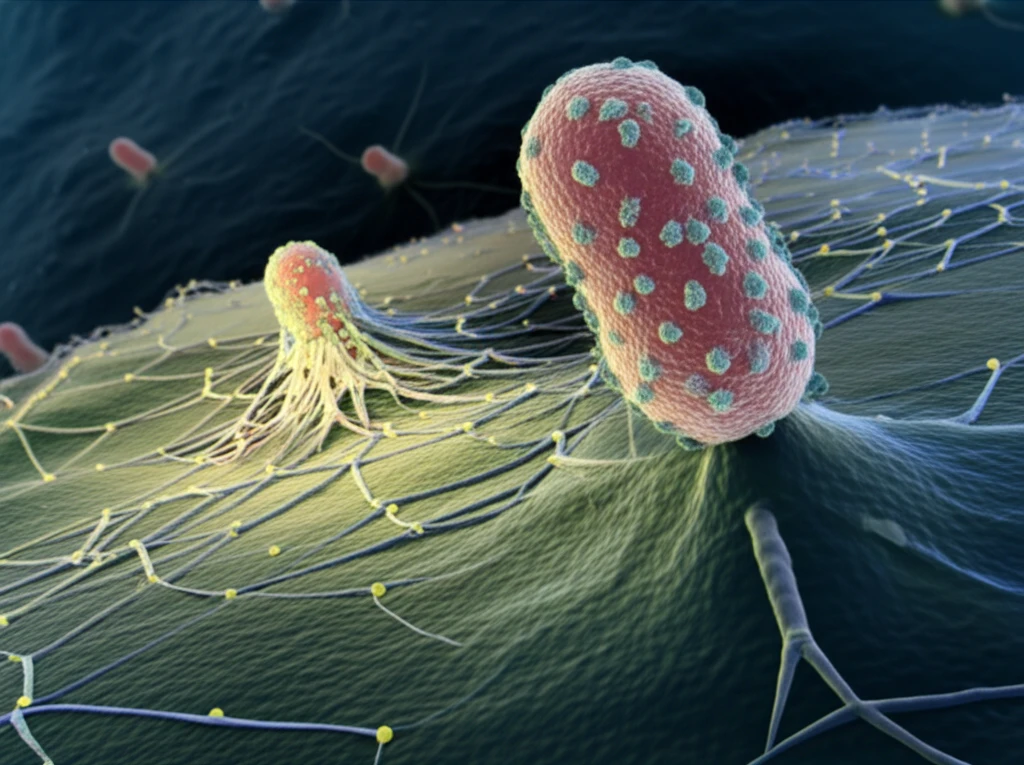
Illustration of Gonorrhea bacteria evading immune system.

Decoding Gonorrhea: How a Clever Protein Helps It Evade Your Immune System

"Scientists uncover the sneaky tactics of the NspA protein in gonorrhea, revealing potential new targets for vaccines and treatments."


Gonorrhea, a sexually transmitted infection caused by the bacterium Neisseria gonorrhoeae (Ng), affects millions globally each year. The rise of antibiotic-resistant strains has made it crucial to understand how this bacterium evades the immune system. New research sheds light on a key player in this evasion: the Neisserial surface protein A (NspA).

Scientists have long known that Ng has several tricks to avoid being destroyed by the complement system, a part of the immune system that directly attacks bacteria. One of these tricks involves binding to Factor H (FH), a protein that regulates and inhibits the complement system, preventing it from harming the body's own cells. This research delves into how NspA contributes to FH binding and, ultimately, to the bacterium's survival.

This article explores the recent findings about NspA's role in gonorrhea, comparing its function to that of its counterpart in Neisseria meningitidis (Nm), a bacterium that causes meningitis. Understanding these mechanisms is vital for developing effective vaccines and therapies against this global health threat.

NspA: The Master of Disguise in Gonorrhea's Immune Evasion

Illustration of Gonorrhea bacteria evading immune system.

The study pinpoints NspA as a critical factor in Ng's ability to resist the body's natural defenses. NspA, located on the surface of the bacterium, directly interacts with Factor H (FH) and Factor H-like protein 1 (FHL-1), both key inhibitors of the complement system. By binding to these proteins, NspA essentially tells the immune system to back off, allowing the gonorrhea bacteria to thrive.

Researchers discovered that NspA's role is independent of lipooligosaccharide (LOS) sialylation, a modification of sugar molecules on the bacterial surface that is also known to help Ng evade the immune system. This independence highlights NspA's significance as a standalone evasion mechanism.

  • Direct Interaction: NspA binds directly to FH and FHL-1, disrupting the complement cascade.
  • LOS Independence: NspA's function doesn't rely on LOS sialylation, marking it as a distinct evasion strategy.
  • FH Domains 6 and 7: Binding occurs specifically through FH domains 6 and 7, crucial regions for complement regulation.
Interestingly, the researchers found that while both Ng and Nm utilize NspA, there are subtle yet important differences. For example, Nm-NspA binds to FH more strongly than Ng-NspA. These differences are due to variations in specific amino acids within the NspA protein, particularly in loops 2 and 3, which are located on the protein's surface and directly interact with FH.

Future Directions: Targeting NspA for New Therapies

The detailed understanding of NspA's role in gonorrhea's immune evasion opens new doors for therapeutic intervention. By identifying the specific regions of NspA that interact with FH, scientists can design targeted vaccines and immunotherapies. These strategies could block NspA's ability to bind to FH, allowing the immune system to effectively clear the infection.

About this Article -

This article was crafted using a human-AI hybrid and collaborative approach. AI assisted our team with initial drafting, research insights, identifying key questions, and image generation. Our human editors guided topic selection, defined the angle, structured the content, ensured factual accuracy and relevance, refined the tone, and conducted thorough editing to deliver helpful, high-quality information.See our About page for more information.

Everything You Need To Know

1

What is the role of NspA in *Neisseria gonorrhoeae*'s ability to evade the immune system?

NspA, or Neisserial surface protein A, plays a crucial role in *Neisseria gonorrhoeae* (*Ng*) evading the immune system. It achieves this by directly interacting with Factor H (FH) and Factor H-like protein 1 (FHL-1). These are key inhibitors of the complement system. By binding to FH and FHL-1, NspA essentially prevents the immune system from attacking the bacteria, allowing *Ng* to thrive and cause infection. The interaction occurs specifically through FH domains 6 and 7, critical regions for complement regulation. This ability makes NspA a key factor in the bacterium's survival and its persistence within the host.

2

How does NspA's method of immune evasion compare to other strategies used by *Neisseria gonorrhoeae*?

NspA's function is independent of lipooligosaccharide (LOS) sialylation, which is another method that *Neisseria gonorrhoeae* (*Ng*) uses to evade the immune system. LOS sialylation is a modification of sugar molecules on the bacterial surface. This independence highlights NspA's significance as a distinct evasion strategy. While LOS sialylation is also involved in immune evasion, NspA operates through a separate mechanism: directly binding to FH and FHL-1. This means that even if LOS sialylation is compromised or absent, NspA can still facilitate immune evasion. This dual approach underlines *Ng*'s sophisticated strategies to ensure its survival within the host, highlighting the importance of targeting multiple pathways to combat the infection effectively.

3

What are the implications of the differences in NspA between *Neisseria gonorrhoeae* and *Neisseria meningitidis*?

The subtle yet important differences in NspA between *Neisseria gonorrhoeae* (*Ng*) and *Neisseria meningitidis* (*Nm*) highlight the diversity in immune evasion strategies among Neisseria species. While both bacteria use NspA, *Nm*-NspA binds to Factor H (FH) more strongly than *Ng*-NspA. These differences arise from variations in specific amino acids within the NspA protein, especially in loops 2 and 3, which directly interact with FH. Understanding these differences is important for several reasons. First, it indicates that the immune evasion mechanisms can be fine-tuned for specific environments or host interactions. Second, it suggests that vaccines or therapies targeting NspA might need to be tailored to each species or even specific strains to be most effective. The variation in binding affinity also implies that the complement system regulation differs slightly, potentially affecting the severity and progression of the infections caused by each bacterium.

4

How can the knowledge of NspA's function lead to new treatments for gonorrhea?

The detailed understanding of NspA's role in gonorrhea's immune evasion opens new avenues for therapeutic intervention. By identifying the specific regions of NspA that interact with Factor H (FH), scientists can design targeted vaccines and immunotherapies. These strategies could be designed to block NspA's ability to bind to FH, thereby allowing the immune system to effectively clear the infection. One approach could involve creating antibodies or small molecules that specifically bind to the NspA-FH interaction sites, preventing the bacteria from disarming the complement system. Another approach could be to develop vaccines that stimulate the immune system to produce these blocking antibodies. This targeted approach could be particularly effective because it focuses on a key mechanism that gonorrhea bacteria use to survive and establish infection, potentially leading to new treatments that are more effective against antibiotic-resistant strains.

5

What is the complement system, and why is it important in the context of gonorrhea?

The complement system is a crucial part of the immune system that directly attacks bacteria. It involves a series of proteins that work together to identify and destroy pathogens, like *Neisseria gonorrhoeae* (*Ng*). In the context of gonorrhea, the complement system is a primary defense mechanism that the body uses to eliminate the bacteria. However, *Ng* has evolved sophisticated strategies to evade this system. One of the main evasion tactics is the use of the NspA protein, which binds to Factor H (FH) and Factor H-like protein 1 (FHL-1). By doing this, NspA interferes with the complement cascade, preventing the immune system from effectively attacking the bacteria. Understanding the complement system and how *Ng* manipulates it is critical for developing effective vaccines and treatments. Targeting NspA, which disrupts the complement system, offers a promising approach to restore the immune system's ability to clear the infection and combat the increasing threat of antibiotic-resistant strains.

Newsletter Subscribe

Subscribe to get the latest articles and insights directly in your inbox.