
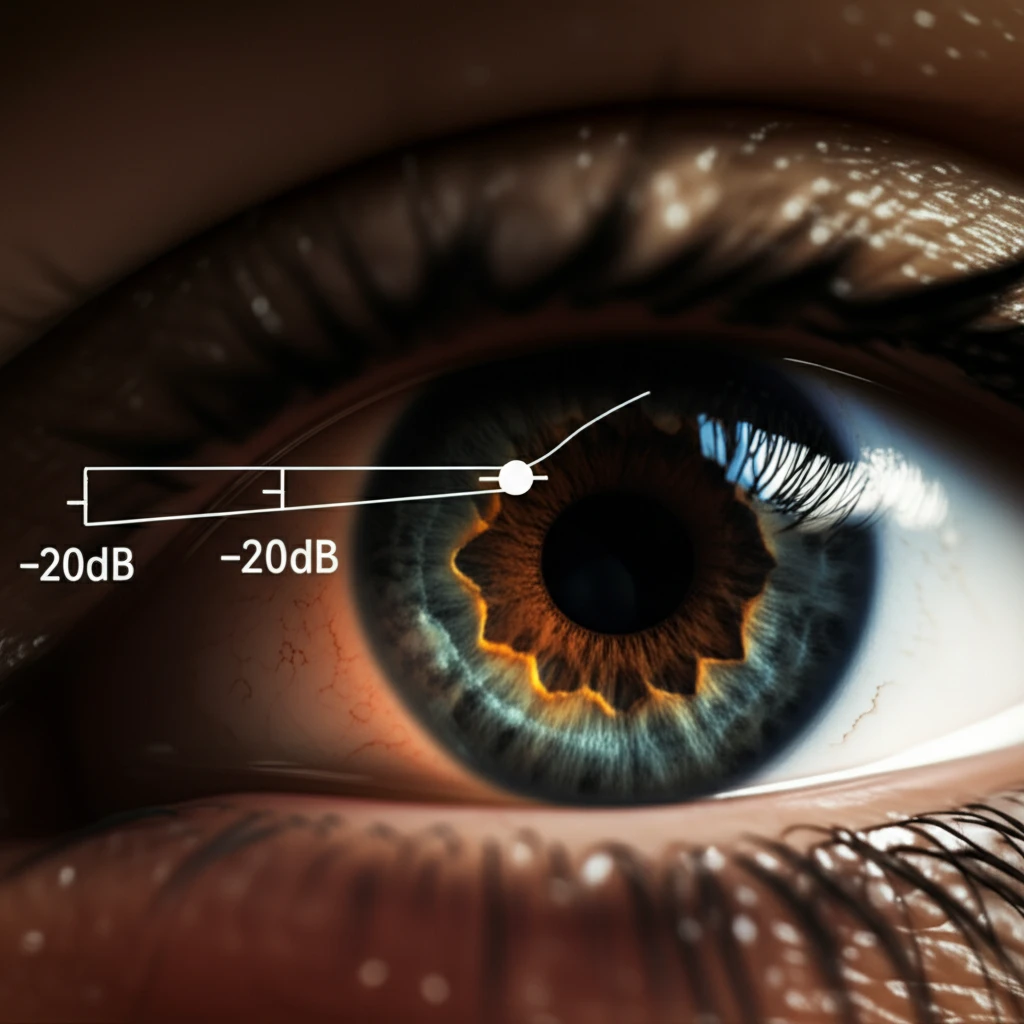
Visual Field Index Transformation: An eye evolving into a visual field plot, representing changes in glaucoma management.

Decoding Glaucoma: How a Key Measurement Shift Can Impact Your Vision

"Understanding the Visual Field Index (VFI) and its changes in advanced glaucoma could be vital for managing your eye health."


Glaucoma, a disease affecting millions worldwide, is characterized by progressive damage to the optic nerve, leading to gradual vision loss. Monitoring the condition effectively requires precise tools, and the Visual Field Index (VFI) has become a key metric in assessing the extent of visual function in glaucoma patients. The VFI provides a percentage that indicates how much visual field remains, ranging from 100% (normal vision) to 0% (complete blindness).

The VFI calculation involves analyzing visual field tests, which measure a patient's ability to detect light at various points in their field of vision. A critical aspect of this analysis is the shift between two types of probability plots: the pattern deviation probability plot (PDPP) and the total deviation probability plot (TDPP). The shift typically occurs when a patient's mean deviation (MD) crosses the -20 decibel (dB) threshold, indicating significant visual field loss.

A study published in Investigative Ophthalmology & Visual Science delved into how this algorithmic change affects VFI values in advanced glaucoma. The research highlights that the transition from PDPP to TDPP can cause notable variations in VFI, which could impact how clinicians interpret disease progression and make treatment decisions. Understanding these nuances is essential for accurate glaucoma management.

Why Does the VFI Calculation Method Matter?

Visual Field Index Transformation: An eye evolving into a visual field plot, representing changes in glaucoma management.

The VFI is designed to provide a comprehensive overview of a patient's visual field. However, the method by which VFI is calculated changes as glaucoma progresses. When the mean deviation (MD) – an indicator of overall visual field loss – is better than -20 dB, the VFI is based on the Pattern Deviation Probability Plot (PDPP). Once the MD crosses -20 dB, the calculation switches to the Total Deviation Probability Plot (TDPP).

This shift is intended to account for the increasing influence of generalized visual field loss as glaucoma advances. However, research indicates that this transition can introduce variability in VFI measurements. This variability can make it challenging to accurately track the rate of glaucoma progression and can potentially lead to misinterpretations of a patient's condition.

  • PDPP vs. TDPP: The PDPP focuses on localized visual field defects, while the TDPP considers both localized and generalized depression of the visual field.
  • Threshold Effect: The switch between PDPP and TDPP at -20 dB MD can create an artificial "step" in the VFI, potentially overestimating the decline in visual function.
  • Clinical Impact: This measurement artifact can influence treatment decisions, potentially leading to unnecessary interventions or a failure to recognize true disease progression.
A key finding from the study is the variability in VFI change when the MD crosses -20 dB. The researchers observed that the decrease in VFI ranged from 3% to 33%, with a median of 15%. This wide range underscores the potential for significant fluctuations in VFI that are not necessarily indicative of actual changes in the patient's visual field. The study identified that the difference in the number of points with normal threshold sensitivities between the PDPP and TDPP significantly influenced the VFI change. The fewer normal points on the TDPP compared to the PDPP, the greater the decrease in VFI.

Practical Implications for Patients and Clinicians

Understanding the potential for VFI variability around the -20 dB MD threshold is crucial for both patients and eye care professionals. Clinicians should be aware of this phenomenon when interpreting VFI results and making treatment decisions. Relying solely on VFI values without considering other clinical factors could lead to inaccurate assessments of glaucoma progression. Patients, in turn, should engage in open communication with their eye care providers, discussing any concerns about changes in their vision or test results. A comprehensive approach to glaucoma management involves integrating VFI data with other clinical findings, such as optic nerve imaging and intraocular pressure measurements. Regular monitoring and a collaborative doctor-patient relationship are essential for preserving vision and maintaining quality of life in individuals with glaucoma.

About this Article -

This article was crafted using a human-AI hybrid and collaborative approach. AI assisted our team with initial drafting, research insights, identifying key questions, and image generation. Our human editors guided topic selection, defined the angle, structured the content, ensured factual accuracy and relevance, refined the tone, and conducted thorough editing to deliver helpful, high-quality information.See our About page for more information.

Everything You Need To Know

1

What is the Visual Field Index (VFI), and why is it important for glaucoma patients?

The Visual Field Index, or VFI, is a percentage that indicates how much of your visual field remains. It's a key metric used to assess the extent of visual function in glaucoma patients, ranging from 100% (normal vision) to 0% (complete blindness). It’s calculated using visual field tests, which measure your ability to detect light at various points in your field of vision. Analyzing the test results involves looking at pattern deviation and total deviation probability plots. Changes to the algorithm used to calculate VFI values, especially in advanced glaucoma, can affect glaucoma management. Regular monitoring of VFI, along with other tests, is crucial for managing glaucoma.

2

Why is there a shift in how the Visual Field Index (VFI) is calculated as glaucoma progresses?

The way the Visual Field Index, or VFI, is calculated matters because the method changes as glaucoma progresses. When the mean deviation (MD) is better than -20 dB, the VFI is based on the Pattern Deviation Probability Plot (PDPP). Once the MD crosses -20 dB, the calculation switches to the Total Deviation Probability Plot (TDPP). This shift is intended to account for increasing generalized visual field loss. However, this transition can introduce variability in VFI measurements, making it challenging to accurately track glaucoma progression and potentially leading to misinterpretations of a patient's condition.

3

Can you explain the difference between the Pattern Deviation Probability Plot (PDPP) and the Total Deviation Probability Plot (TDPP)?

The Pattern Deviation Probability Plot (PDPP) focuses on localized visual field defects, pinpointing specific areas where vision is affected. The Total Deviation Probability Plot (TDPP), on the other hand, considers both localized and generalized depression of the visual field, accounting for overall reductions in visual sensitivity. The switch from PDPP to TDPP in VFI calculation occurs when the mean deviation (MD) crosses -20 dB, marking significant visual field loss and a shift in how the algorithm interprets the remaining visual field. PDPP is used for earlier stages, while TDPP is used for later stages as overall vision decreases.

4

What does the -20 dB threshold effect mean in the context of the Visual Field Index (VFI)?

The -20 dB threshold effect refers to the artificial 'step' in the Visual Field Index, or VFI, that can occur when the calculation method switches from the Pattern Deviation Probability Plot (PDPP) to the Total Deviation Probability Plot (TDPP) at a mean deviation (MD) of -20 dB. This can lead to an overestimation of the decline in visual function, potentially influencing treatment decisions. The variability in VFI change when the MD crosses -20 dB can be significant, ranging from 3% to 33%, underscoring the potential for fluctuations in VFI that are not necessarily indicative of actual changes in a patient's visual field.

5

What are the practical implications of Visual Field Index (VFI) variability for glaucoma patients and clinicians?

For patients, it’s crucial to openly communicate any concerns about changes in vision or test results with eye care providers. A comprehensive approach to glaucoma management involves integrating Visual Field Index, or VFI, data with other clinical findings, such as optic nerve imaging and intraocular pressure measurements. Regular monitoring and a collaborative doctor-patient relationship are essential for preserving vision and maintaining quality of life. Clinicians should be aware of the potential for VFI variability around the -20 dB mean deviation (MD) threshold when interpreting VFI results and making treatment decisions.

Newsletter Subscribe

Subscribe to get the latest articles and insights directly in your inbox.