
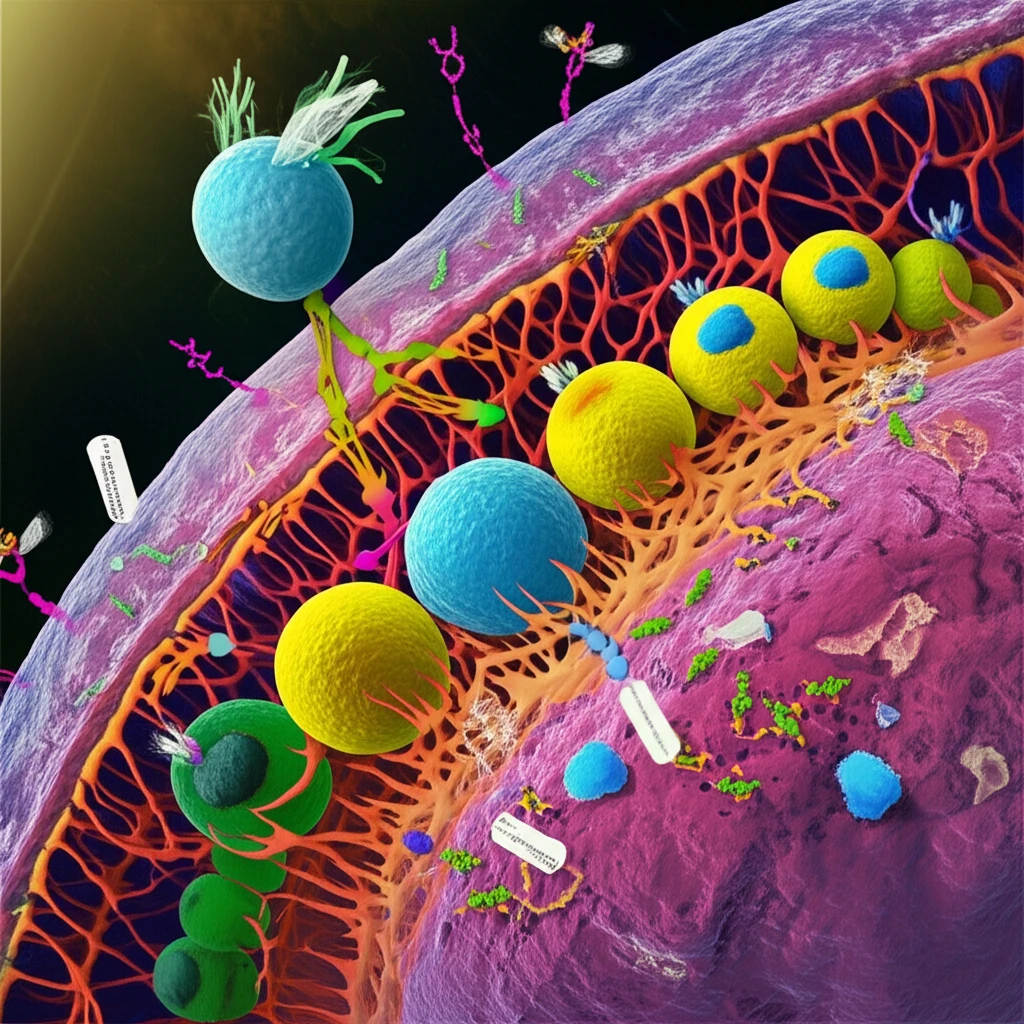
Interconnected cellular pathways within a fruit fly accessory gland.

Decoding Fruit Fly Fertility: How Cells Talk to Ensure Reproductive Success

"New research unveils the intricate cellular communication within fruit fly accessory glands, shedding light on the secrets of male fertility and offering potential clues for understanding reproductive processes in other species."


In the competitive world of reproduction, males across species have evolved diverse strategies to ensure their genetic legacy. From mate-guarding to more subtle biochemical influences, the drive to propagate one's genes shapes behavior and physiology. In fruit flies (Drosophila melanogaster), a key aspect of male reproductive success lies in the seminal fluid, a cocktail of factors that influence the female's post-mating behavior.

The seminal fluid, produced by the male accessory gland, contains proteins that trigger a range of changes in the female, collectively known as the post-mating response (PMR). These changes include decreased receptivity to other males, altered feeding behavior, and increased ovulation. Understanding how these factors are produced and delivered is crucial to understanding male fertility.

New research focuses on the intricate cellular organization of the accessory gland, particularly the role of secondary cells. These cells, though few in number, are vital for sustaining the female's post-mating response. By investigating the molecular machinery within these cells, scientists are uncovering the secrets of fruit fly fertility and revealing potential parallels to reproductive processes in other species.

Unlocking the Secrets of Secondary Cells: A Cellular Communication Network

Interconnected cellular pathways within a fruit fly accessory gland.

The accessory gland in male fruit flies consists of two main cell types: main cells and secondary cells. While main cells make up the majority of the gland, secondary cells, representing only about 4% of the total, play a disproportionately important role in sustaining the female's post-mating response. These secondary cells are characterized by large, vacuole-like compartments (VLCs), which are now understood to be key trafficking hubs within the cell.

Recent research has identified a network of proteins, called Rabs, that control the movement of molecules and membranes within these secondary cells. These Rabs act like molecular switches, directing traffic to specific locations within the cell. Specifically, Rabs 6, 7, 11, and 19 have been found to be associated with distinct VLC populations, suggesting that these organelles are highly organized and perform specialized functions.

  • Rab6: Appears early in VLC formation and is essential for the creation of all VLC classes.
  • Rab7 and Rab11: Contribute to specific VLC populations and are necessary for proper post-mating response.
  • Rab19: Localizes to VLCs but doesn't seem essential for PMR, potentially involved in specialized trafficking or redundant pathways.
Further experiments revealed that Rab6 is crucial for the formation of all VLC classes. Without Rab6, these cellular compartments fail to develop properly, and the male's ability to induce a long-term post-mating response in females is significantly impaired. This suggests that Rab6 acts as a master regulator, orchestrating the development of the entire VLC network.

Implications and Future Directions: From Flies to Fertility

This research provides valuable insights into the complex cellular processes that underpin male fertility in fruit flies. By identifying the key Rabs involved in VLC formation and function, scientists have laid the groundwork for a deeper understanding of how these cells contribute to the post-mating response.

Furthermore, the creation of an online image reference platform (https://flyrabag.genev.unige.ch) provides a valuable resource for researchers studying Rab localization in the accessory gland. This platform allows for detailed visualization and analysis of Rab protein expression patterns, facilitating future discoveries in this area.

While this research focuses on fruit flies, the principles of cellular communication and trafficking are likely to be relevant to reproductive processes in other species, including mammals. Further investigation into the role of Rabs and VLCs in other organisms could lead to new strategies for addressing fertility challenges and improving reproductive health.

About this Article -

This article was crafted using a human-AI hybrid and collaborative approach. AI assisted our team with initial drafting, research insights, identifying key questions, and image generation. Our human editors guided topic selection, defined the angle, structured the content, ensured factual accuracy and relevance, refined the tone, and conducted thorough editing to deliver helpful, high-quality information.See our About page for more information.

Everything You Need To Know

1

What is the significance of the accessory gland in fruit flies?

The accessory gland in male fruit flies is a crucial organ for successful reproduction. It produces seminal fluid, a complex mixture of proteins and other factors. This seminal fluid, in turn, triggers a post-mating response (PMR) in the female fruit fly. The PMR includes changes like decreased receptivity to other males, altered feeding behavior, and increased ovulation, all of which enhance the chances of the male's genes being passed on. The gland's function is therefore essential for male fertility within the fruit fly context.

2

What is the role of secondary cells?

Secondary cells are a type of cell found within the accessory gland, which is key for the post-mating response. Though comprising only a small percentage of the gland, they play a vital role in ensuring the female fruit fly exhibits the PMR. These cells are characterized by large, vacuole-like compartments (VLCs) and are critical for sustaining the female's response. Understanding the function of secondary cells provides significant insights into male fertility and reproductive strategies.

3

What are Rabs, and why are they important?

Rabs are a family of proteins identified as key regulators of cellular trafficking within secondary cells of the accessory gland. These proteins act as molecular switches, directing the movement of molecules and membranes to specific locations within the cell. Specifically, Rab6, Rab7, Rab11, and Rab19 have been identified. These Rabs orchestrate complex processes. They create, maintain, and regulate the VLCs that are crucial for the function of secondary cells and the PMR. Without these Rabs, specifically Rab6, the VLCs would not develop properly, rendering the male infertile.

4

What specifically is the role of Rab6 in fruit fly reproduction?

Rab6 is a specific Rab protein. It is essential for the formation of all classes of VLCs within the secondary cells. It is a 'master regulator'. Without Rab6, the VLCs will not develop properly, and the male's ability to induce the long-term PMR in females is significantly impaired. This highlights the crucial role of Rab6 in orchestrating the development of the entire VLC network within secondary cells, directly impacting the male's reproductive success.

5

What are the implications of this research on fruit fly fertility?

The research has significant implications because it reveals fundamental insights into male fertility within fruit flies. It identifies the key roles of the accessory gland, secondary cells, and Rabs in ensuring successful reproduction. By identifying the Rabs involved in VLC formation and function, scientists have laid the groundwork for a deeper understanding of how these cells contribute to the post-mating response. This knowledge can potentially provide clues for understanding reproductive processes in other species.

Newsletter Subscribe

Subscribe to get the latest articles and insights directly in your inbox.