
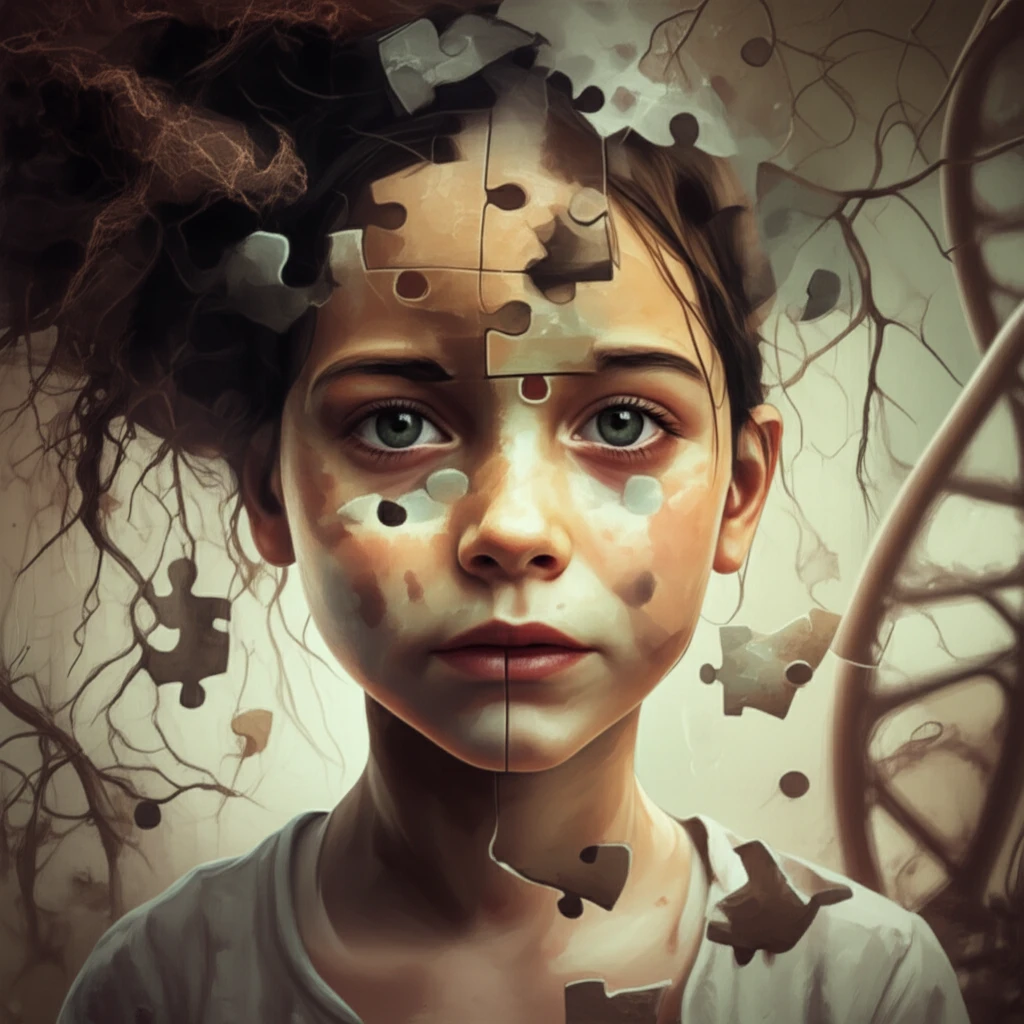
Decoding Emotions: How Your Child's Brain Reads Faces (and What Happens When It Doesn't)

"New research uncovers the genetic roots of emotion recognition, offering insights into irritability, depression, and social struggles in kids."
Recognizing facial expressions is a fundamental skill, allowing us to navigate social interactions and build relationships. But what happens when this ability is compromised? For some children and adolescents, correctly interpreting emotions can be a significant challenge, particularly those struggling with irritability, depression, or autism spectrum disorders.
A groundbreaking study published in the Journal of the American Academy of Child & Adolescent Psychiatry sheds light on the complex factors that influence emotion recognition in youth. By studying twins, researchers have begun to unravel the genetic and environmental contributions to this crucial skill and its connection to mental health.
This article delves into the findings of this innovative research, explaining how genetics and environment intertwine to shape a child's ability to understand facial expressions. We'll explore the implications of these findings for identifying and supporting children who may be struggling with emotion recognition deficits, potentially paving the way for more targeted interventions.
The Scale and Stakes of Emotion Recognition Research
A scientometric analysis of 39,686 articles from the Web of Science (2004–2023) reveals emotion recognition as a vital and rapidly evolving field, spanning psychological approaches to AI-driven methods. Twin studies implicate common genetic factors in deficits regarding the recognition of happiness, which are associated with irritability and neuroticism in childhood and adolescence. The field of multimodal emotion recognition—integrating text, audio, facial expressions, and physiological data—has achieved significant advances in recent years.
How Researchers Typically Measure Emotion Recognition
The most widely accepted method for assessing emotion recognition involves presenting participants with facial expressions depicting the six or seven basic emotions—happiness, sadness, anger, fear, surprise, and disgust—and asking them to identify each one. Ekman's basic facial emotion expression paradigm remains a standard tool in both clinical and research settings. Limitations of these methods include their reliance on static images, cultural variability in expression, and the difficulty of capturing the full complexity of real-world emotional communication.
Key Milestones in Understanding Emotion Recognition
The study of how humans read faces traces back to early psychological research on facial expressions as universal signals of emotion. A foundational milestone was the development of discrete emotion models, which categorized a small set of basic emotions as biologically hardwired. More recent decades have seen the field expand from unimodal, lab-based studies to multimodal, real-world applications powered by artificial intelligence.
The Genetic Blueprint of Emotion Recognition: Nature vs. Nurture
The study involved 957 twins between the ages of 9 and 17. Researchers assessed their irritability, neuroticism, and depression levels and then had them complete a face-emotion labeling task (FELT). This task involved identifying six basic emotions—anger, disgust, fear, happiness, sadness, and surprise—displayed on faces with varying degrees of intensity.
- Heritability: Recognition of each emotion showed a significant genetic component.
- Shared Genetic Factors: A common set of genes influences the recognition of all emotions.
- Specific Genetic Factors: Additional genes play a role in recognizing individual emotions.
- Environmental Influence: Non-shared environmental factors also contribute to emotion recognition abilities.
A Decade of Comprehensive Reviews
Multiple comprehensive reviews published between 2024 and 2025 confirm that emotion recognition technology has undergone rapid development over the past decade. A systematic review in the International Journal of Information Management notes the mutual influence between emotions and diseases as a driving force behind growing research attention. Researchers emphasize that emotion recognition and generation have emerged as crucial topics in AI, playing a significant role in healthcare, customer service, and human-computer interaction.
Inconsistencies and Gaps in the Literature
A systematic literature review analyzing 609 articles across IEEE, Science Direct, Springer, and MDPI found that emotion recognition, sentiment analysis, and affective computing remain fragmented research domains with inconsistent methodologies. Research on impairing emotional outbursts in children variably addresses them under the rubrics of tantrums, anger, irritability, aggression, rage attacks, or emotional and behavioral dysregulation, with no consistent methods for identification or assessment across development or systems of care.
Age, Clinical Status, and Emotion Recognition Ability
A study comparing facial emotion recognition in young healthy subjects, healthy older adults, and mild cognitive impairment (MCI) patients found measurable differences in how these groups identify Ekman's six basic emotions. Meanwhile, trait irritability in adults was not associated with impaired face emotion identification, even after a frustration manipulation—suggesting that irritability-related mechanisms in adults may differ from those observed in pediatric samples.
Implications for Parents and Educators: What Can We Do?
This study provides valuable insights into the complex interplay of genetics and environment in shaping emotion recognition abilities in children and adolescents. While we can't change a child's genetic makeup, understanding the genetic component can help us better understand individual vulnerabilities.
Where the Field Stands Today
The convergence of psychology, cognitive science, and artificial intelligence has brought emotion recognition from a niche academic pursuit to a cross-disciplinary field with real-world applications. Expert consensus holds that while technical capabilities have advanced rapidly, fundamental questions about the validity and ethics of inferring emotions from facial expressions remain unresolved. A balanced synthesis acknowledges both the promise of these systems and the significant scientific humility still warranted.
Personalized, Intelligent, and Emotionally Aware Systems
A comprehensive review of multimodal emotion recognition in WIREs Data Mining and Knowledge Discovery identifies the integration of emotion theories, discrete and dimensional models, and multiple emotional response systems as key frontiers. The future of emotion detection, according to industry analysis, lies in creating more personalized, intelligent, and emotionally aware digital experiences. As AI continues evolving, emotion recognition technologies are expected to become standard components of healthcare diagnostics, automotive safety systems, and enterprise decision-making.
Ethical and Systemic Hurdles Ahead
As emotion recognition technology scales from research labs to public infrastructure, systemic challenges around bias, privacy, and consent become increasingly urgent. The scientific claims behind emotion recognition products have been questioned by researchers and civil society groups alike. Any deployment at scale must grapple with questions about whose emotions are recognized, whose are not, and who bears the risk when systems fail.
When the Technology Meets Reality
In 2022, Microsoft announced it would stop offering clients facial analysis capabilities that purport to infer emotional states, citing collaboration with researchers who highlighted the technology's limitations. Researchers note major gaps in understanding how to create passive emotion recognition pipelines suitable for real-world deployment, with few existing validated tools for passively collected data. Organizations like Six Seconds demonstrate that measurable, meaningful returns on investment can come from building emotional intelligence through human-centered approaches rather than purely technological ones.
The findings emphasize the importance of early identification and intervention for children struggling with irritability, neuroticism, or depression, as these conditions may impact their ability to accurately perceive emotions in others. Targeted interventions aimed at improving emotion recognition skills may be beneficial for these youth.
Future research should focus on further elucidating the specific genes involved in emotion recognition and exploring the potential for targeted interventions to improve these skills in children and adolescents. By understanding the underlying mechanisms, we can develop more effective strategies to support youth in navigating the complexities of social interaction and emotional well-being.