
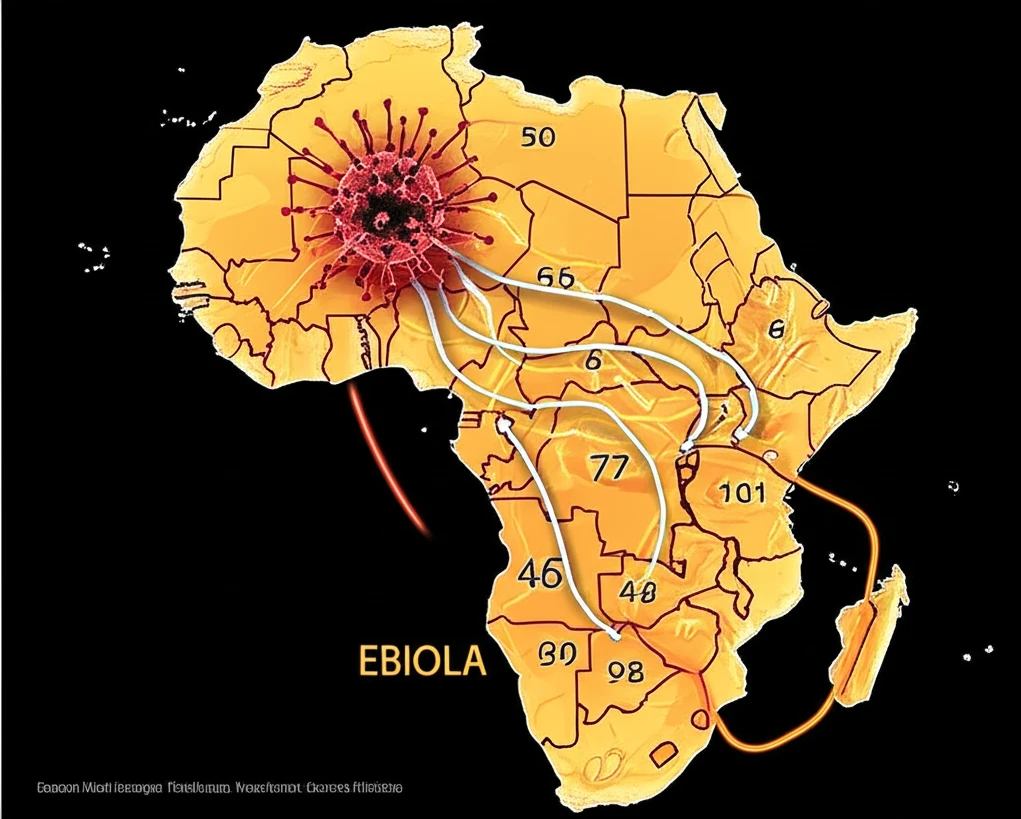
Decoding Ebola: How Early Growth Patterns Can Predict Epidemic Size

"New research reveals a surprising link between the initial growth rate of an Ebola outbreak and its ultimate scale, offering a potential tool for earlier, more effective interventions."
Imagine being able to predict the size of a potential Ebola outbreak just by observing its initial growth. For years, public health officials have relied on traditional indicators to gauge the severity of an epidemic, often reacting after the situation has already escalated. But what if the key to containment lies in the earliest stages of the disease's spread?
A groundbreaking study published in Epidemiology and Infection suggests this might be the case. Researchers have uncovered a significant relationship between the early growth patterns of Ebola epidemics and their eventual size. This discovery could revolutionize our approach to managing and controlling future outbreaks, not just for Ebola, but potentially for other infectious diseases as well.
This article unpacks the findings of this pivotal research, exploring how understanding the 'signature features' of epidemic growth can provide invaluable insights into the trajectory and scale of an outbreak. We'll delve into the specifics of the study, examining its methodology, key findings, and the implications for public health strategies.
The Ebola Epidemic's Hidden Clues: Unveiling the Growth Scaling Parameter
The core of this research centers on a concept called the 'growth scaling parameter' (represented as 'p' in mathematical models). This parameter essentially captures how the growth rate of an epidemic changes over time. Think of it like this: does the number of new cases increase exponentially (very rapidly), or does the growth slow down as the outbreak progresses? The value of 'p' provides a quantitative measure of this dynamic.
- Data Collection: Gathering weekly case data from administrative areas affected by the Ebola outbreak.
- Growth Scaling Quantification: Quantifying the scaling of growth parameters from the ascending phase of Ebola outbreaks.
- Statistical Analysis: Performing correlation and regression analyses to determine the strength of association between 'p' and epidemic size.
- Validation: Comparing West Africa findings against data from two historical Ebola outbreaks in Congo (1976) and Uganda (2000).
The Future of Epidemic Control: From Prediction to Prevention
This research offers a compelling argument for incorporating growth scaling parameters into epidemic forecasting models. By identifying the signature features of epidemic growth early on, public health officials can more accurately assess the risk of a major outbreak and tailor their interventions accordingly. This proactive approach could lead to more effective resource allocation, targeted control measures, and ultimately, a reduction in the overall impact of infectious diseases.