
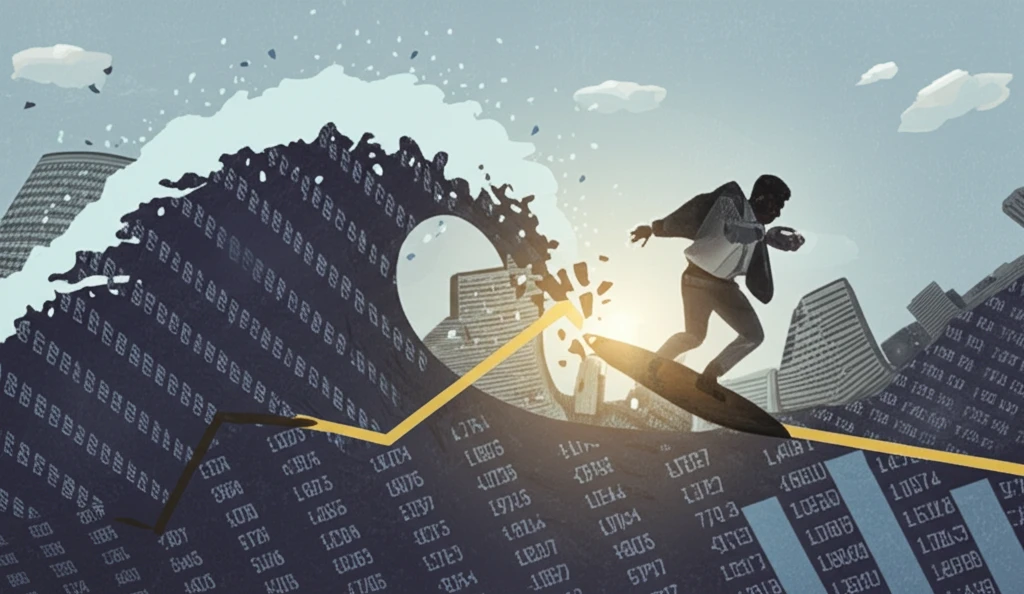
Businessman surfing a stock market wave.

Decoding Dynamic Markets: How Threshold Models Can Revolutionize Your Investment Strategy

"Unlock hidden patterns and gain a competitive edge by understanding how dynamic panel threshold models are reshaping economic analysis."


In today's rapidly evolving economic landscape, traditional forecasting methods often fall short. The increasing complexity of global markets demands more sophisticated tools that can capture non-linear relationships and sudden shifts in economic behavior. This is where dynamic panel threshold models (DPTMs) come into play, offering a powerful approach to understanding and predicting market dynamics.

Threshold regression models have become increasingly popular among empirical researchers due to their ability to identify critical junctures, or thresholds, at which the relationships between economic variables change. For example, the impact of debt on economic growth might shift dramatically once a country's debt-to-GDP ratio exceeds a certain level. Similarly, the effect of inflation on economic growth may reverse course beyond a specific threshold.

DPTMs extend these models to the panel data context, allowing for the analysis of multiple entities (e.g., countries, firms) over time. This approach acknowledges that the relationships between economic variables may not only be non-linear but also dynamic, evolving over time and differing across entities. By capturing these nuances, DPTMs offer a more realistic and nuanced understanding of market behavior, which can be invaluable for making informed investment decisions.

What are Dynamic Panel Threshold Models (DPTMs)?

Businessman surfing a stock market wave.

Dynamic panel threshold models build upon traditional regression models by introducing a threshold variable that divides the data into different regimes. Within each regime, the relationship between the dependent variable (e.g., economic growth) and independent variables (e.g., debt, investment) is assumed to be linear. However, the relationship can differ significantly across regimes, allowing for non-linear and dynamic effects.

Imagine the stock market as a seesaw. Up to a certain point, positive economic news might reliably push stock prices higher. However, past a certain "greed" threshold, investors might become increasingly nervous about inflation, or over valuation, causing the market to respond by going down instead. DPTMs allow analysts to identify and quantify these points.

Understanding the Mechanics:
  • Threshold Variable: The variable that determines the regime. This could be anything from inflation rates to debt levels, or consumer confidence indices.
  • Threshold Value: The specific value of the threshold variable that triggers a shift from one regime to another.
  • Regimes: The different states or conditions defined by the threshold variable.
  • Panel Data: Data collected on multiple entities (e.g., countries, firms) over time.
These models allow for endogeneity, meaning that the threshold variable and the other regressors are allowed to be related/impacted by/impact the outcome variable. It uses Generalized Method of Moments (GMM) estimation by generalizing the Arellano and Bond dynamic panel estimator.

The Future of Investment: Embracing Dynamic Modeling

Dynamic panel threshold models represent a significant step forward in economic modeling, offering a more nuanced and realistic understanding of market dynamics. As computational power increases and data becomes more readily available, DPTMs are poised to become an indispensable tool for empirical researchers and investment professionals alike. By embracing these sophisticated techniques, investors can gain a competitive edge, navigate market complexities with greater confidence, and ultimately achieve more successful outcomes.

About this Article -

This article was crafted using a human-AI hybrid and collaborative approach. AI assisted our team with initial drafting, research insights, identifying key questions, and image generation. Our human editors guided topic selection, defined the angle, structured the content, ensured factual accuracy and relevance, refined the tone, and conducted thorough editing to deliver helpful, high-quality information.See our About page for more information.

This article is based on research published under:

DOI-LINK: https://doi.org/10.48550/arXiv.2211.04027,

Title: Bootstraps For Dynamic Panel Threshold Models

Subject: econ.em

Authors: Woosik Gong, Myung Hwan Seo

Published: 08-11-2022

Everything You Need To Know

1

What are Dynamic Panel Threshold Models (DPTMs) and how do they differ from traditional forecasting methods?

Dynamic Panel Threshold Models (DPTMs) are sophisticated statistical tools designed to analyze non-linear relationships and sudden shifts in economic behavior within panel data. Unlike traditional forecasting methods, which often assume linear relationships, DPTMs incorporate threshold variables to identify critical junctures where relationships between economic variables change. These models allow for different regimes, meaning the impact of variables like debt or inflation on economic growth can vary significantly depending on the state of the threshold variable. For instance, the effect of inflation on economic growth might reverse direction beyond a certain threshold, offering a more nuanced understanding of market dynamics. The use of panel data allows for the analysis of multiple entities, such as countries or firms, over time, acknowledging that relationships evolve and differ across entities.

2

How does the threshold variable work within a Dynamic Panel Threshold Model (DPTM), and what are some examples?

The threshold variable is the core component of a Dynamic Panel Threshold Model (DPTM), determining the regime or condition of the economic system being analyzed. It acts as a switch, dividing the data into distinct regimes where the relationship between the dependent and independent variables can differ. Examples of threshold variables include inflation rates, debt levels (like a country's debt-to-GDP ratio), or consumer confidence indices. For example, consider the effect of debt on economic growth; the threshold variable could be the debt-to-GDP ratio. Below a certain threshold value, increased debt might stimulate growth. However, once this ratio exceeds a specific value (the threshold), the impact of debt might shift to negatively affect growth, highlighting the non-linear dynamics captured by DPTMs.

3

What is 'Panel Data' in the context of Dynamic Panel Threshold Models (DPTMs), and why is it important?

Panel data, in the context of Dynamic Panel Threshold Models (DPTMs), refers to data collected on multiple entities (such as countries, firms, or individuals) over multiple time periods. This structure is crucial because it allows researchers and analysts to capture the dynamic and evolving nature of economic relationships. By observing how economic variables interact across different entities and over time, DPTMs can identify patterns and non-linearities that would be missed by analyzing a single entity or a single point in time. This approach provides a richer and more comprehensive understanding of market behavior, which is invaluable for informed decision-making in investment and economic analysis.

4

How can Dynamic Panel Threshold Models (DPTMs) improve investment decisions compared to traditional approaches?

Dynamic Panel Threshold Models (DPTMs) significantly enhance investment decisions by offering a more sophisticated and realistic understanding of market dynamics compared to traditional methods. Traditional approaches often assume linear relationships between economic variables, which can oversimplify complex market behaviors. DPTMs, on the other hand, identify critical turning points (thresholds) and non-linear relationships, such as when the impact of debt or inflation changes on economic growth. By identifying these shifts, investors can better anticipate market changes, manage risks more effectively, and make more informed decisions. For example, understanding how investment returns change at various levels of market volatility enables strategies to be more robust. Moreover, the ability of DPTMs to handle endogeneity—where the threshold variable and other regressors can be impacted by the outcome variable—provides a more accurate portrayal of the market environment, offering a competitive advantage.

5

What are the key components of a Dynamic Panel Threshold Model (DPTM), and how do they interact?

The key components of a Dynamic Panel Threshold Model (DPTM) are the threshold variable, the threshold value, regimes, and panel data. The threshold variable is the element that determines the different regimes within the model. The threshold value is a specific level of the threshold variable that triggers a shift from one regime to another. Regimes represent the different states or conditions defined by the threshold variable, where the relationships between economic variables can vary. Panel data, encompassing multiple entities over time, provides the data framework for the analysis. These components interact to provide a nuanced understanding of the economic environment. The model employs Generalized Method of Moments (GMM) estimation, using the Arellano and Bond dynamic panel estimator, to analyze the data within these different regimes, thereby identifying how relationships between economic variables change based on the value of the threshold variable.

Newsletter Subscribe

Subscribe to get the latest articles and insights directly in your inbox.