
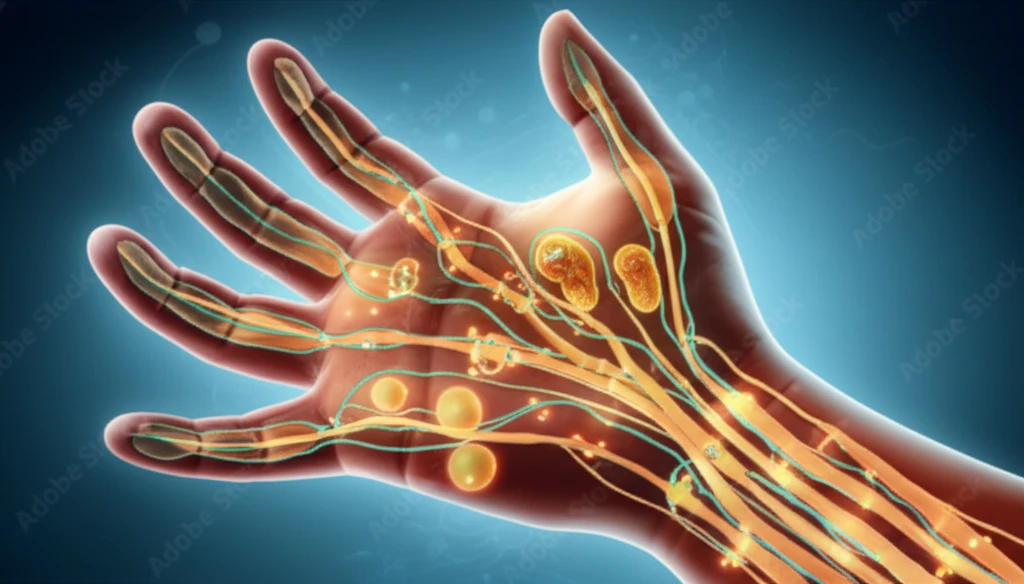
Surreal illustration linking Dupuytren's contracture with the renin-angiotensin system and embryonic stem cells.

Decoding Dupuytren's Disease: How Embryonic Cells and Blood Pressure Pathways Could Hold the Key to New Treatments

"New research uncovers potential links between embryonic stem cells, blood pressure regulation, and Dupuytren's disease, offering hope for more effective, non-surgical therapies."


Dupuytren's disease (DD) is a condition that affects the hands, causing the tissue under the skin of the palm to thicken and tighten. This can lead to the fingers bending inwards towards the palm, making it difficult to straighten them. While not life-threatening, DD can significantly impact a person's quality of life, affecting their ability to perform everyday tasks.

Currently, treatments for DD, such as surgery and injections, often come with high recurrence rates and potential complications. Scientists are actively searching for new and more effective ways to manage this condition, focusing on the underlying biological processes that contribute to its development.

A groundbreaking study published in Plastic and Reconstructive Surgery Global Open has shed light on a potential link between DD, embryonic stem cell-like populations, and the renin-angiotensin system (RAS). The RAS is known for its role in regulating blood pressure and mediating fibrosis (scarring) in organs like the heart and kidneys. This unexpected connection opens up exciting new avenues for developing targeted therapies for DD.

The Surprising Role of Embryonic Stem Cells and Blood Pressure in Dupuytren's Disease

Surreal illustration linking Dupuytren's contracture with the renin-angiotensin system and embryonic stem cells.

The study, conducted by researchers at the Gillies McIndoe Research Institute, investigated the expression of RAS components in tissue samples from patients with DD. They used a variety of techniques, including immunohistochemistry (IHC) staining, Western blotting (WB), and NanoString mRNA analysis, to examine the presence and activity of key proteins and genes involved in the RAS pathway.

The results revealed that several components of the RAS, including (pro)renin receptor (PRR), angiotensin-converting enzyme (ACE), angiotensin II receptor 1 (ATIIR1), and angiotensin II receptor 2 (ATIIR2), were expressed in the microvessels surrounding the DD nodules and cords. These microvessels are known to be associated with an embryonic stem cell-like population, suggesting a potential link between these cells, the RAS, and the development of DD.

Here’s a breakdown of the key findings:
  • IHC Staining: Showed the presence of PRR, ACE, ATIIR1, and ATIIR2 on the ERG+ and CD34+ endothelium (the inner lining) of microvessels surrounding the DD cords and nodules. PRR was also found on the pericytes, which are cells that wrap around blood vessels and help to stabilize them.
  • Western Blotting: Confirmed the protein expression of PRR, ACE, and ATIIR2, but not ATIIR1.
  • NanoString Analysis: Showed transcriptional activation (increased gene activity) of PRR, ACE, and ATIIR1, but ATIIR2 expression was below detectable levels.
These findings suggest that the embryonic stem cell-like population in DD tissues may be influenced by the RAS. Further research is needed to fully understand the nature of this relationship, the RAS could be a therapeutic target for DD, potentially leading to new treatments.

What This Means for the Future of Dupuytren's Disease Treatment

The discovery of a potential link between the RAS and embryonic stem cell-like populations in DD opens new possibilities for treatment. By targeting specific components of the RAS, researchers may be able to develop therapies that can prevent or reverse the progression of DD. More research is needed to determine exactly how the RAS influences the behavior of these cells and whether modulating RAS activity can effectively treat DD in humans.

About this Article -

This article was crafted using a human-AI hybrid and collaborative approach. AI assisted our team with initial drafting, research insights, identifying key questions, and image generation. Our human editors guided topic selection, defined the angle, structured the content, ensured factual accuracy and relevance, refined the tone, and conducted thorough editing to deliver helpful, high-quality information.See our About page for more information.

This article is based on research published under:

DOI-LINK: 10.1097/gox.0000000000001422, Alternate LINK

Title: Embryonic Stem Cell-Like Population In Dupuytren’S Disease Expresses Components Of The Renin-Angiotensin System

Subject: Surgery

Journal: Plastic and Reconstructive Surgery - Global Open

Publisher: Ovid Technologies (Wolters Kluwer Health)

Authors: Nicholas On, Sabrina P. Koh, Helen D. Brasch, Jonathan C. Dunne, James R. Armstrong, Swee T. Tan, Tinte Itinteang

Published: 2017-07-01

Everything You Need To Know

1

What is Dupuytren's disease and how does it affect people?

Dupuytren's disease (DD) is a condition where the tissue under the skin in the palm thickens and tightens, pulling the fingers inward. This can make it difficult to straighten the fingers and impacts a person's ability to perform everyday tasks. The condition is not life-threatening, but significantly impacts the quality of life. Current treatments like surgery and injections have high recurrence rates and potential complications.

2

What is the significance of the Renin-angiotensin system (RAS) in relation to Dupuytren's disease?

The renin-angiotensin system (RAS) regulates blood pressure and mediates fibrosis, or scarring, in organs. This study found that components of the RAS, including (pro)renin receptor (PRR), angiotensin-converting enzyme (ACE), angiotensin II receptor 1 (ATIIR1), and angiotensin II receptor 2 (ATIIR2), are present in the microvessels of DD tissue. This is significant because the RAS could be a therapeutic target for DD. By targeting the RAS, researchers hope to prevent or reverse the progression of DD.

3

What specific findings were discovered about the components of the Renin-angiotensin system (RAS) in the study?

The study found that microvessels surrounding the Dupuytren's disease (DD) nodules and cords expressed components of the Renin-angiotensin system (RAS). These microvessels are associated with an embryonic stem cell-like population. Specifically, the study used immunohistochemistry (IHC) staining, Western blotting (WB), and NanoString mRNA analysis. IHC staining showed the presence of (pro)renin receptor (PRR), angiotensin-converting enzyme (ACE), angiotensin II receptor 1 (ATIIR1), and angiotensin II receptor 2 (ATIIR2). Western blotting confirmed PRR, ACE, and ATIIR2, but not ATIIR1 protein expression. NanoString analysis showed transcriptional activation of PRR, ACE, and ATIIR1.

4

What is the connection between embryonic stem cell-like populations and Dupuytren's disease?

Embryonic stem cell-like populations are found in the microvessels of Dupuytren's disease (DD) tissue. These cells are of interest because they appear to be influenced by the renin-angiotensin system (RAS). The exact nature of this relationship is still being investigated, but researchers hypothesize that modulating the RAS could affect the behavior of these cells, and potentially lead to new treatments for DD.

5

What does this new research mean for the future of Dupuytren's disease treatment?

The implications of this research are significant as they suggest the Renin-angiotensin system (RAS) could be a therapeutic target for Dupuytren's disease (DD). By targeting specific components of the RAS, researchers hope to prevent or reverse the progression of DD. Further research is needed to determine the precise relationship between the RAS and the embryonic stem cell-like populations in DD tissues, and if modulating RAS activity can effectively treat DD in humans. This opens new avenues for non-surgical therapies.

Newsletter Subscribe

Subscribe to get the latest articles and insights directly in your inbox.