
Decoding DNA Cleavage: How Arginine Residues Orchestrate a Bacterial Defense

"Unraveling the distinct roles of two symmetric arginine residues in Thermus thermophilus Argonaute (TtAgo) for precision DNA target cleavage."
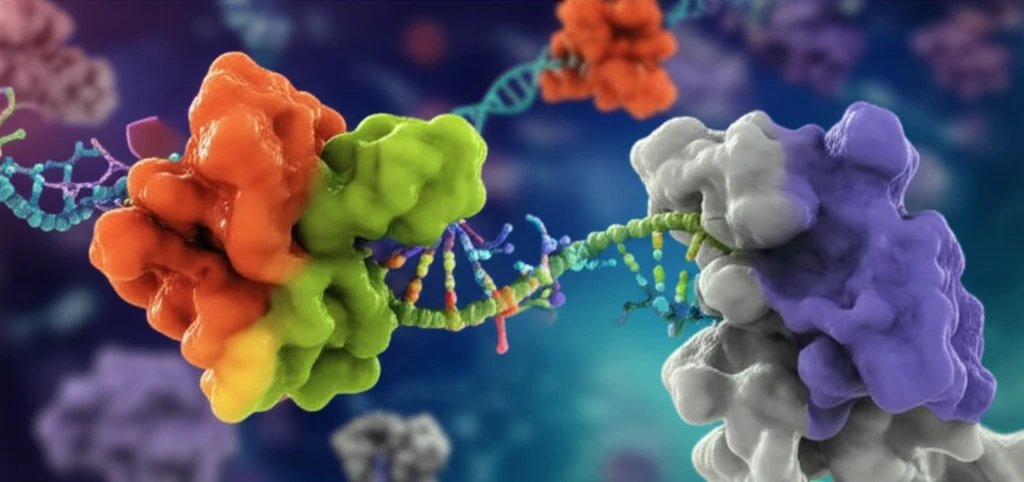
In the ongoing battle between bacteria and foreign invaders like viruses and plasmids, bacteria have evolved sophisticated defense mechanisms. One such defense relies on Argonaute (Ago) proteins, which act as guardians of the bacterial genome by precisely targeting and cleaving foreign DNA. Understanding how these Ago proteins achieve such specificity is crucial for developing new gene-editing tools.
This article delves into the intricate workings of Thermus thermophilus Argonaute (TtAgo), a bacterial Ago protein. TtAgo's active site features two arginine residues, R545 and R486, positioned symmetrically around a crucial glutamate 'finger'. The puzzle lies in deciphering how these seemingly identical arginines collaborate to catalyze DNA cleavage.
Recent research has shed light on the distinct roles of R545 and R486 in TtAgo-mediated DNA cleavage. Through a combination of advanced simulations and experimental validation, scientists have uncovered that only one of these arginine residues, R545, is directly involved in the cleavage reaction. This discovery challenges previous assumptions about the symmetrical roles of these residues and opens new avenues for designing more precise and efficient gene-editing technologies.
R545: The Structural Anchor in DNA Cleavage
The TtAgo active site houses a catalytic tetrad, Asp-Glu-Asp-Asp, which is essential for DNA cleavage. The insertion of a glutamate finger completes this tetrad. The study reveals that R545 plays a key role in stabilizing the catalytic tetrad conformation. It acts as a structural anchor, ensuring that the tetrad remains properly aligned for efficient target cleavage.
- Critical Anchor: R545 stabilizes the catalytic tetrad, essential for DNA cleavage.
- Experimental Validation: Mutating R545 eliminates TtAgo's cleavage activity.
- Structural Integrity: R545 maintains the active site's configuration.
Implications for Gene Editing and Beyond
The discovery of the distinct roles of R545 and R486 in TtAgo provides valuable insights into the catalytic specificity of Ago proteins. This knowledge can be leveraged to design new and improved gene-editing tools with enhanced precision and efficiency.
By understanding the specific structural requirements for DNA cleavage, scientists can engineer Ago proteins to target specific DNA sequences with greater accuracy, minimizing off-target effects and improving the safety and efficacy of gene-editing therapies.
Furthermore, this research highlights the evolutionary divergence of Ago proteins in prokaryotes and eukaryotes. While eukaryotic Ago proteins rely on two symmetric residues (arginine and histidine) for target cleavage, bacterial Ago proteins like TtAgo employ a more specialized approach, with only one arginine residue playing a direct role in the cleavage reaction. This understanding sheds light on the evolution of these crucial defense mechanisms.