
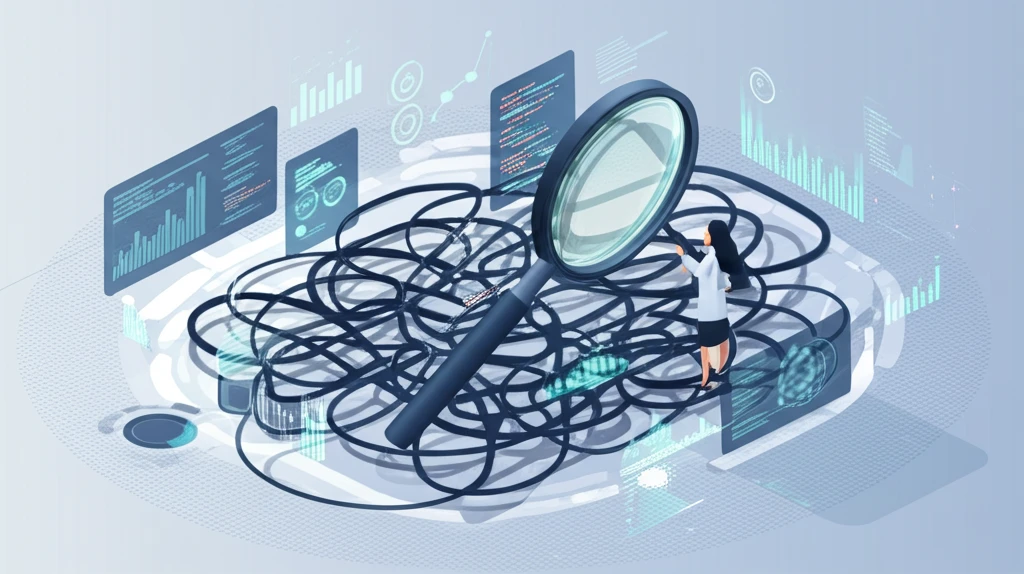
Decoding Data: How Error Analysis Can Sharpen Your Insights

"Navigate the complexities of data analysis with our guide to understanding and correcting errors for stronger, more reliable conclusions."
In an era dominated by data, the ability to extract meaningful insights is more crucial than ever. From guiding business strategies to shaping public policy, data analysis plays a pivotal role in decision-making. However, the reliability of these decisions hinges on the accuracy of the underlying data. Errors in data, if left unaddressed, can lead to skewed results, flawed conclusions, and ultimately, misguided actions.
One of the significant challenges in data analysis is dealing with errors that arise from various sources. These errors, broadly categorized as measurement errors or errors-in-variables (EIV), occur when the recorded value of a variable deviates from its true value. This can happen due to faulty measurement instruments, human error in data entry, or inherent inaccuracies in data collection processes. The impact of these errors is far-reaching, affecting not only the immediate analysis but also any subsequent models or predictions based on the flawed data.
This article aims to demystify the complexities of error analysis in data. By providing clear explanations and practical examples, we will explore techniques for identifying and mitigating non-classical errors-in-variables. Whether you're a seasoned data scientist or just beginning your journey into the world of analytics, this guide will equip you with the knowledge and tools necessary to ensure the integrity and reliability of your data-driven insights. Understanding these methods can transform how you approach data, leading to stronger conclusions and more effective strategies.
What are Errors-in-Variables (EIV) and Why Should You Care?
Errors-in-Variables (EIV) refer to the discrepancies that occur when the values of variables in a dataset are inaccurately measured or recorded. These errors can stem from a variety of sources, including limitations in measurement tools, mistakes in data entry, or inherent variability in the data collection process. Unlike random noise, EIV can exhibit systematic patterns, leading to biased and misleading results if not properly addressed.
- Biased Results: EIV can systematically skew the outcomes of statistical analyses, leading to incorrect conclusions about relationships between variables.
- Invalid Inferences: Flawed data undermines the validity of any inferences drawn from the analysis, making it difficult to generalize findings to larger populations.
- Suboptimal Decisions: Decisions based on analyses affected by EIV can be misguided, resulting in inefficient resource allocation and missed opportunities.
- Model Misspecification: EIV can lead to the development of models that do not accurately represent the underlying relationships in the data, reducing their predictive power.
The Future of Data Analysis: Embracing Error Correction
The field of data analysis is continuously evolving, with new techniques and tools emerging to tackle increasingly complex challenges. As datasets grow larger and more intricate, the importance of addressing errors-in-variables will only continue to rise. By adopting robust error correction methods, data analysts can ensure the reliability of their findings and make more informed decisions. Whether you're working in business, science, or policy, mastering error analysis is essential for navigating the data-driven landscape and unlocking the true potential of your data.