
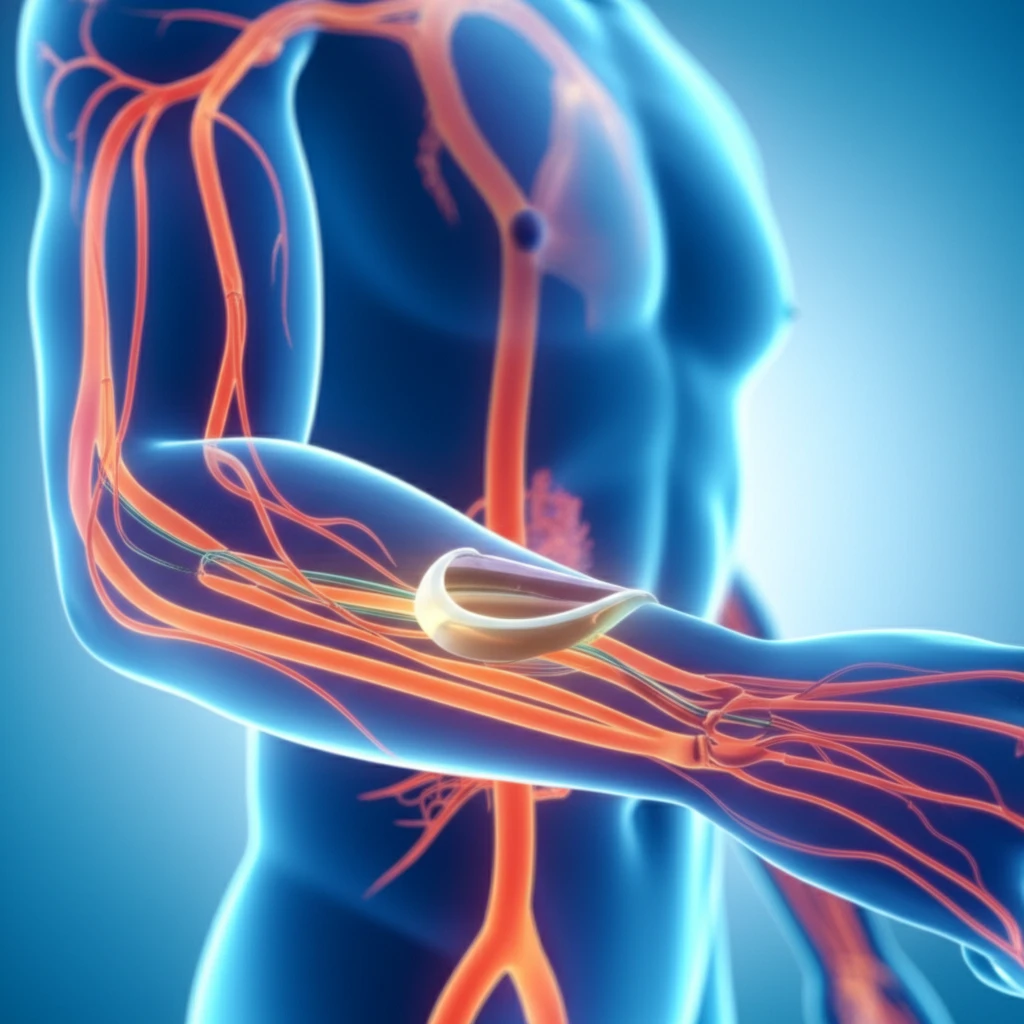
Futuristic health monitoring concept with glowing veins and arteries.

Decoding Cuffless Blood Pressure Monitoring: Is Accurate, Continuous Tracking Finally Within Reach?

"Explore the potential of photoplethysmogram (PPG) indicators and pulse arrival time (PAT) in revolutionizing blood pressure estimation, addressing challenges, and offering insights into future advancements."


Continuous, cuffless blood pressure (BP) monitoring has the potential to revolutionize healthcare, offering convenience and proactive health management. Recent research focuses on photoplethysmogram (PPG) indicators and pulse arrival time (PAT) as key components in achieving accurate, continuous BP estimation without the need for traditional cuffs. However, this field faces significant physiological challenges that need to be addressed.

Traditional methods of blood pressure measurement, such as intermittent cuff-based devices, provide snapshots of BP at specific moments. Continuous monitoring, on the other hand, offers a dynamic view of BP fluctuations throughout the day, which can be particularly valuable for individuals at risk of cardiovascular events or those managing hypertension.

This article explores the potential and challenges of using PPG and PAT in cuffless BP monitoring, drawing from recent research and expert discussions in the field. We aim to provide a comprehensive overview of the physiological factors influencing BP estimation, potential solutions for improving accuracy, and the future directions of this exciting and rapidly evolving area of healthcare technology.

Unpacking the Physiology: Why Cuffless BP Monitoring Is a Complex Puzzle

Futuristic health monitoring concept with glowing veins and arteries.

Helmond & Joseph's comments on previous research underscore the complexity of relying on pulse arrival time (PAT) for cuffless blood pressure measurement. PAT, which is composed of pre-ejection period (PEP) and pulse transit time (PTT), is susceptible to various physiological factors that can confound BP estimation. Understanding these factors is crucial for developing accurate and reliable cuffless BP monitoring devices.

The challenge lies in minimizing the effects of physiological variables like pre-ejection period (PEP) and smooth muscle tone, which can significantly impact PAT and, consequently, BP readings. Smooth muscle tone, for example, can vary due to factors such as vascular contractility, peripheral vasodilation, and even mental stress, leading to inconsistencies in PTT.

Here are some potential solutions for improving accuracy:
  • Combining heart rate variability with PAT and PPG features.
  • Using ballistocardiogram (BCG) as the proximal timing reference for PTT calculation.
  • Extracting features from the PPG wave to account for smooth muscle tone.
By addressing these physiological challenges and incorporating advanced signal processing techniques, researchers are paving the way for more accurate and reliable cuffless BP monitoring devices. The goal is to develop devices that meet professional standards and provide valuable insights into an individual's cardiovascular health.

The Future of Cuffless Monitoring: Convenience, Accuracy, and Proactive Health

Despite the challenges, the future of cuffless BP monitoring is promising. By combining advanced techniques and addressing the physiological factors that influence BP estimation, researchers are steadily improving the accuracy and reliability of these devices.

The development of accurate and user-friendly cuffless BP monitors has the potential to transform healthcare by enabling continuous, unobtrusive monitoring. This will empower individuals to take a more proactive role in managing their cardiovascular health and provide clinicians with valuable data for diagnosis and treatment.

While further research and refinement are needed, cuffless BP monitoring is poised to become an integral part of personalized healthcare, offering convenience, accuracy, and the potential for early detection and prevention of cardiovascular events.

About this Article -

This article was crafted using a human-AI hybrid and collaborative approach. AI assisted our team with initial drafting, research insights, identifying key questions, and image generation. Our human editors guided topic selection, defined the angle, structured the content, ensured factual accuracy and relevance, refined the tone, and conducted thorough editing to deliver helpful, high-quality information.See our About page for more information.

This article is based on research published under:

DOI-LINK: 10.1088/1361-6579/aadf17, Alternate LINK

Title: Reply To Comment On ‘New Photoplethysmogram Indicators For Improving Cuffless And Continuous Blood Pressure Estimation Accuracy’

Subject: Physiology (medical)

Journal: Physiological Measurement

Publisher: IOP Publishing

Authors: Wan-Hua Lin, Oluwarotimi Williams Samuel, Guanglin Li

Published: 2018-09-27

Everything You Need To Know

1

What are photoplethysmogram (PPG) indicators and pulse arrival time (PAT), and why are they important in blood pressure monitoring?

Photoplethysmogram (PPG) indicators and pulse arrival time (PAT) are emerging as key components in continuous, cuffless blood pressure (BP) monitoring. PPG indicators use light to detect blood volume changes in the microvascular bed of tissue, providing insights into the pulsatile nature of blood flow. Pulse arrival time (PAT) measures the time it takes for a pulse wave to travel from the heart to a peripheral site. Combining PPG and PAT offers a non-invasive way to estimate blood pressure continuously, unlike traditional cuff-based methods that only provide intermittent snapshots. This continuous monitoring can be valuable for individuals needing proactive cardiovascular health management.

2

What are the primary challenges in using pulse arrival time (PAT) for cuffless blood pressure measurement, and how do physiological factors impact its accuracy?

The accuracy of cuffless blood pressure measurement using pulse arrival time (PAT) is significantly affected by physiological factors. PAT is composed of pre-ejection period (PEP) and pulse transit time (PTT), both of which are susceptible to variability. Factors such as smooth muscle tone, vascular contractility, peripheral vasodilation, and even mental stress can influence PTT, leading to inconsistencies in blood pressure readings. Therefore, minimizing the impact of these physiological variables is crucial for developing reliable cuffless BP monitoring devices. If unaddressed, these variables will confound blood pressure estimation, hindering the clinical utility of PAT-based monitoring.

3

What solutions are being explored to improve the accuracy of cuffless blood pressure monitoring, considering the physiological challenges?

To improve the accuracy of cuffless blood pressure (BP) monitoring, several solutions are being explored. One approach is combining heart rate variability with pulse arrival time (PAT) and photoplethysmogram (PPG) features to provide a more comprehensive assessment. Another is using ballistocardiogram (BCG) as the proximal timing reference for pulse transit time (PTT) calculation. Additionally, extracting features from the PPG wave to account for smooth muscle tone can help mitigate inconsistencies. By integrating these advanced signal processing techniques and addressing the physiological factors that influence BP estimation, researchers aim to develop devices that meet professional standards.

4

How does continuous blood pressure monitoring, utilizing photoplethysmogram (PPG) and pulse arrival time (PAT), differ from traditional cuff-based methods, and what are its potential benefits for individuals at risk of cardiovascular events?

Traditional cuff-based methods provide intermittent snapshots of blood pressure (BP) at specific moments, whereas continuous blood pressure monitoring, using photoplethysmogram (PPG) and pulse arrival time (PAT), offers a dynamic view of BP fluctuations throughout the day. This continuous monitoring is particularly valuable for individuals at risk of cardiovascular events or those managing hypertension, as it captures BP changes in real-time, providing a more comprehensive understanding of their cardiovascular health. This allows for more proactive health management and timely interventions based on continuous data, potentially reducing the risk of adverse events.

5

Beyond convenience, what are the broader implications of accurate and reliable cuffless blood pressure monitoring for proactive health management and the future of healthcare technology?

Accurate and reliable cuffless blood pressure monitoring, leveraging photoplethysmogram (PPG) and pulse arrival time (PAT), has far-reaching implications for proactive health management and the future of healthcare technology. Continuous monitoring enables timely detection of blood pressure abnormalities, facilitating early intervention and personalized treatment plans. It can empower individuals to take greater control of their health through continuous feedback and trend analysis. Furthermore, the integration of these technologies into wearable devices could revolutionize remote patient monitoring, enabling healthcare providers to track patient health remotely and make informed decisions based on real-time data. This shift could lead to more efficient and cost-effective healthcare delivery, particularly for individuals with chronic conditions or those at risk of cardiovascular events.

Newsletter Subscribe

Subscribe to get the latest articles and insights directly in your inbox.