
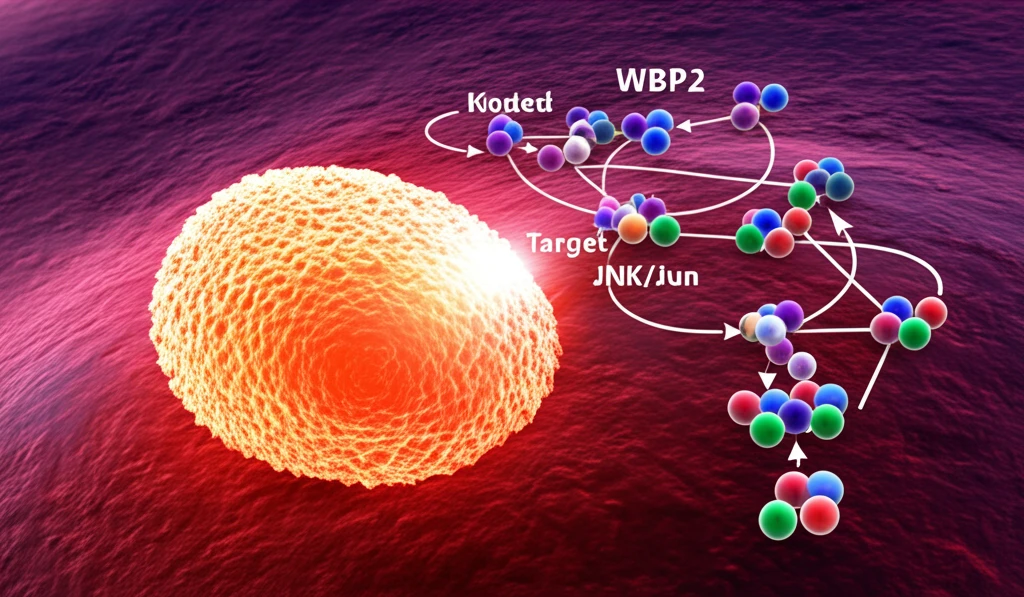
Surreal illustration of a breast cancer cell with WBP2 as a central glowing node, highlighting interconnected JNK/Jun and Wnt signaling pathways.

Decoding Breast Cancer: How WBP2 Could Revolutionize Treatment

"New research illuminates the crucial role of WBP2 in triple-negative breast cancer, potentially paving the way for targeted therapies."


Breast cancer remains a formidable global challenge, impacting millions of lives annually. While advancements in treatment have occurred, triple-negative breast cancer (TNBC) stands out as a particularly aggressive subtype. TNBC lacks the three common receptors targeted in breast cancer therapy, making it difficult to treat effectively. As a result, scientists are urgently seeking new approaches to combat this disease.

Recent research has spotlighted a protein called WW domain-binding protein 2 (WBP2) and its significant role in TNBC. WBP2 acts as a crucial node, connecting various signaling pathways that drive cancer progression. Understanding WBP2's function could unlock novel therapeutic strategies and improve outcomes for patients with TNBC.

This article delves into the groundbreaking findings of a study published in the Journal of Biological Chemistry, which uncovers how WBP2 primes TNBC cells for responses to Wnt signaling via the JNK/Jun kinase pathway. By unraveling this intricate mechanism, scientists are one step closer to developing precision medicine approaches for managing TNBC.

The Central Role of WBP2 in TNBC: What the Science Says

Surreal illustration of a breast cancer cell with WBP2 as a central glowing node, highlighting interconnected JNK/Jun and Wnt signaling pathways.

The study, led by researchers at the National University of Singapore, investigated the downstream activity of WBP2 in TNBC cells. Through a combination of RNA interference (RNAi), RNA sequencing (RNA-Seq), and mass spectrometry, the team identified Wnt/WBP2- and WBP2-dependent targets in MDA-MB231 TNBC cells. The results revealed that WBP2 is essential for the expression of a core set of genes involved in Wnt signaling, including AXIN2.

AXIN2, a key Wnt signaling component, was found to be crucial for Wnt/WBP2-mediated breast cancer growth and migration. Furthermore, the researchers discovered that WBP2 regulates a broader range of genes and proteins independent of Wnt signaling, indicating its role in priming cells for Wnt activity. This priming effect involves the upregulation of G protein pathway suppressor 1 (GPS1) and TRAF2- and NCK-interacting kinase (TNIK).

  • AXIN2's Importance: Essential for breast cancer growth and migration.
  • WBP2's Priming Effect: Upregulates GPS1 and TNIK, preparing cells for Wnt activity.
  • JNK/Jun Pathway Activation: GPS1 activates this pathway, creating a positive feedback loop with TNIK.
The activation of GPS1 triggers the c-Jun N-terminal kinase (JNK)/Jun pathway, resulting in a positive feedback loop with TNIK that mediates Wnt-induced AXIN2 expression. This intricate interplay promotes TNBC growth by integrating JNK with Wnt signaling. Importantly, the study found that WBP2 expression significantly influences the sensitivity of TNBC to JNK/TNIK inhibitors, suggesting a potential avenue for targeted therapy.

Looking Ahead: WBP2 as a Potential Target for TNBC Therapy

The research concludes that WBP2 links JNK to Wnt signaling in TNBC, with GPS1 and TNIK acting as constituents of a WBP2-initiated cascade. These findings suggest that WBP2 could be a promising drug target for JNK/TNIK-based precision medicine approaches to manage TNBC. By targeting WBP2, researchers hope to disrupt the signaling pathways that fuel cancer growth and improve treatment outcomes for patients with this aggressive form of breast cancer. Further research is needed to explore the full potential of WBP2-targeted therapies and their impact on TNBC.

About this Article -

This article was crafted using a human-AI hybrid and collaborative approach. AI assisted our team with initial drafting, research insights, identifying key questions, and image generation. Our human editors guided topic selection, defined the angle, structured the content, ensured factual accuracy and relevance, refined the tone, and conducted thorough editing to deliver helpful, high-quality information.See our About page for more information.

This article is based on research published under:

DOI-LINK: 10.1074/jbc.ra118.005796, Alternate LINK

Title: The Transcriptional Coactivator Wbp2 Primes Triple-Negative Breast Cancer Cells For Responses To Wnt Signaling Via The Jnk/Jun Kinase Pathway

Subject: Cell Biology

Journal: Journal of Biological Chemistry

Publisher: Elsevier BV

Authors: Zilin Li, Shen Kiat Lim, Xu Liang, Yoon Pin Lim

Published: 2018-12-01

Everything You Need To Know

1

What is the role of WBP2 in triple-negative breast cancer (TNBC)?

WBP2 (WW domain-binding protein 2) plays a crucial role in triple-negative breast cancer (TNBC) by acting as a central node that connects multiple signaling pathways driving cancer progression. It's essential for the expression of genes involved in Wnt signaling, including AXIN2, which is crucial for breast cancer growth and migration. Furthermore, WBP2 primes TNBC cells for Wnt signaling activity through the upregulation of GPS1 and TNIK, thereby influencing the sensitivity of TNBC to JNK/TNIK inhibitors.

2

How does WBP2 influence the Wnt signaling pathway in TNBC?

WBP2 is essential for the expression of genes involved in Wnt signaling, specifically by regulating AXIN2, a key component of the Wnt pathway that promotes breast cancer growth and migration. Additionally, WBP2 primes TNBC cells, preparing them for Wnt activity. This priming involves the upregulation of GPS1 and TNIK, which then activate the JNK/Jun kinase pathway, leading to a positive feedback loop that further enhances Wnt-induced AXIN2 expression.

3

What is the significance of AXIN2, GPS1, and TNIK in the context of WBP2's function in TNBC?

AXIN2, GPS1, and TNIK are critical players in the WBP2-mediated processes within TNBC. AXIN2, a key Wnt signaling component, is essential for breast cancer growth and migration. WBP2 regulates the expression of AXIN2. WBP2 also upregulates GPS1 and TNIK, preparing cells for Wnt activity. GPS1 then activates the JNK/Jun kinase pathway, resulting in a positive feedback loop with TNIK, which mediates Wnt-induced AXIN2 expression, all contributing to TNBC growth.

4

How could targeting WBP2 lead to new therapies for triple-negative breast cancer?

Targeting WBP2 offers a promising approach to managing TNBC by disrupting the signaling pathways that fuel cancer growth. The research indicates that WBP2 links the JNK pathway to the Wnt signaling pathway. By targeting WBP2, researchers aim to disrupt the WBP2-initiated cascade, potentially reducing the growth and spread of TNBC. Moreover, since WBP2 expression influences sensitivity to JNK/TNIK inhibitors, this suggests a potential avenue for precision medicine approaches that improve treatment outcomes.

5

What is the JNK/Jun pathway and how does it relate to WBP2, GPS1, and TNIK in TNBC?

The JNK/Jun pathway, or c-Jun N-terminal kinase/Jun pathway, is a signaling cascade that plays a crucial role in TNBC. GPS1 activates this pathway, creating a positive feedback loop with TNIK, both of which are upregulated by WBP2. This intricate interplay then promotes TNBC growth by integrating JNK with Wnt signaling. Therefore, understanding the relationship between WBP2, GPS1, TNIK, and the JNK/Jun pathway is key to developing targeted therapies aimed at disrupting the cancer's progression.

Newsletter Subscribe

Subscribe to get the latest articles and insights directly in your inbox.