
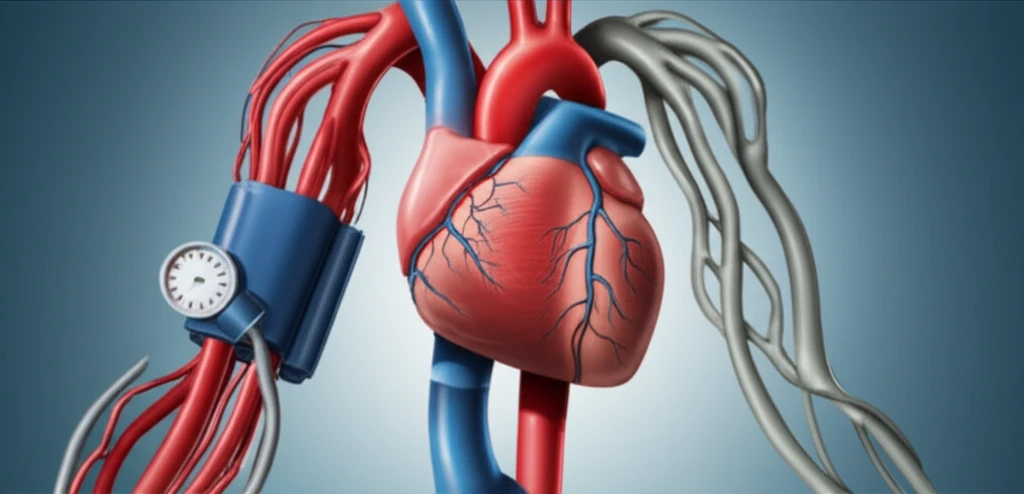
Surreal illustration of a heart with healthy and stiff arteries, showing blood pressure cuff

Decoding Blood Pressure: Why Your Arm Cuff Might Be Lying to You (Especially If You Have Type 2 Diabetes)

"Central blood pressure is the pressure to which your vital organs are exposed, and it may differ significantly from what your standard arm cuff indicates. Here's what you need to know."


High blood pressure is a well-known villain when it comes to cardiovascular health. We diligently monitor the numbers, often relying on the familiar arm cuff measurement taken at the brachial artery. But what if that convenient reading isn't telling the whole story, especially for individuals with type 2 diabetes?

A growing body of research suggests that brachial blood pressure, or SBP, may not accurately reflect central blood pressure, the pressure experienced by our vital organs like the heart, brain, and kidneys. This discrepancy is due to something called systolic blood pressure (SBP) amplification, and it can be particularly relevant for those with type 2 diabetes (T2D).

For T2D patients, vascular irregularities can affect BP amplification and central BP indices (i.e. augmentation index [AIx] and augmentation pressure [AP]), it's essential to understand the nuances of central blood pressure and its implications for overall health management.

What is Central Blood Pressure and Why Should You Care?

Surreal illustration of a heart with healthy and stiff arteries, showing blood pressure cuff

Think of your arteries as a complex highway system. Blood pressure isn't uniform throughout; it changes as blood travels from the heart to the periphery. Central blood pressure is the pressure in the aorta, the main artery stemming from the heart. This is the pressure that directly impacts your most important organs.

Brachial blood pressure, measured at your arm, is easily accessible, making it a standard screening tool. However, the phenomenon of 'amplification' means that the pressure wave changes as it travels down your arm. For some people, this amplification can lead to a significant difference between the pressure at your arm and the pressure closer to your heart.

  • Vascular Irregularities: Endothelial dysfunction, arterial stiffening (both central and peripheral), and other vascular issues common in T2D can impact how blood pressure waves travel and amplify.
  • CV Risk Factors: Co-existing conditions like hyperlipidemia (high cholesterol) and smoking can further influence central blood pressure.
  • Higher Central Systolic Stress: All of these factors can culminate in a higher central systolic stress, increasing risk of organ damage.
A study of 2758 patients with T2D and 10,561 healthy controls, found that while central-to-brachial SBP amplification was similar between groups, central BP indices (AIx and AP) were significantly higher in the T2D group. This indicates increased central systolic loading in T2D patients that may not be apparent from brachial BP alone.

The Takeaway: Know Your Numbers, Know Your Risks

While arm cuff measurements remain a valuable tool, this research highlights the importance of considering central blood pressure, especially for individuals with type 2 diabetes. A more complete cardiovascular risk assessment might involve additional measurements and a discussion with your doctor about personalized management strategies. Focusing not only on blood pressure numbers, but also pressure-independent parameters such as AIx may be a useful addition. Stay informed, stay proactive, and take control of your heart health.

About this Article -

This article was crafted using a human-AI hybrid and collaborative approach. AI assisted our team with initial drafting, research insights, identifying key questions, and image generation. Our human editors guided topic selection, defined the angle, structured the content, ensured factual accuracy and relevance, refined the tone, and conducted thorough editing to deliver helpful, high-quality information.See our About page for more information.

This article is based on research published under:

DOI-LINK: 10.1038/s41371-018-0124-4, Alternate LINK

Title: Central-To-Brachial Blood Pressure Amplification In Type 2 Diabetes: A Systematic Review And Meta-Analysis

Subject: Internal Medicine

Journal: Journal of Human Hypertension

Publisher: Springer Science and Business Media LLC

Authors: Rachel E. Climie, Martin G. Schultz, James W. Fell, Lorena Romero, Petr Otahal, James E. Sharman

Published: 2018-11-13

Everything You Need To Know

1

What is the difference between central blood pressure and brachial blood pressure?

Central blood pressure is the pressure in the aorta, the main artery stemming from the heart, directly impacting vital organs. Brachial blood pressure is measured at the arm using a standard arm cuff. Due to 'amplification,' the pressure wave changes as it travels from the heart to the arm, potentially leading to different readings. For instance, in the case of individuals with Type 2 Diabetes, the differences may be significant due to vascular irregularities.

2

Why is central blood pressure particularly important for individuals with Type 2 Diabetes?

For individuals with Type 2 Diabetes, vascular irregularities such as endothelial dysfunction and arterial stiffening can affect how blood pressure waves travel and amplify. These irregularities can lead to a higher central systolic stress, increasing the risk of organ damage. Central BP indices (AIx and AP) may be significantly higher in this group compared to those without T2D. Therefore, solely relying on brachial blood pressure might not provide a complete picture of cardiovascular risk.

3

What are the key factors that can influence central blood pressure, especially in the context of cardiovascular health?

Several factors can influence central blood pressure. Vascular irregularities, including endothelial dysfunction and arterial stiffening (both central and peripheral), can impact how blood pressure waves travel. Co-existing cardiovascular risk factors like hyperlipidemia (high cholesterol) and smoking can also significantly influence central blood pressure. These factors can culminate in a higher central systolic stress, increasing the risk of organ damage.

4

How does the concept of 'amplification' affect the accuracy of brachial blood pressure readings?

The phenomenon of 'amplification' describes how the pressure wave changes as it travels from the heart to the periphery, like the arm. This means that the brachial blood pressure, measured at the arm, may not accurately reflect the central blood pressure in the aorta. For some people, this amplification can lead to a significant difference between the pressure at the arm and the pressure closer to their heart, potentially underestimating the actual pressure vital organs are exposed to.

5

Besides blood pressure numbers, what other parameters are important to consider for a comprehensive cardiovascular risk assessment?

A comprehensive cardiovascular risk assessment should not only focus on blood pressure numbers but also consider pressure-independent parameters like AIx (augmentation index). The study mentioned that central BP indices such as AIx and AP (augmentation pressure) were significantly higher in the Type 2 Diabetes group. This suggests that assessing these parameters alongside traditional brachial blood pressure measurements can provide a more complete understanding of cardiovascular health, especially for individuals with T2D.

Newsletter Subscribe

Subscribe to get the latest articles and insights directly in your inbox.