
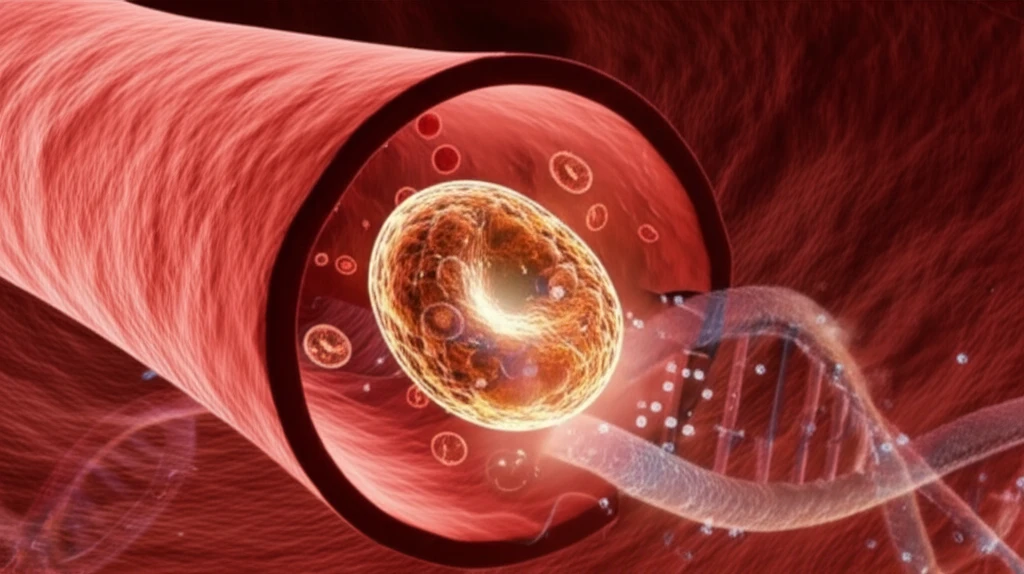
Illustration of a resilient blood clot symbolizing fibrinolysis resistance due to genetic factors.

Decoding Blood Clots: How a Gene Mutation Could Explain Thrombosis Risk

"Unraveling the Mystery of FIX-Padua and Its Impact on Fibrinolysis Resistance"


Inherited thrombophilia, a condition marked by a heightened tendency to form blood clots, has long been linked to various genetic factors. These factors often involve either an overactive coagulation system or impaired fibrinolysis—the body's natural process for dissolving clots. Understanding these genetic underpinnings is crucial for identifying individuals at risk and developing targeted interventions.

One newly discovered piece of this puzzle is the FIX-Padua mutation, a spontaneous genetic change that dramatically increases the activity of Factor IX, a key protein in the coagulation cascade. Individuals with this mutation face a significantly higher risk of venous thromboembolism (VTE), a condition where blood clots form in the veins.

But how exactly does FIX-Padua increase this risk? Recent research has delved into the mutation's influence on fibrinolysis, revealing that FIX-Padua makes blood clots more resistant to breakdown. This article explores the mechanisms behind this resistance, focusing on the role of thrombin-activatable fibrinolysis inhibitor (TAFI) and offering new insights into the thrombotic risks associated with FIX-Padua.

FIX-Padua: The Key Player in Fibrinolysis Resistance

Illustration of a resilient blood clot symbolizing fibrinolysis resistance due to genetic factors.

The study, conducted by researchers at the University of Padua Medical School and Aldo Moro University, investigated the impact of FIX-Padua on TAFI-mediated regulation of fibrinolysis. They analyzed blood samples from a subject with FIX-Padua, their family members, and a control group, measuring clot lysis times, TAFI activation, and thrombin generation.

The results revealed a striking difference: plasma from FIX-Padua carriers exhibited significantly longer clot lysis times compared to controls. This difference disappeared when TAFI activation was blocked, highlighting TAFI's crucial role in the increased fibrinolysis resistance.

  • Increased Thrombin Generation: FIX-Padua was found to significantly enhance thrombin generation. This is important because thrombin is a key activator of TAFI.
  • Enhanced TAFI Activation: Consequently, increased thrombin led to greater TAFI activation in FIX-Padua carriers compared to controls.
  • FXI Independence: The study also found that hyperactive FIX, unlike wild-type FIX, could maintain fibrinolysis resistance even when the FXI-dependent positive feedback loop was blocked. This suggests that FIX-Padua can bypass a normal regulatory mechanism, further solidifying its impact.
These findings suggest a model where FIX-Padua's heightened activity leads to increased thrombin production, which in turn, drives greater TAFI activation. TAFIa, the active form of TAFI, then inhibits fibrinolysis, making clots more stable and harder to break down. This detailed understanding highlights a new pathway by which FIX-Padua increases the risk of thrombosis.

Implications and Future Directions

This research provides valuable insights into the mechanisms underlying the increased thrombotic risk associated with the FIX-Padua mutation. By demonstrating that FIX-Padua enhances fibrinolytic resistance through increased TAFI activation, the study identifies a potential target for therapeutic interventions.

For individuals carrying the FIX-Padua mutation, these findings underscore the importance of understanding their heightened risk and potentially adopting preventative measures in consultation with their healthcare providers. Further research is needed to determine the best strategies for managing this risk, which could include lifestyle modifications or targeted therapies aimed at modulating thrombin or TAFI activity.

Ultimately, a deeper understanding of the interplay between coagulation and fibrinolysis, as illuminated by this study, could pave the way for more effective prevention and treatment of thrombophilia and related conditions.

About this Article -

This article was crafted using a human-AI hybrid and collaborative approach. AI assisted our team with initial drafting, research insights, identifying key questions, and image generation. Our human editors guided topic selection, defined the angle, structured the content, ensured factual accuracy and relevance, refined the tone, and conducted thorough editing to deliver helpful, high-quality information.See our About page for more information.

This article is based on research published under:

DOI-LINK: 10.1160/th13-06-0489, Alternate LINK

Title: Factor Ix-Padua Enhances The Fibrinolytic Resistance Of Plasma Clots

Subject: Hematology

Journal: Thrombosis and Haemostasis

Publisher: Georg Thieme Verlag KG

Authors: Concetta Ammollo, Fabrizio Semeraro, Mario Colucci, Paolo Simioni

Published: 2014-01-01

Everything You Need To Know

1

What is the FIX-Padua mutation?

FIX-Padua is a specific gene mutation that increases the activity of Factor IX. Factor IX is a protein involved in the coagulation cascade. This mutation leads to a higher risk of venous thromboembolism (VTE), as it makes blood clots more resistant to breakdown, which is known as fibrinolysis.

2

Why is the discovery of FIX-Padua important?

The discovery of FIX-Padua is significant because it helps explain a specific mechanism behind inherited thrombophilia. Individuals with the FIX-Padua mutation have an increased risk of blood clot formation due to the mutation's impact on the fibrinolysis process. This finding provides new insights into the genetic factors that contribute to the condition and opens doors for potential therapeutic interventions.

3

How does FIX-Padua affect the process of fibrinolysis?

The FIX-Padua mutation impacts fibrinolysis by increasing the activation of thrombin-activatable fibrinolysis inhibitor (TAFI). This process starts with FIX-Padua enhancing thrombin generation. Increased thrombin leads to greater TAFI activation, resulting in TAFIa, the active form, which then inhibits fibrinolysis, making blood clots more stable and harder to break down. This highlights a pathway by which the FIX-Padua mutation increases the risk of thrombosis.

4

What is the role of TAFI in the context of FIX-Padua?

TAFI (thrombin-activatable fibrinolysis inhibitor) plays a crucial role in the impact of FIX-Padua on fibrinolysis. With FIX-Padua, the increased thrombin generation enhances TAFI activation. The active form of TAFI, TAFIa, then inhibits fibrinolysis, making clots more resistant to breakdown. Blocking TAFI activation removes the difference in clot lysis times, demonstrating TAFI's direct involvement in the process.

5

What are the implications of this research for future treatment?

Understanding the mechanisms of FIX-Padua could lead to new treatments. Because FIX-Padua increases thrombotic risk by enhancing fibrinolytic resistance, the identification of TAFI as a key player opens the potential for targeted therapies. Future research could explore ways to modulate TAFI activity, thereby reducing the risk of blood clot formation in individuals with the FIX-Padua mutation. Other targets could be factors involved in thrombin generation.

Newsletter Subscribe

Subscribe to get the latest articles and insights directly in your inbox.